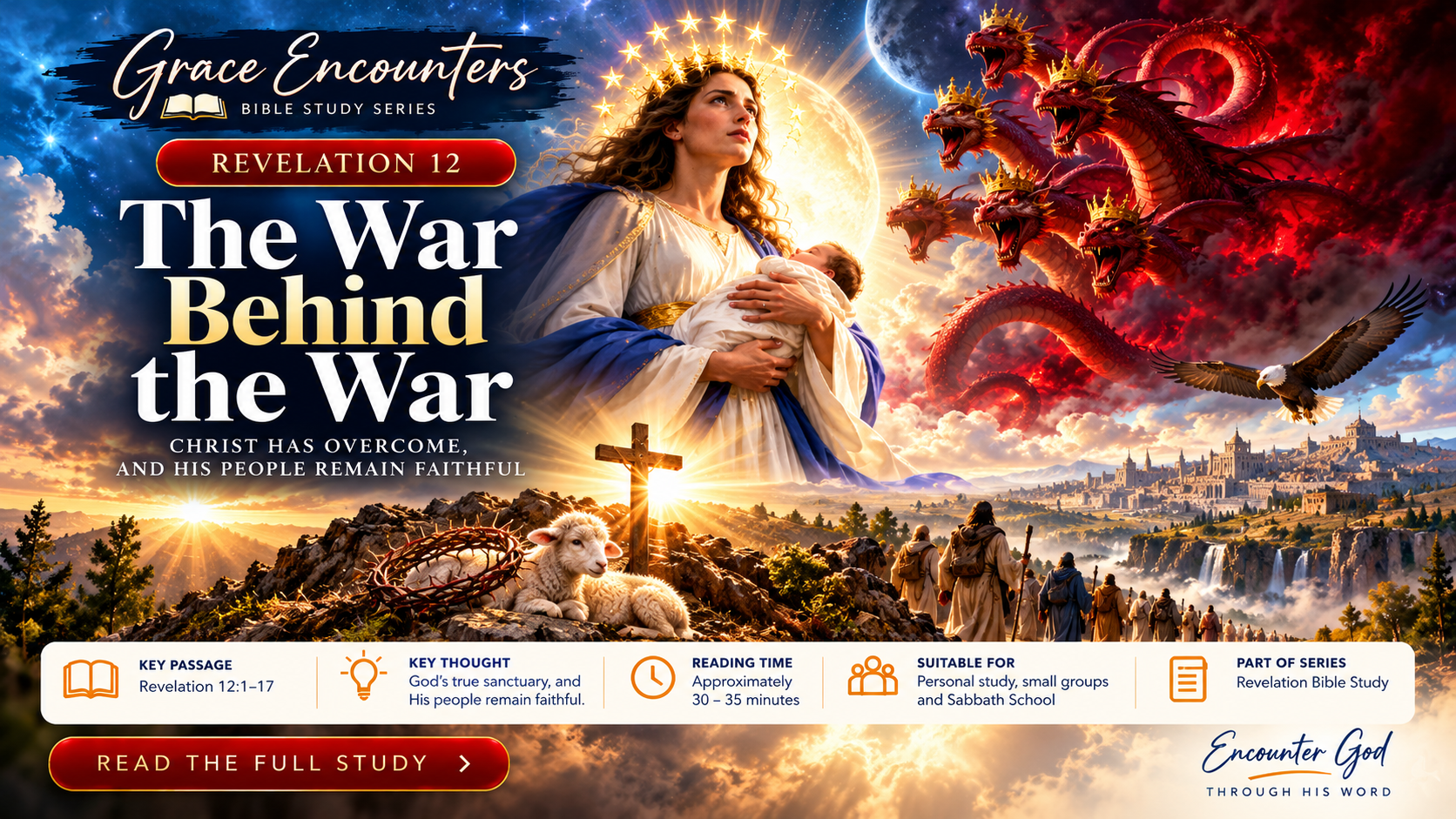
The Great Controversy, the Faithfulness of God, and the Victory of the Lamb
Grace Encounters | Journey Through Revelation
Scripture Reading: Revelation 12:1–17
Key Verse: “And they overcame him by the blood of the Lamb, and by the word of their testimony; and they loved not their lives unto the death.” — Revelation 12:11, KJV
Key Thought: The Great Controversy began when self-exaltation displaced trust in God. At Calvary, Jesus revealed the Father’s character through self-sacrificing love and secured the decisive victory over Satan. God’s faithful people overcome, not through their own righteousness, but through the blood of the Lamb.
Introduction — The Conflict Behind Human History
Why is there so much suffering in a world created by a loving God?
Why does evil seem so persistent?
Why does following Jesus not guarantee an easy life?
And why, when we have surrendered ourselves to God, do we so often find ourselves struggling to trust Him when life becomes difficult?
Revelation 12 draws back the curtain on a conflict far greater than the struggles we see around us.
It reveals the Great Controversy between Christ and Satan.
But we must be careful how we approach this chapter.
Revelation 12 is not primarily a study about Satan. It is a revelation of Jesus Christ.
Yes, we need to understand where rebellion began. We need to recognise the nature of Satan’s deception. We need to understand why the dragon makes war against God’s people.
But we must never become so occupied with the enemy that we lose sight of the Saviour.
The central message of Revelation 12 is not that Satan is powerful.
It is that Jesus has overcome.
The dragon is defeated.
The woman is preserved.
The accuser is cast down.
And God’s people overcome through the blood of the Lamb.
To understand the significance of this victory, however, we need to begin with the origin of the conflict.
1. The Origin of the Great Controversy — When Self Took the Throne
Before sin entered our world, rebellion had already arisen among heavenly beings.
God did not create evil.
He did not create Satan as an evil being.
Scripture presents angelic rebellion as a departure from God’s will, not as something God commanded or approved.
Two Old Testament passages have traditionally been understood as revealing the pride that characterised Satan’s original rebellion.
Ezekiel 28 — The corruption of the heart
Ezekiel 28:11–19 is a lamentation addressed to the king of Tyre.
Yet its language is extraordinary.
It speaks of Eden, the garden of God, an anointed covering cherub, and a being who was perfect in his ways until iniquity was found in him.
The description looks beyond the earthly ruler to Satan’s rebellion.
Within the traditional understanding, the passage gives us a profound insight into the nature of rebellion.
“Thou wast perfect in thy ways from the day that thou wast created, till iniquity was found in thee.” — Ezekiel 28:15
And then:
“Thine heart was lifted up because of thy beauty, thou hast corrupted thy wisdom by reason of thy brightness.” — Ezekiel 28:17
Consider that statement.
His beauty was not the problem.
His wisdom was not the problem.
His position was not the problem.
These were gifts he had received.
The problem arose when he began treating the gifts of God as grounds for exalting himself.
His attention turned from the Giver to the gifts, and ultimately to himself.
The very things that should have inspired gratitude became occasions for pride.
We cannot fully explain how the first sinful desire arose in a created being who had known God’s goodness. Scripture does not give us a complete psychological account of the origin of evil.
But the traditional reading of Ezekiel identifies the corruption of the heart through pride as central to the rebellion.
Isaiah 14 — “I will exalt my throne”
Isaiah 14:12–15 contains another passage traditionally associated with Satan’s fall.
Its immediate historical setting is a taunt against the king of Babylon.
The KJV uses the name Lucifer, derived from a Latin rendering of the Hebrew expression commonly translated “shining one, son of dawn.”
The passage does not explicitly identify the figure as Satan, but its language of heavenly ambition has long been connected with the rebellion of the devil.
Listen to the repeated declarations:
“I will ascend into heaven.”
“I will exalt my throne.”
“I will sit also upon the mount of the congregation.”
“I will be like the most High.”
— Isaiah 14:13–14
The repeated emphasis is unmistakable.
I will.
The creature desires a position of supremacy.
He no longer wishes merely to serve God. He seeks to exalt himself.
And here we find an important principle about the nature of sin.
Sin is not merely the breaking of an external rule.
At its heart, rebellion involves the displacement of God’s authority by self.
It is the desire to become the centre of one’s own existence.
The danger of placing self upon the throne
This is where the story becomes personal.
We may never openly say, “I will exalt my throne above God.”
But how often do we live as though our will should prevail over His?
How often do we trust our judgment more than His promises?
How often do we become so impressed with our abilities, achievements, knowledge, or religious standing that we forget Who gave us those gifts?
There is an Afrikaans expression that captures the danger rather vividly:
We are dancing on the devil’s stoep.
Whenever self takes the place that belongs to God, we begin walking in the direction of the very rebellion that brought sin into the universe.
This does not mean healthy self-worth, responsible initiative, or appreciation of God’s gifts is sinful.
The issue is self-exaltation — making ourselves the ultimate authority rather than living in loving dependence upon God.
And this brings us to a remarkable contrast.
Satan sought to ascend. Jesus chose to humble Himself.
Philippians 2:5–8 describes the mind of Christ.
Though He was in the form of God, He did not exploit His divine status for selfish advantage.
Instead, He humbled Himself, took the form of a servant, and became obedient unto death — even death on a cross.
Consider the contrast.
The rebellious creature sought exaltation.
The eternal Son humbled Himself.
One sought supremacy.
The Other gave Himself in love.
One made self the centre.
The Other laid down His life to save others.
At Calvary, the true character of God was revealed through self-sacrificing love.
And the contrast with Satan’s rebellion became unmistakable.
The cross was not merely a demonstration of love. Through His death, Jesus also dealt decisively with sin and death and secured our redemption (Hebrews 2:14; Colossians 2:13–15).
That is the background against which we must read Revelation 12.
The chapter does not require us to settle every detail of the chronology of Satan’s expulsion.
What matters for our study is that rebellion arose, deception spread, and Christ’s victory at the cross decisively answered the accusations of the enemy.
Now let us allow Revelation 12 to speak.
2. The Woman Clothed With the Sun — Revelation 12:1–2
John sees a remarkable sign:
“And there appeared a great wonder in heaven; a woman clothed with the sun, and the moon under her feet, and upon her head a crown of twelve stars.” — Revelation 12:1
Throughout Scripture, a woman can symbolise God’s covenant people.
Isaiah 54 portrays God’s people using marriage imagery.
Jeremiah 6:2 compares Zion to a beautiful woman.
Paul speaks of presenting the church as a pure bride to Christ (2 Corinthians 11:2).
Revelation itself later contrasts a faithful woman with an unfaithful woman.
The woman of Revelation 12 therefore represents God’s covenant people across the unfolding history of salvation.
She gives birth to the Messiah, showing that her identity cannot be restricted to the Christian church after Pentecost.
She represents the people through whom God preserved His promises and brought the Saviour into the world.
The sun, moon, and twelve stars
The imagery recalls Joseph’s dream in Genesis 37:9–11, where the sun, moon, and stars represent members of his family.
The twelve stars suggest the covenant people of God, recalling the twelve tribes of Israel and, in the New Testament, the twelve apostles.
Within traditional Adventist interpretation, the sun has also been associated with the fuller revelation of Christ’s righteousness and the moon with the earlier revelation that pointed forward to Him.
These are symbolic applications rather than meanings explicitly defined by Revelation 12.
The central point is clear.
The woman is portrayed in heavenly splendour.
Her significance comes from her relationship with God.
She does not shine because she has manufactured her own righteousness.
Her glory is received.
And that raises a personal question:
Am I clothed in Christ’s righteousness, or am I still trying to establish my own?
3. The Dragon Waiting to Devour — Revelation 12:3–4
John sees another sign.
A great red dragon appears, having seven heads, ten horns, and seven crowns.
Its tail draws a third of the stars of heaven, and it stands before the woman, waiting to devour her Child.
Unlike some of Revelation’s other symbols, the dragon is explicitly identified.
Revelation 12:9 calls him:
“That old serpent, called the Devil, and Satan, which deceiveth the whole world.”
The reference to the serpent immediately takes us back to Genesis 3.
There, the serpent questions God’s word, contradicts His warning, and suggests that God is withholding something desirable from humanity.
The temptation was not merely about eating forbidden fruit.
It was an attack upon trust in God’s goodness.
The serpent presented God as someone who could not be fully trusted.
That is why the character of God is so central to the Great Controversy.
A third of the stars
Within the traditional Adventist understanding, the third of the stars represents the angels who joined Satan’s rebellion.
Revelation 12:9 confirms that Satan has angels associated with him and that they were cast out with him.
The identification of the stars in verse 4 with those angels is a reasonable traditional interpretation, although John does not explicitly define the fraction.
Jude 6 and 2 Peter 2:4 also speak of angels who sinned and came under judgment.
Together, these passages reveal that rebellion was not confined to humanity.
The dragon’s hostility towards Christ
The dragon stands ready to devour the Child.
Throughout biblical history, Satan opposed God’s redemptive purposes.
Herod’s attempt to destroy the infant Jesus, recorded in Matthew 2, illustrates this hostility.
But Satan could not prevent the coming of the Messiah.
God’s promise would be fulfilled.
The Seed of the woman would come.
And the serpent would not have the final victory.
4. The Male Child — Revelation 12:5
The woman gives birth to a male Child who is destined to rule all nations with a rod of iron.
Her Child is caught up to God and to His throne.
The reference to ruling the nations with a rod of iron connects directly with Psalm 2:7–9.
Revelation 19:15 applies the same imagery to Jesus Christ.
The Child is Jesus.
John moves rapidly from His birth to His heavenly exaltation.
He does not recount every event of Christ’s earthly ministry.
His focus is on the outcome.
The dragon failed to destroy the Messiah.
Jesus came.
Jesus overcame.
Jesus ascended.
And He reigns.
This is the foundation of the chapter.
God’s people do not face the enemy hoping that Christ might eventually become victorious.
They belong to the Saviour who has already secured the decisive victory.
5. The Woman in the Wilderness — Revelation 12:6
The woman flees into the wilderness.
There God has prepared a place for her, where she is nourished for 1,260 days.
The same prophetic period appears in verse 14 as “a time, and times, and half a time.”
It also corresponds to the 42 months of Revelation 13:5.
Within the traditional Adventist historicist interpretation, the 1,260 prophetic days represent 1,260 literal years, commonly associated with the period AD 538–1798.
This interpretation draws on the day-year approach to symbolic prophecy and a particular reading of the history of papal political and religious power.
The dates are not supplied by Revelation itself, and their historical application is debated. They belong to the wider historicist interpretation of Daniel and Revelation.
The prophetic concern is not a condemnation of individual Catholic Christians.
It concerns the dangers of religious power becoming coercive, the suppression of conscience, and the persecution of those who seek to follow God’s Word.
God prepared a place
But there is something in this passage that we must not overlook while studying prophetic history.
The woman flees into the wilderness.
And God has prepared a place for her.
She does not create her own refuge.
God provides it.
Throughout history, believers have faced persecution, displacement, isolation, and suffering because of their faith.
Yet Revelation presents God as One who has not forgotten His people.
The wilderness may be a place of danger.
But it can also become a place where God’s sustaining grace is experienced.
Israel discovered this in the wilderness.
Elijah experienced it.
And generations of faithful believers have discovered it.
God does not promise that His people will never enter the wilderness. He promises that they will not be forgotten there.
6. War in Heaven — Revelation 12:7–9
John now describes war in heaven.
Michael and his angels fight against the dragon and his angels.
The dragon does not prevail.
He and his angels lose their place in heaven and are cast out.
Who is Michael?
The name Michael means “Who is like God?”
Michael appears in Daniel 10, Daniel 12, Jude 9, and Revelation 12.
Seventh-day Adventists traditionally understand Michael as a title for Christ in His role as Commander of the heavenly hosts.
This does not mean that Jesus is a created angel. Adventist theology affirms His eternal deity.
Other Christian traditions understand Michael as a distinct archangel.
Revelation 12 does not explicitly identify Michael as Jesus, so the identification should be presented as a theological interpretation supported by the wider biblical argument.
The timing of Satan’s expulsion
We have deliberately chosen not to make the precise timing of Satan’s expulsion the centre of this study.
Scripture establishes that Satan rebelled, that angels joined his rebellion, and that he became the deceiver of humanity.
Revelation 12 also connects his defeat with the victory of Christ.
John 12:31–33 is especially significant because Jesus speaks of the ruler of this world being cast out in connection with His approaching death.
We should therefore distinguish the original rebellion from the decisive victory accomplished through Christ.
Revelation 12:7–12 has been interpreted as describing the original heavenly conflict, the cross-related defeat of Satan, or the conflict in a way that encompasses both.
The chapter does not require us to settle every chronological detail to understand its central message.
Satan has been defeated, and Christ’s victory is the foundation of the believer’s hope.
The cross reveals the character of God
The Great Controversy is not a struggle between two equal powers.
God is the Creator.
Satan is a created being.
The deeper controversy concerns God’s character, His authority, His justice, and the trustworthiness of His love.
At the cross, Satan’s hostility towards God was exposed through the rejection and crucifixion of the innocent Son of God.
At that same cross, Jesus revealed the Father’s love through His willingness to give Himself for humanity.
The contrast could not be greater.
The enemy seeks to destroy.
Jesus gives life.
The enemy accuses.
Jesus intercedes.
The enemy deceives.
Jesus reveals the truth about His Father.
And the cross becomes the decisive demonstration that God’s love is not selfish, arbitrary, or coercive.
7. The Accuser Is Cast Down — Revelation 12:10
John hears a loud voice announcing the arrival of salvation, strength, the kingdom of God, and the authority of Christ.
The reason given is extraordinary.
The accuser of God’s people has been cast down.
Satan’s activity is not limited to temptation.
He also accuses.
We see this in Job 1–2, where he questions Job’s motives and faithfulness.
And we experience something similar when our failures become the basis for despair.
Sometimes the accusation begins with something true.
I have failed.
I have neglected prayer.
I have been impatient.
I have tried to take control instead of trusting God.
But then comes the false conclusion:
Because you have failed, you cannot come to Jesus.
That is not the gospel.
The gospel tells us that because we are sinners, we desperately need Jesus.
Our confidence is not in our spiritual performance.
It is in our Saviour.
Romans 8:33–34 asks who can bring a charge against God’s people and points us to Christ, who died, rose again, and intercedes for us.
The accuser points to our failures.
Jesus points us to His sacrifice.
And the question becomes:
Whose voice will I believe?
8. They Overcame by the Blood of the Lamb — Revelation 12:11
This is the heart of Revelation 12.
“And they overcame him by the blood of the Lamb, and by the word of their testimony; and they loved not their lives unto the death.”
Notice the three elements.
By the blood of the Lamb
Our victory begins with Jesus.
Not with our goodness.
Not with our denominational identity.
Not with our knowledge of prophecy.
Not even with our obedience.
Christ’s sacrifice is the foundation of our salvation.
We cannot add anything to the saving sufficiency of Calvary.
By the word of their testimony
The believer’s testimony bears witness to Christ.
It is not primarily a declaration of personal achievement.
It is a witness to what Jesus has done and continues to do.
Sometimes the most powerful testimony is not:
“Look how strong I have become.”
It is:
“Look how faithfully Jesus has carried me.”
They loved not their lives unto death
Faithfulness may be costly.
Some believers have endured imprisonment, persecution, rejection, and death because they would not deny Christ.
Their victory did not always look like earthly deliverance.
Sometimes it meant remaining faithful even when their circumstances did not change.
Revelation measures victory differently from the world.
The world often measures success through power, security, and survival.
Heaven honours faithfulness to Christ.
We do not overcome by becoming strong enough to defeat Satan. We overcome through the Lamb and remain faithful to Him.
9. The Dragon’s Wrath — Revelation 12:12
Heaven rejoices, but the earth receives a warning.
The devil has come down with great wrath because he knows his time is short.
His anger is real.
His deception is dangerous.
His opposition to God’s people continues.
But we must never mistake desperation for victory.
The dragon is angry precisely because his defeat is certain.
This is why Revelation must never become a study dominated by fear.
The chapter does not invite us to become fascinated with Satan’s power.
It invites us to trust the victorious Christ.
10. The Woman Preserved — Revelation 12:13–16
The dragon persecutes the woman.
But she is given two wings of a great eagle so that she may escape into the wilderness.
The imagery recalls Exodus 19:4:
“Ye have seen what I did unto the Egyptians, and how I bare you on eagles’ wings, and brought you unto myself.”
What a beautiful connection.
God carried Israel.
God preserved His people.
And God continues to sustain those who belong to Him.
The serpent sends a flood after the woman.
In prophetic symbolism, waters can represent peoples and nations, as Revelation 17:15 demonstrates in its own context.
The flood in Revelation 12 has often been understood as overwhelming persecution and hostile forces.
The earth helps the woman by swallowing the flood.
Traditional historicist interpretation has connected this imagery with geographical refuge and the development of places where persecuted believers found greater religious freedom.
That historical identification is interpretive rather than explicitly stated by John.
But the central message is clear.
God does not abandon His people.
He sustains them through the conflict.
And His purposes are not defeated by the dragon’s hostility.
11. The Remnant — Revelation 12:17
The chapter closes with the dragon making war against the remaining offspring of the woman.
John identifies them as those:
“Which keep the commandments of God, and have the testimony of Jesus Christ.”
This verse is particularly important for Seventh-day Adventists.
But it must be approached with care.
We must not begin by assuming that the remnant means a particular denomination and then read that assumption into the text.
We must first ask:
What does Scripture mean by a remnant?
The remnant is what remains
The Greek expression in Revelation 12:17 refers to the remaining offspring of the woman.
The remnant belongs to the woman.
There is continuity between God’s covenant people and those who remain faithful amid opposition.
The remnant concept appears throughout Scripture.
In Elijah’s day, God preserved seven thousand who had not bowed to Baal (1 Kings 19:18).
Paul later referred to a remnant according to grace (Romans 11:5).
Isaiah also spoke of a remnant who would return to the mighty God and depend upon Him (Isaiah 10:20–22).
The remnant is therefore not primarily a claim of superiority.
It is a testimony to God’s preserving grace and the faithfulness of those who continue to trust Him.
God’s covenant people — not lineage, but allegiance
Here we need to understand the covenant relationship.
God chose Israel for a purpose.
In Exodus 19:5–6, He called them His peculiar treasure, a kingdom of priests, and a holy nation.
Their calling was to reveal His character to the nations.
God’s promise to Abraham already contained that universal purpose:
“In thee shall all families of the earth be blessed.” — Genesis 12:3
Israel’s election was never intended to mean that God loved other nations less.
His desire was that the nations would come to know Him.
Yet throughout Israel’s history, God’s people repeatedly failed to live according to their calling.
They turned to idols.
They trusted political alliances.
They neglected justice and mercy.
They sometimes treated their covenant identity as a guarantee of God’s favour, even while disregarding His will.
But we must not reduce Israel’s history to failure.
Scripture also records faithful believers, prophets, and ordinary people who trusted God.
And God never ceased to be faithful to His promises.
Paul explicitly rejects the idea that God has simply cast away Israel (Romans 11:1).
This matters because the very message we are discovering is that God remains faithful even when His people are unfaithful.
The covenant fulfilled in Christ
Galatians 3:29 says:
“And if ye be Christ’s, then are ye Abraham’s seed, and heirs according to the promise.”
The promise to Abraham finds its fulfilment in Jesus Christ.
Through Him, people from every nation are invited into God’s covenant family.
The new covenant is established through His blood (Luke 22:20).
God promises to write His law upon the hearts of His people (Jeremiah 31:33; Hebrews 8:10).
And through the Holy Spirit, He transforms their desires and enables them to walk in His ways (Ezekiel 36:26–27).
This is why the distinction between lineage and allegiance is so meaningful.
We do not inherit salvation because we belong to a particular ethnic group.
Nor do we inherit salvation because our names appear on the membership register of a particular church.
We belong to God through Jesus Christ.
Our allegiance is the response of faith to His grace.
Allegiance is the fruit of belonging, not the price of admission.
Inheritance is rooted in relationship
Romans 8:16–17 tells us that the Spirit bears witness that we are God’s children.
And if we are children, we are heirs.
Galatians 4:6–7 likewise connects our inheritance with our adoption into God’s family through Christ.
Inheritance is not presented as a reward for joining the correct religious institution.
It flows from our relationship with God through Jesus.
This does not make the church irrelevant.
Christ calls believers into fellowship, worship, discipleship, mutual care, and shared witness.
But the church does not save.
Jesus saves.
Does the remnant mean a denomination?
Revelation 12:17 does not name a denomination.
It describes the remaining offspring of the woman by their faithfulness to God’s commandments and the testimony of Jesus.
Seventh-day Adventists understand their movement as having a distinctive prophetic calling to proclaim the three angels’ messages, uphold God’s commandments, including the Sabbath, and bear witness to Jesus.
That conviction can be explained and examined through Scripture.
But it must never become the claim that only people holding membership in the Seventh-day Adventist Church can be saved.
Revelation 18:4 is especially important:
“Come out of her, my people.”
God calls them His people even while they are in Babylon.
He knows those who belong to Him.
We do not have the authority to declare that everyone outside our denomination is lost, or that everyone inside it is saved.
The final judgment belongs to God.
And His judgment is perfectly just, informed by the truth of each person’s heart, knowledge, and response to the light received.
The testimony of Jesus
Revelation 19:10 connects the testimony of Jesus with the spirit of prophecy.
Adventists understand this as supporting the continuing prophetic gift, including the ministry of Ellen G. White.
There is also a recognised interpretive question about whether the expression means testimony originating from Jesus or testimony borne about Jesus.
We should not conceal that distinction.
What must remain central is that genuine prophetic witness directs people to Christ and remains subject to the authority of Scripture.
No messenger may take the place of the Saviour.
And no prophetic gift should become a substitute for a living relationship with Him.
12. The Sabbath — A Sign, Not a Ticket to Heaven
This brings us to a subject of particular importance.
Revelation 12:17 identifies God’s faithful people as those who keep His commandments.
And Revelation 14:12 repeats that description, connecting commandment keeping with the faith of Jesus.
Within the Adventist understanding of the final conflict, the Sabbath becomes especially significant because it directs our attention to the Creator and the question of worship.
But we must understand what the Sabbath actually signifies.
The Sabbath points to the Creator
Exodus 20:8–11 connects the Sabbath with God’s work of creation.
The Sabbath reminds us that we did not create ourselves.
Our existence is a gift.
Our lives belong to the One who made us.
And our worship belongs to Him.
The Sabbath points to the God who sanctifies
Exodus 31:13 says:
“Verily my sabbaths ye shall keep: for it is a sign between me and you throughout your generations; that ye may know that I am the LORD that doth sanctify you.”
Ezekiel 20:12 repeats the same principle.
The Sabbath is a sign that God is the One who sanctifies His people.
Notice what it does not say.
It does not say that we sanctify ourselves through our ability to observe a day.
It points to God’s sanctifying work.
We should recognise that these sign passages were originally addressed to Israel within its covenant setting. Their application to Christians is understood differently across Christian traditions. Adventists understand the seventh-day Sabbath as an enduring creation ordinance and commandment, while other Christians interpret its covenant significance differently.
For our study, we should present the Adventist conviction clearly, without pretending that every theological step is explicitly stated in Revelation 12.
The Sabbath is not a ticket
The Sabbath is important.
We should never minimise its place in Scripture.
But it is not a ticket to heaven.
It is not a token we present to God as proof that we have earned salvation.
It is not a substitute for knowing Jesus.
The Sabbath points to the Creator who made us and the God who sanctifies us.
And in the wider biblical story, it invites us to consider our dependence upon God’s completed work rather than our own self-sufficiency.
When we turn the Sabbath into the means of earning salvation, we have lost sight of the Saviour to whom it points.
We can observe the correct day while still harbouring pride, bitterness, self-righteousness, and spiritual independence.
We can possess accurate prophetic knowledge while failing to reflect the character of Jesus.
We can belong to the right religious movement while neglecting the relationship that gives our faith meaning.
And we can become so concerned with identifying the errors of others that we fail to recognise our own need for grace.
This is one of the most serious dangers we must guard against.
The Sabbath must never become a reason to boast.
It should remind us that we belong to God and depend upon Him.
Worship is ultimately a question of allegiance
The final conflict in Revelation concerns worship.
But worship is more than outward religious observance.
It involves the heart.
It involves trust.
It involves loyalty.
It involves recognising God as Creator, Redeemer, and Lord.
And that allegiance must arise from a living relationship with Jesus Christ.
The Sabbath has significance within that relationship.
But the Sabbath cannot replace the relationship.
Jesus is our Saviour. The Sabbath is a sign. We must never confuse the two.
Explore Further — The Sabbath: A Sign of God’s Love and Covenant Faithfulness
The Sabbath is far more than a question of which day we worship. It is a beautiful invitation to remember our Creator, to rest in His grace, and to recognise that He is the One who sanctifies us.
But how does the Sabbath connect with creation, redemption, the new covenant, and the final call to worship in Revelation?
And how do we distinguish genuine Sabbath observance, flowing from a relationship with Jesus, from legalism?
These questions deserve careful study, allowing Scripture to interpret Scripture and keeping Jesus at the centre.
Continue reading: The Sabbath — A Sign of Relationship, Not a Ticket to Heaven
A complete Grace Encounters Bible study exploring the Sabbath from Genesis to Revelation.
13. Surrender Is Not Passivity
There is one more important connection we must make.
If salvation is entirely by grace, and if our victory comes through Christ, does that mean we simply do nothing?
Not at all.
A covenant relationship is living and active.
Jesus says in John 15:4:
“Abide in me, and I in you.”
And in verse 5:
“Without me ye can do nothing.”
Paul writes in Philippians 2:12–13:
“Work out your own salvation with fear and trembling.
For it is God which worketh in you both to will and to do of his good pleasure.”
Notice the relationship.
God works within us.
And we respond to His work.
He transforms the heart.
He awakens the desire to obey.
He supplies the strength.
And we cooperate with His Spirit through trust, surrender, and obedience.
We do not obey in order to persuade God to love us.
We obey because His love is changing us.
Surrender is therefore not the abandonment of responsible choices.
It is the willing submission of our will to God.
It is learning to trust Him enough to follow where He leads.
Our Grace Encounter — Lord, You Take the Steering Wheel
There is something deeply personal about this chapter.
I know that Jesus has overcome.
I believe that He is my Saviour.
I know that without Him I can do nothing.
And yet I so often find myself trying to take control again.
I surrender my life to Him.
I ask Him to lead me.
I tell Him that I trust Him.
Then something unexpected happens.
The road becomes difficult.
A problem appears that I cannot solve.
The future becomes uncertain.
And almost without realising it, I reach for the steering wheel.
I begin planning, worrying, calculating, and trying to manage everything myself.
I may still be praying.
I may still believe.
But somewhere along the way, I have shifted from depending upon Jesus to depending upon my own ability to control the situation.
And then I wonder why I have lost my peace.
This reminds me of Abraham.
God had promised him a son.
But when the fulfilment of that promise seemed impossible, Abraham and Sarah attempted to bring about the promised future through their own solution.
The story of Hagar and Ishmael in Genesis 16 reminds us how easily we can move from trusting God’s promise to trying to accomplish His purposes through our own methods.
The lesson is not that God wants us to be inactive.
It is that our actions must arise from trust in Him rather than an attempt to replace His leading.
I think this is one of the lessons the Lord continually teaches me.
I do not have to know the road if I know the One who is leading me.
Jesus did not ask me to defeat Satan.
He has already secured the victory.
He did not ask me to manufacture righteousness.
He offers me His.
He did not ask me to face the future in my own strength.
He asks me to abide in Him.
And perhaps spiritual maturity is not becoming increasingly confident in my ability to manage life.
Perhaps it is becoming increasingly confident in His ability to lead me.
There are days when my prayer needs to be very simple:
Lord, I don’t know this road. But I know You. You drive.
And when I find myself reaching for the steering wheel again, I can surrender it again.
Not because Jesus has abandoned me.
But because He is patiently teaching me to trust Him.
Surrender does not mean I stop making decisions, fulfilling responsibilities, or responding to His guidance.
It means that I no longer insist on being the ultimate authority over my life.
I listen.
I trust.
I obey.
I follow.
And when I fail, I return to Him.
The message of Revelation 12 is not that I must become strong enough to overcome the dragon.
It is that I must remain with the Lamb who has already overcome him.
Get with Christ. Stay with Christ.
That is where the victory is.
14. What Revelation 12 Reveals About the Character of God
Throughout this chapter, God’s character stands in contrast to Satan’s.
Satan seeks self-exaltation.
Christ humbles Himself.
Satan deceives.
Christ reveals the truth.
Satan accuses.
Christ intercedes.
Satan persecutes.
God sustains His people.
Satan seeks to destroy.
Christ gives His life.
And perhaps the most remarkable truth is that God remains faithful even when His people fail.
Throughout the history of Israel, He remained faithful to His covenant promises.
Throughout the history of the Christian church, He has continued calling people to repentance, faith, and obedience.
And throughout the final conflict, He will remain faithful to those who trust Him.
The Great Controversy is not ultimately about which power is stronger.
God’s power has never been in question.
It concerns the truth about His character.
Is He trustworthy?
Is His law an expression of love?
Does He desire willing allegiance or forced submission?
Can His creatures trust Him even when obedience becomes costly?
At Calvary, Jesus revealed the answer.
He did not save humanity through coercion.
He gave Himself in love.
And through His sacrifice, He secured the victory that His people could never accomplish for themselves.
15. A Final Reflection — The Remnant Belongs to the Lamb
When we reach the final verse of Revelation 12, we must remember everything that came before it.
The remnant is not introduced as a people who have achieved righteousness through their own efforts.
They are the remaining offspring of the woman, identified by their faithfulness to God’s commandments and the testimony of Jesus.
But verse 11 has already told us how God’s people overcome.
By the blood of the Lamb.
This is the foundation of everything.
Our obedience does not make Jesus victorious.
His victory makes faithful obedience possible.
Our denominational identity does not purchase salvation.
Christ alone saves.
Our Sabbath keeping does not earn us a place in heaven.
It points us towards the God who creates and sanctifies.
And our knowledge of prophecy does not make us superior to those who understand less.
It gives us a responsibility to reveal the character of Jesus more clearly.
The final question is not whether I can prove that my religious organisation is better than another.
It is whether I belong to Jesus and am responding faithfully to the light He has given me.
God knows His people.
He knows their hearts.
And He is calling people from every nation, tribe, tongue, and people to worship Him.
The remnant’s calling is not to boast in its identity.
It is to bear witness to the Lamb.
The remnant does not overcome because it is the remnant. The remnant overcomes because of Jesus.
A Prayer of Surrender
Heavenly Father,
Thank You for revealing the Great Controversy to us, not so that we may live in fear of the enemy, but so that we may see the victory of Your Son.
Thank You that You did not create evil and that Your character is one of perfect love, truth, and righteousness.
Forgive me for the times when self has taken the throne of my heart.
Forgive me when I have become impressed with my own abilities, my knowledge, my obedience, or my religious identity.
Teach me to recognise that everything good comes from You.
Lord Jesus, thank You for humbling Yourself and giving Your life for me.
Thank You that the victory over sin and death was secured at Calvary.
Thank You that I do not have to earn Your love or manufacture my own righteousness.
Help me to live in a genuine covenant relationship with You.
Write Your law upon my heart.
Teach me to love what You love.
Help me to obey because I trust You, not because I am trying to earn my salvation.
May the Sabbath always remind me that You are my Creator and the One who sanctifies me.
Never allow me to turn Your beautiful gift into a reason for pride or a barrier between myself and those whom You also love.
And Lord, when I become frightened by the road ahead, forgive me for reaching for the steering wheel again.
Teach me to trust You.
Teach me to listen.
Teach me to follow.
I do not need to know every turn in the road.
I need to know You.
May my life bear witness to Your faithfulness, Your grace, and Your love.
And may I always remember that my victory is not found in myself.
It is found in the blood of the Lamb.
In Jesus’ precious name,
Amen.
Scripture for Further Thought
Take time to explore these passages alongside this study. Compare Scripture with Scripture, follow the connections, and allow the Bible to illuminate its own message.
The origin and nature of rebellion
- Ezekiel 28:11–19 — Pride, beauty, and the corruption of the heart
- Isaiah 14:4, 12–15 — Self-exaltation and downfall
- Genesis 3:1–15 — The serpent’s deception and God’s promise
- John 8:44 — Satan’s relationship with truth and deception
- Jude 6 — Angels who abandoned their proper place
The victory of Christ
- Philippians 2:5–11 — The humility and exaltation of Christ
- John 12:31–33 — The ruler of this world cast out
- Hebrews 2:14–15 — Christ’s victory through death
- Colossians 2:13–15 — Christ’s triumph over hostile powers
- Romans 8:31–39 — Christ’s intercession and inseparable love
God’s covenant faithfulness
- Genesis 12:1–3 — The blessing promised to all nations
- Exodus 19:5–6 — Israel’s calling as a kingdom of priests
- Romans 3:3–4 — God’s faithfulness despite human unbelief
- Romans 11:1–5 — God’s continuing faithfulness and the remnant of grace
- Galatians 3:26–29 — Belonging to Christ and inheriting the promise
- Hebrews 8:6–13 — The new covenant
- Ezekiel 36:26–27 — A new heart and the work of the Spirit
The Sabbath, obedience, and worship
- Genesis 2:1–3 — The seventh day blessed and sanctified
- Exodus 20:8–11 — The Sabbath and creation
- Exodus 31:13 — The Sabbath as a covenant sign
- Ezekiel 20:12 — The God who sanctifies
- John 14:15 — Love and obedience
- Revelation 14:6–12 — The everlasting gospel, worship, and faithfulness
Surrender and dependence
- John 15:1–11 — Abiding in Christ
- Philippians 2:12–13 — God working in us
- Romans 8:14–17 — Children and heirs of God
- Ephesians 2:8–10 — Saved by grace for good works
- Hebrews 12:1–2 — Looking unto Jesus
Further Reading
Ellen G. White
- Patriarchs and Prophets, Chapter 1 — “Why Was Sin Permitted?”
- The Great Controversy, Chapter 29 — “The Origin of Evil”
- The Great Controversy, Chapter 3 — “An Era of Spiritual Darkness”
- The Great Controversy, Chapter 4 — “The Waldenses”
- The Desire of Ages, Chapter 79 — “It Is Finished”
- Steps to Christ, Chapter 8 — “Growing Up Into Christ”
These works provide additional Adventist theological and historical perspectives. Scripture remains the primary authority by which their interpretations and applications are evaluated.
Grace Encounters — The Heart of the Message
Revelation 12 begins with a woman clothed in heavenly light.
It reveals a dragon consumed by hatred.
It shows us a conflict that reaches from heaven to earth.
It describes persecution, wilderness experiences, accusation, and the continuing struggle of God’s people.
But it does not leave us looking at the dragon.
It brings us to the Lamb.
The One who humbled Himself.
The One who revealed the Father’s heart.
The One who gave His life.
The One who overcame.
And the One who invites us to remain with Him.
The Great Controversy began when self-exaltation displaced trust in God.
The gospel calls us back into a relationship of love, trust, and willing surrender.
And the remnant’s greatest testimony is not that they belong to a particular religious organisation.
It is that they belong to Jesus.
The victory is not in my ability to hold everything together.
The victory is in the One who holds me.
“And they overcame him by the blood of the Lamb.” — Revelation 12:11
Continue Your Journey Through Revelation
Previous Study: Revelation 11 — The Two Witnesses and the Faithfulness of God’s Word
Next Study: Revelation 13 — The Beasts, the Question of Worship, and the Final Test of Allegiance
Grace Encounters — Meeting the Heart of God in His Word