Grace Encounters | Discovering Jesus in Revelation
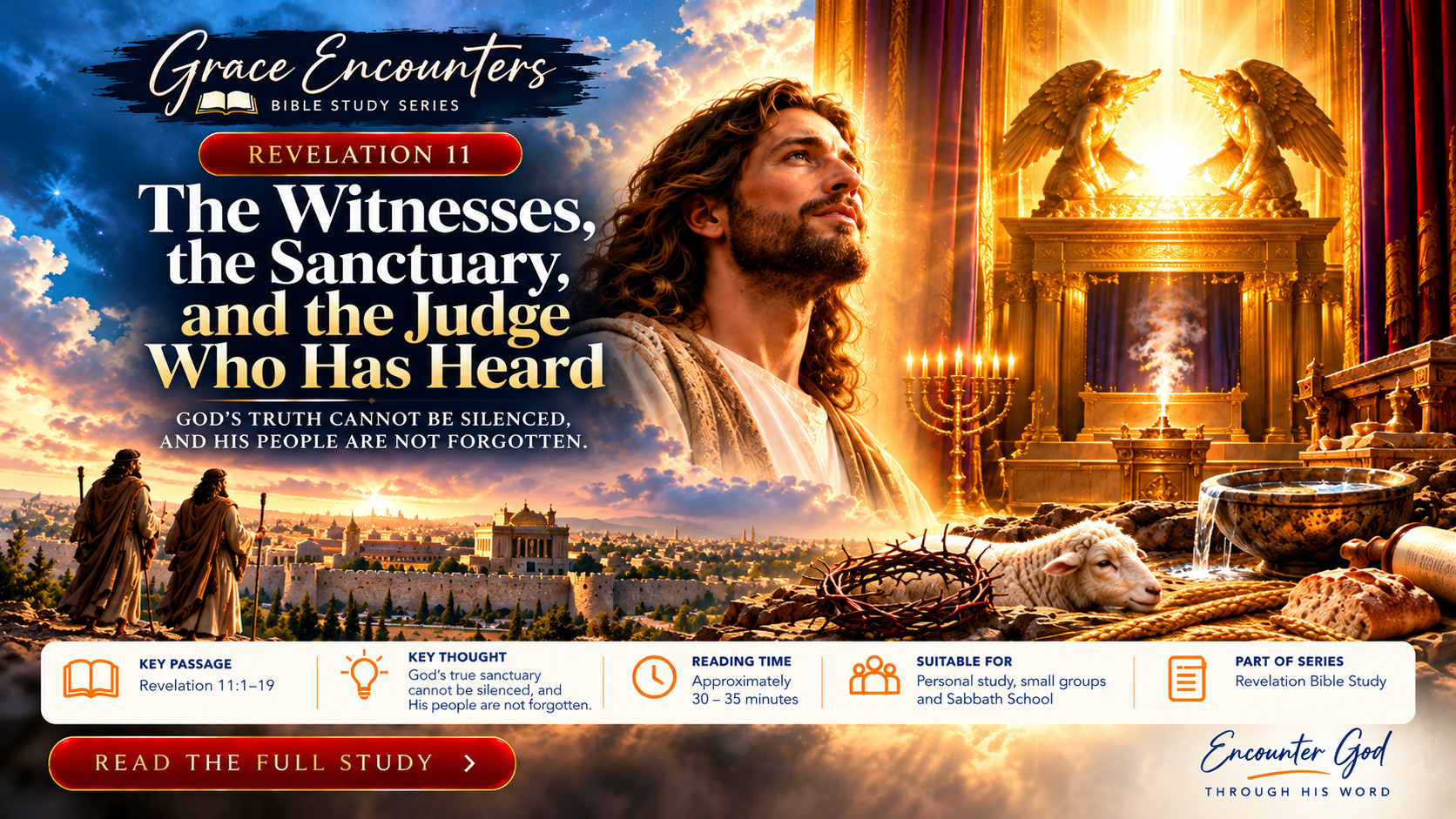
Scripture Reading: Revelation 11:1–19
Key Thought
God’s truth cannot ultimately be silenced. His people are neither forgotten nor abandoned. His judgement is not merely an announcement of condemnation, but the assurance that evil will be answered, injustice will be exposed, and Christ’s everlasting kingdom will prevail.
At the heart of Revelation 11 stands Jesus Christ: the faithful Witness, our heavenly High Priest, and the righteous Judge who knows every story.
Introduction — When the Story Seems to Be Over
Revelation 11 is a chapter of striking contrasts.
We encounter a temple being measured, witnesses clothed in sackcloth, a beast emerging from the bottomless pit, apparent defeat, resurrection, heavenly worship, judgement, and finally the opening of God’s temple in heaven.
At first glance, these scenes may appear disconnected.
Yet a remarkable thread runs through them all.
God has never abandoned His testimony, His people, or His promises.
Throughout history, there have been times when God’s truth seemed almost extinguished. Religious institutions have misrepresented His character. Political powers have attempted to silence His Word. Faithful people have suffered while those responsible for their suffering appeared to prosper.
And throughout Scripture, the same question rises from the hearts of God’s people:
How long, O Lord?
Revelation 11 does not dismiss that question.
It answers by drawing our attention towards heaven, where Christ reigns, ministers for His people, and will bring every hidden thing into the light.
As we study this chapter, our purpose is not simply to identify historical powers or calculate prophetic periods.
We want to discover Jesus.
We want to understand what this prophecy reveals about the character of the God who has promised never to forsake His children.
1. Revelation 11:1–2 — The Temple Is Measured
John is given a reed resembling a measuring rod and instructed:
“Rise, and measure the temple of God, and the altar, and them that worship therein.” — Revelation 11:1, KJV
The outer court, however, is excluded from the measurement and given to the Gentiles, who tread the holy city underfoot for forty-two months.
What does measuring mean?
Throughout Scripture, measuring may communicate ownership, evaluation, restoration, or the establishment of boundaries.
In Ezekiel 40–43, a heavenly guide measures the temple as part of a vision of restoration and God’s return to dwell among His people.
In Zechariah 2, Jerusalem is measured in a vision that anticipates God’s protection and presence.
Later, in Revelation 21, the New Jerusalem is measured.
These passages invite us to consider that the measuring of the temple in Revelation 11 is not simply an architectural exercise.
The worshippers themselves are included.
The vision concerns God’s people and their relationship with Him.
The sanctuary and the worshippers
The earthly sanctuary was the place where God revealed His desire to dwell among His people.
“And let them make me a sanctuary; that I may dwell among them.” — Exodus 25:8, KJV
Yet the sanctuary was never an end in itself.
Its services, sacrifices, priesthood, and furnishings pointed beyond themselves to the saving work of Jesus Christ.
The New Testament directs our attention to Christ as our great High Priest, ministering in the heavenly sanctuary (Hebrews 8:1–2).
Revelation 11 therefore invites us to consider God’s people in relation to His heavenly ministry.
The passage does not explicitly define the measuring as a particular phase of heavenly judgement. That association emerges from comparing Revelation with Daniel, Hebrews, and the sanctuary imagery of Scripture.
But one thing is clear: God’s worshippers matter to Him.
They are not overlooked.
He knows those who belong to Him.
The outer court and the forty-two months
The outer court is excluded from the measurement, and the holy city is trampled for forty-two months.
This introduces one of Revelation’s recurring prophetic periods.
To understand its significance, we must look beyond this verse.
2. The Forty-Two Months and the 1,260 Days — A Prophetic Period
Several passages describe what appears to be the same symbolic period:
- Forty-two months — Revelation 11:2; 13:5.
- 1,260 days — Revelation 11:3; 12:6.
- A time, times, and half a time — Daniel 7:25; Revelation 12:14.
Using a thirty-day prophetic month, forty-two months equal 1,260 days. A time, times, and half a time is commonly understood as three-and-a-half years.
These passages repeatedly associate the period with opposition to God’s people, persecution, wilderness experience, or the exercise of hostile power.
The historicist understanding before the Adventist movement
The interpretation of prophetic days as years did not originate with William Miller or the Seventh-day Adventist Church.
The symbolic interpretation of prophetic periods developed over many centuries.
Joachim of Fiore, writing in the twelfth century, applied a year-day understanding to the 1,260 days. His broader prophetic system differed considerably from later Protestant interpretations, but his work demonstrates that this approach predates the Reformation.
During the centuries surrounding the Protestant Reformation, interpreters increasingly examined the prophetic descriptions of religious oppression in relation to developments within Christian history.
Martin Luther and other Reformers identified the biblical Antichrist with the papal institution, particularly its claims to religious supremacy.
Their concern was not merely political.
They believed that Christ alone is the Head of the church and that Scripture must remain the supreme authority for Christian faith.
However, the Reformers did not all calculate the 1,260 years in the same way, nor did they agree on every prophetic identification.
Later Protestant historicists developed the chronological interpretations more systematically.
John Napier, the Scottish mathematician and biblical commentator, argued in his 1593 exposition of Revelation that the forty-two months, 1,260 days, and three-and-a-half times represented a prophetic period of 1,260 years.
His proposed chronology differed from the dates subsequently adopted by Seventh-day Adventists.
The important historical distinction is that the historicist interpretation belongs to a much broader Christian tradition than the Adventist movement alone.
The traditional Adventist interpretation
Within traditional Seventh-day Adventist historicism, the 1,260 years are identified with the period AD 538–1798.
The beginning is associated with developments in the political and ecclesiastical position of the bishop of Rome.
The conclusion is associated with the events of 1798, when French forces entered Rome and Pope Pius VI was taken prisoner.
Adventist interpreters have understood this period as representing the historical ascendancy and subsequent weakening of papal temporal power.
However, Revelation does not expressly provide the dates AD 538 and 1798.
Those dates arise from a particular historical application of the day-year principle.
The significance of AD 538, the precise historical boundaries of the period, and the application of the day-year principle deserve careful examination.
Other Christian interpretations
Some Christian interpreters understand the period as a literal three-and-a-half years, often associated with a future period of tribulation.
Others regard it as a symbolic representation of a limited period during which God’s people experience opposition.
These approaches differ substantially in their understanding of prophetic fulfilment.
Yet the repeated period communicates an assurance that should not be overlooked.
Opposition to God is not unlimited.
The powers of this world do not determine the final outcome of history.
God remains sovereign.
And His people are not forgotten.
3. Revelation 11:3–4 — The Two Witnesses
God declares:
“And I will give power unto my two witnesses, and they shall prophesy a thousand two hundred and threescore days, clothed in sackcloth.” — Revelation 11:3, KJV
The witnesses are described as two olive trees and two candlesticks standing before the God of the earth.
The imagery of Zechariah 4
The imagery directs us back to Zechariah 4.
There, Zechariah sees a golden lampstand supplied with oil from two olive trees.
The vision includes one of Scripture’s great declarations:
“Not by might, nor by power, but by my spirit, saith the LORD of hosts.” — Zechariah 4:6, KJV
In Zechariah’s immediate setting, the two anointed ones are associated with God’s provision for His work among the restored community.
Revelation draws upon this imagery to describe witnesses sustained by divine power.
Their testimony does not depend upon military strength, political influence, or human authority.
It is sustained by God.
Who are the two witnesses?
Within the Protestant historicist tradition, the two witnesses have frequently been identified with the Old and New Testaments.
Ellen G. White explicitly adopts this understanding in The Great Controversy, Chapter 15, identifying the two witnesses as the Scriptures.
This interpretation emphasises the continuing testimony of God’s written Word through centuries of opposition.
Other Christian interpreters have understood the witnesses as two prophetic figures, as representatives of the witnessing church, or as a symbolic portrayal of God’s prophetic testimony.
The passage itself does not explicitly name the Old and New Testaments.
Its imagery is drawn from Zechariah and is expressed through the language of prophetic witness.
Whatever identification we adopt, we should not miss the central significance of their calling.
They testify on God’s behalf.
And all faithful biblical testimony ultimately directs us to Jesus.
“Search the scriptures; for in them ye think ye have eternal life: and they are they which testify of me.” — John 5:39, KJV
The purpose of Scripture is not merely to supply information about God.
It is to lead us into an encounter with Christ.
4. Revelation 11:5–6 — The Authority of the Witnesses
The witnesses are described as having extraordinary authority.
Fire proceeds from their mouths against their enemies. They have power to shut heaven so that rain does not fall, to turn waters into blood, and to strike the earth with plagues.
The imagery recalls two significant Old Testament figures.
Elijah
Elijah announced a drought during the reign of Ahab (1 Kings 17).
His ministry exposed the conflict between worship of the living God and allegiance to Baal.
Moses
Through Moses, God confronted Pharaoh and delivered Israel from bondage.
The turning of water into blood recalls the plagues upon Egypt.
The power of God’s Word
The image of fire proceeding from the witnesses’ mouths also recalls Jeremiah 5:14, where God’s words are compared with fire.
This does not authorise Christians to use violence against those who reject their testimony.
The power of faithful witness lies in the truth God has entrusted to His servants.
God’s Word exposes falsehood, confronts injustice, calls people to repentance, and reveals the way of salvation.
And once again, the focus leads us to Christ.
Jesus did not establish His kingdom through coercion.
He revealed the Father’s character through truth, sacrificial love, and obedience.
5. Revelation 11:7–10 — When the Witnesses Appear to Be Defeated
The vision takes a dramatic turn.
When the witnesses have completed their testimony, the beast ascending from the bottomless pit makes war against them, overcomes them, and kills them.
Their bodies lie in the street of the great city, symbolically called Sodom and Egypt, where the Lord was also crucified.
The inhabitants of the earth celebrate their apparent defeat.
The beast from the bottomless pit
This is the first explicit appearance of a beast in Revelation’s narrative.
Later chapters develop the imagery of beastly powers in greater detail.
Here, the beast represents opposition to God’s testimony.
The language of the bottomless pit communicates a connection with destructive, hostile forces.
Spiritual Sodom and Egypt
The city is described symbolically rather than identified by its ordinary geographical name.
Egypt recalls Pharaoh’s resistance to God’s authority.
Sodom recalls the moral corruption and injustice condemned in the Old Testament.
The reference to the place where the Lord was crucified introduces another dimension: the rejection of God’s revelation in Jesus Christ.
These symbolic descriptions portray a community or power characterised by opposition to God.
The precise historical identification has been understood differently by Christian interpreters.
6. The Two Witnesses and the French Revolution — A Historicist Understanding
The French Revolution occupies an important place in Protestant historicist interpretations of Revelation 11.
The historical setting
During the revolutionary period, particularly in 1793–1794, France experienced campaigns of dechristianisation.
Churches were closed or repurposed, religious practices were restricted in many areas, and some revolutionary movements attempted to replace established Christian institutions with alternative civic beliefs and ceremonies.
These developments were not uniform throughout France, and revolutionary religious policies changed over time.
Nevertheless, the period included significant attacks upon Christian institutions and public religious expression.
The Protestant historicist interpretation
Some Protestant historicist interpreters understood these events as a manifestation of the opposition to God’s Word described in Revelation 11.
The imagery of spiritual Egypt and Sodom was associated with rejection of divine authority and moral rebellion.
The apparent death of the witnesses was interpreted as the suppression of Scripture’s public testimony.
Ellen White’s understanding in The Great Controversy
In Chapter 15 of The Great Controversy, entitled The Bible and the French Revolution, Ellen G. White develops this interpretation in considerable detail.
She identifies the two witnesses with the Old and New Testaments.
She understands their testimony in sackcloth as representing the witness of Scripture during centuries when biblical truth was obscured or suppressed.
She interprets the revolutionary rejection of Christianity and Scripture in France as the fulfilment of the prophecy concerning the apparent death of the witnesses.
In her explanation, the three-and-a-half prophetic days correspond to approximately three-and-a-half years associated with revolutionary measures against Christianity and a subsequent restoration of religious toleration.
She also connects the restoration and exaltation of the witnesses with the renewed influence and worldwide distribution of Scripture.
A warning in two directions
An important element of Ellen White’s discussion is sometimes overlooked.
She does not present the French Revolution merely as an isolated outbreak of hostility towards Christianity.
She also argues that centuries of religious oppression, persecution, and the suppression of biblical truth contributed to the conditions that produced a violent rejection of religion.
This gives her interpretation a warning in two directions.
Religious authorities can misrepresent God’s character through coercion and persecution.
But the rejection of religious oppression can itself become destructive when it develops into hostility towards God, conscience, and moral responsibility.
Both errors obscure the God revealed in Jesus Christ.
Reading the prophecy with care
We must distinguish between what Revelation explicitly states and the historical events with which interpreters have associated it.
Revelation 11 does not identify France by name.
Neither does it provide the dates of the French Revolution.
The identification of revolutionary France as the fulfilment of this prophecy emerges from the historicist approach, which understands Revelation as describing the unfolding conflict between truth and error across Christian history.
The historical details, including the proposed three-and-a-half-year correspondence, require careful examination.
Acknowledging this distinction does not diminish the authority of Scripture.
Rather, it recognises that God’s Word is authoritative while our understanding of its historical application must remain open to careful study.
We can therefore appreciate the insights of Protestant historicist interpreters and Ellen White without treating every proposed historical correspondence as an explicit statement of the biblical text.
What does this reveal about God’s character?
There is a particularly important spiritual lesson here.
Religious persecution can misrepresent God’s character so profoundly that people begin rejecting the distorted picture of God they have been shown.
This does not justify hostility towards Christianity.
But it should cause every Christian to examine how we represent Jesus.
The enemy’s purpose is not only to silence God’s Word.
It is also to distort the character of the God revealed through that Word.
That is why our witness matters.
People should encounter something of the character of Christ in those who claim to represent Him.
7. Revelation 11:11–12 — The Witnesses Rise Again
After three-and-a-half days, the Spirit of life from God enters the witnesses.
They stand upon their feet, and great fear falls upon those who see them.
Then a voice from heaven calls:
“Come up hither.” — Revelation 11:12, KJV
The witnesses ascend to heaven in a cloud while their enemies behold them.
The breath of life
The language recalls Ezekiel 37, where God’s Spirit brings life to the valley of dry bones.
What appears beyond restoration is restored by divine power.
Within the historicist interpretation, the resurrection of the witnesses is associated with the renewed public influence and dissemination of Scripture following periods of suppression.
The growth of Bible societies and the increasing availability of Scripture are often regarded as significant expressions of this renewed testimony.
When the story seems to be over
There is a deeply personal lesson here.
How often do we look at circumstances and conclude that everything has come to an end?
A relationship appears beyond repair.
A prayer seems unanswered.
A faithful witness appears to have achieved nothing.
An injustice remains unresolved.
And yet Revelation reminds us that apparent defeat is not necessarily the final chapter.
Do not determine the end from the middle of the story.
The witnesses appeared defeated.
But God had not finished.
This does not mean every earthly disappointment will be reversed in the way we hope.
It means that God’s ultimate purposes cannot be defeated, even when we cannot understand His timing.
When I cannot understand God’s hand, I can still trust His heart.
The resurrection pattern
The imagery also directs our thoughts towards Jesus.
He was rejected, condemned, crucified, and laid in a tomb.
To His followers, it appeared that everything they had believed was lost.
But the resurrection revealed that death had not defeated Him.
The apparent triumph of evil was not the end of the story.
And because Christ lives, the testimony of His people is never without hope.
8. Revelation 11:13–14 — The Earthquake and the Second Woe
A great earthquake follows.
A tenth part of the city falls, seven thousand are killed, and the survivors are terrified and give glory to the God of heaven.
The second woe passes, and the third approaches.
The imagery of earthquakes frequently accompanies divine intervention and judgement in biblical prophecy.
Historicist interpreters have proposed various historical applications of this scene.
The details are not interpreted uniformly, and the passage does not identify a specific historical earthquake.
What is significant within the narrative is that the apparent defeat of God’s witnesses is followed by a dramatic reversal.
Those who had celebrated their destruction are confronted with the reality of divine power.
God’s testimony has not been extinguished.
9. Revelation 11:15 — The Seventh Trumpet and the Everlasting Kingdom
The seventh angel sounds his trumpet.
Great voices in heaven proclaim:
“The kingdoms of this world are become the kingdoms of our Lord, and of his Christ; and he shall reign for ever and ever.” — Revelation 11:15, KJV
This is one of the great declarations of Revelation.
The conflict between earthly powers and God’s kingdom will not continue forever.
Christ’s reign will prevail.
The connection with Daniel 7
Daniel sees the Ancient of Days seated in judgement.
The heavenly court is assembled, and the books are opened.
Then Daniel sees One like the Son of Man approaching the Ancient of Days.
“And there was given him dominion, and glory, and a kingdom, that all people, nations, and languages, should serve him.” — Daniel 7:14, KJV
The Son of Man approaches the Ancient of Days in heaven.
The scene is therefore not simply a description of Christ descending to earth.
It is a heavenly scene involving judgement, authority, and the granting of an everlasting kingdom.
Jesus identifies Himself with the Son of Man imagery, particularly in His testimony before the high priest (Matthew 26:64).
The kingdom already and not yet
The New Testament teaches that Christ has already been exalted and reigns at the Father’s right hand.
Yet Revelation also anticipates the final, visible triumph of His kingdom.
This is sometimes described as the already and not yet of God’s reign.
Christ’s authority is real now.
But the complete removal of evil and the restoration of creation remain future.
Revelation 11 directs us towards that final triumph.
The kingdoms of this world do not have the last word.
Jesus does.
10. Revelation 11:16–17 — Heaven Worships the Righteous King
The twenty-four elders fall upon their faces and worship God.
They give thanks because He has taken His great power and begun to reign.
This heavenly response is significant.
The announcement of God’s judgement and reign produces worship.
Why?
Because heaven understands something that we often struggle to see from our limited earthly perspective.
God’s reign is good news.
His authority is not exercised through corruption, selfish ambition, or injustice.
His character is righteous.
His decisions are trustworthy.
His kingdom is founded upon truth and love.
The elders worship because the One who reigns is worthy of their trust.
11. Revelation 11:18 — Judgement, Vindication, and the God Who Has Heard
Revelation declares that the nations were angry, God’s wrath has come, and the time has arrived for the dead to be judged.
The passage also speaks of rewarding God’s servants and destroying those who destroy the earth.
This is a solemn declaration.
But we should not overlook the hope it contains.
Judgement is more than condemnation
In modern language, judgement is often associated almost exclusively with punishment.
Yet throughout Scripture, judgement also includes vindication, deliverance, and the restoration of justice.
Daniel 7 portrays the heavenly court and the eventual vindication of the saints.
The judgement does not merely expose evil.
It establishes that God’s people have not suffered unnoticed.
The cry of the martyrs
In Revelation 6:10, the souls beneath the altar cry:
“How long, O Lord, holy and true, dost thou not judge and avenge our blood on them that dwell on the earth?” — KJV
Their cry is not a request for uncontrolled revenge.
It is an appeal to the righteous Judge.
They want justice.
They want the truth acknowledged.
They want assurance that their suffering matters.
And Revelation 11 moves us towards the answer.
God has heard.
When the truth is finally heard
There is something profoundly personal about this.
When someone has suffered injustice, one of the deepest wounds is often the feeling that nobody truly knows what happened.
Sometimes people do not believe them.
Sometimes their experience is dismissed.
Sometimes the person responsible escapes accountability.
And sometimes the victim carries the burden of a truth that has never been properly heard.
There is a particular kind of relief when someone in authority finally listens.
When the truth can be spoken.
When the experience is acknowledged.
When the person who suffered no longer has to carry the story alone.
Human courts, however, are limited.
Evidence may be incomplete.
Memories may be imperfect.
Witnesses may be unavailable.
Even the most conscientious judge cannot know everything.
But the Judge of all the earth is not limited in that way.
He knows every fact.
He understands every motive.
He has seen every hidden act.
He knows the tears that were never witnessed by another human being.
And He understands the wounds that words cannot adequately describe.
The Judge has heard.
God’s judgement and His character
This does not mean we are authorised to decide in advance the eternal destiny of another person.
God alone possesses complete knowledge.
Scripture reminds us that He judges with perfect righteousness and understands the light each person has received (Romans 2:12–16).
His judgement is not arbitrary.
Neither is it indifferent.
He will not excuse evil.
But He will not commit injustice in the process of dealing with it.
That is why the judgement can be good news.
The One who judges is the same Jesus who revealed the Father’s love through His life, death, and resurrection.
The reward of God’s servants
Revelation speaks of rewarding God’s servants, the prophets, the saints, and those who fear His name.
Salvation is never earned through human merit.
It is God’s gift through Jesus Christ.
Yet Scripture also assures us that faithfulness is not forgotten.
The God who sees a sparrow fall also sees every act of love, every quiet sacrifice, and every prayer offered in faith.
Nothing entrusted to Him is lost.
12. Revelation 11:19 — The Temple of God Is Opened in Heaven
John now sees something extraordinary:
“And the temple of God was opened in heaven, and there was seen in his temple the ark of his testament.” — Revelation 11:19, KJV
The chapter that began with the measuring of the temple concludes with the opening of the heavenly temple.
And at the centre of the scene stands the ark of God’s covenant.
The significance of the ark
In the earthly sanctuary, the ark was situated in the Most Holy Place.
It was associated with God’s covenant, His law, His presence, and the mercy seat.
The mercy seat was central to the Day of Atonement service described in Leviticus 16.
The imagery therefore brings together two truths that must never be separated.
God is righteous.
And God is merciful.
His law reveals His character.
His mercy provides the way of reconciliation.
The heavenly sanctuary
Hebrews teaches that the earthly sanctuary was a copy and shadow of heavenly realities.
Jesus is presented as our great High Priest, ministering in the true sanctuary established by God (Hebrews 8:1–2).
The earthly priesthood and sacrifices pointed forward to Him.
The sanctuary was always intended to reveal God’s plan of salvation.
Revelation 11:19 directs our attention to the heavenly reality.
The ark is seen in God’s temple.
The covenant has not been forgotten.
God’s purposes remain secure.
And the ministry of Jesus remains central.
13. The Sanctuary — Every Symbol Leads Us to Jesus
The sanctuary becomes especially meaningful when we recognise the relationship between type and antitype.
A type is a person, event, institution, or symbol that points forward to a greater fulfilment.
The antitype is the reality towards which the earlier symbol directed attention.
The New Testament identifies Christ as the fulfilment of the sanctuary’s central purpose.
The Altar of Burnt Offering — Jesus, Our Sacrifice
The altar of burnt offering stood in the courtyard of the sanctuary.
Here, sacrifices were offered, reminding Israel of the seriousness of sin and the need for atonement.
The sacrificial system taught that reconciliation with God required more than human effort or good intentions.
Yet the blood of animals could never, in itself, remove sin (Hebrews 10:4).
These sacrifices pointed forward to a greater and sufficient sacrifice.
When John the Baptist saw Jesus approaching, he declared:
“Behold the Lamb of God, which taketh away the sin of the world.” — John 1:29, KJV
Hebrews 10:10–14 explains that Christ offered Himself once for all.
His sacrifice does not need to be repeated.
How does the altar point to Jesus?
The altar directs us to Calvary, where Jesus willingly gave His life for our salvation. He is both the perfect sacrifice and the Saviour who reconciles us to God.
The Laver — Jesus, Our Cleansing
Between the altar and the entrance to the sanctuary stood the laver, where the priests washed before entering into their sacred duties.
The washing symbolised the importance of cleansing and holiness in approaching God.
But physical water could never cleanse the human heart from sin.
True spiritual cleansing comes through God’s saving grace.
Jesus told His disciples:
“Now ye are clean through the word which I have spoken unto you.” — John 15:3, KJV
And 1 John 1:7 declares that the blood of Jesus Christ cleanses us from all sin.
In John 13, Jesus washed His disciples’ feet, illustrating His humility and the cleansing His followers need.
How does the laver point to Jesus?
The laver reminds us that Jesus not only forgives our sins through His sacrifice but also cleanses and transforms our lives. Through Him, we are made clean and prepared to live in fellowship with God.
The Lampstand — Jesus, the Light of the World
Inside the Holy Place stood the golden lampstand.
Its lamps provided light within the sanctuary.
Without that light, the priestly ministry would have taken place in darkness.
Light throughout Scripture is associated with truth, life, holiness, and the revelation of God.
Jesus declared:
“I am the light of the world: he that followeth me shall not walk in darkness, but shall have the light of life.” — John 8:12, KJV
The lampstand’s oil also invites us to consider the work of the Holy Spirit, particularly in light of Zechariah 4.
Jesus promised that the Spirit would guide His followers into truth and glorify Him (John 16:13–14).
How does the lampstand point to Jesus?
The lampstand directs us to Jesus as the Light of the World. He reveals the Father’s character, exposes the darkness of sin, and illuminates the path of salvation. Through the Holy Spirit, His light continues to shine in the lives of His people.
The Table of Showbread — Jesus, the Bread of Life
Opposite the lampstand stood the table of showbread, upon which twelve loaves were regularly placed before the Lord.
The bread represented God’s continuing provision and Israel’s covenant relationship with Him.
Bread is essential for sustaining physical life.
But humanity needs more than physical nourishment.
Jesus declared:
“I am the bread of life: he that cometh to me shall never hunger.” — John 6:35, KJV
He is the One who satisfies the deepest hunger of the human soul.
Just as Israel depended upon God’s provision in the wilderness, we depend upon Christ for spiritual life.
How does the table of showbread point to Jesus?
The bread directs us to Jesus as the Bread of Life. He is our spiritual nourishment, our sustainer, and the One who satisfies the hunger that nothing in this world can fill.
The Altar of Incense — Jesus, Our Intercessor
Before the veil separating the Holy Place from the Most Holy Place stood the golden altar of incense.
Incense was offered as part of the sanctuary’s regular ministry.
Scripture associates incense with the prayers of God’s people.
“Let my prayer be set forth before thee as incense.” — Psalm 141:2, KJV
Revelation 8:3–4 also connects incense with the prayers of the saints ascending before God.
The New Testament presents Jesus as our great High Priest, who intercedes for us.
“Wherefore he is able also to save them to the uttermost that come unto God by him, seeing he ever liveth to make intercession for them.” — Hebrews 7:25, KJV
Our prayers are not accepted because we have found perfect words or because we are worthy in ourselves.
We approach the Father through Jesus Christ.
How does the altar of incense point to Jesus?
The altar of incense directs us to Jesus as our Mediator and Intercessor. Through Him, we have access to the Father, and we can approach God’s throne with confidence, knowing that our Saviour continually represents us.
The Veil — Jesus, Our Way Into God’s Presence
The veil separated the Holy Place from the Most Holy Place.
It represented the restricted access to God’s immediate presence under the earthly sanctuary system.
Only the high priest entered the Most Holy Place, and only on the appointed Day of Atonement.
At the moment of Jesus’ death, the veil of the temple was torn from top to bottom (Matthew 27:50–51).
Hebrews explains that through Christ’s sacrifice, believers now have confidence to enter God’s presence.
“Having therefore, brethren, boldness to enter into the holiest by the blood of Jesus.” — Hebrews 10:19, KJV
Jesus Himself declared:
“I am the way, the truth, and the life: no man cometh unto the Father, but by me.” — John 14:6, KJV
How does the veil point to Jesus?
The veil directs us to Jesus as the One who opens the way to the Father. Through His death and priestly ministry, the barrier created by sin is overcome, and we are invited into fellowship with God.
The Ark of the Covenant and the Mercy Seat — Jesus, Our Righteousness and Mercy
Within the Most Holy Place stood the ark of the covenant.
Inside the ark were the tablets of God’s law.
Above it was the mercy seat, associated with God’s presence and the atoning ministry performed on the Day of Atonement.
Here, two great truths were brought together.
God’s righteousness cannot be separated from His mercy.
His law reveals His holy character.
His mercy reveals His desire to forgive and restore sinners.
On the Day of Atonement, blood was brought into the Most Holy Place as part of the sanctuary’s cleansing ritual (Leviticus 16).
The New Testament directs us to Jesus as the fulfilment of God’s saving purpose.
Romans 3:25 uses language associated with the place or means of atonement in describing Christ.
Through His sacrifice, God demonstrates both His righteousness and His grace.
Jesus did not come to persuade an unwilling Father to love us.
He came because the Father already loved us (John 3:16).
How do the ark and mercy seat point to Jesus?
The ark and mercy seat direct us to Jesus as the One in whom God’s righteousness and mercy meet. He upholds the Father’s character, provides atonement for sin, and makes reconciliation possible. In Him, we discover that God’s justice and His love are not competing qualities but expressions of the same perfect character.
The Sanctuary as a Whole — Jesus, Our Complete Salvation
When we stand back and consider the sanctuary as a whole, a beautiful picture emerges.
At the altar, we discover Jesus, our Sacrifice.
At the laver, we discover Jesus, our Cleansing.
At the lampstand, we discover Jesus, our Light.
At the table of showbread, we discover Jesus, our Bread of Life.
At the altar of incense, we discover Jesus, our Intercessor.
At the veil, we discover Jesus, our Way to the Father.
At the ark and mercy seat, we discover Jesus, the revelation of God’s righteousness and mercy.
And in the priesthood, we discover Jesus, our great High Priest.
The sanctuary does not present a collection of disconnected religious objects.
It tells one unfolding story.
The story of a God who loves us so deeply that He has made every provision to bring us home.
From the courtyard to the Most Holy Place, the message becomes increasingly clear.
Jesus is not merely part of the plan of salvation.
Jesus is the centre of it all.
The Heart of the Sanctuary — God Reconciled Us to Himself
And perhaps the most beautiful truth revealed through the sanctuary is this: the entire plan of salvation originated in the loving heart of God.
Paul writes:
“And all things are of God, who hath reconciled us to himself by Jesus Christ, and hath given to us the ministry of reconciliation; To wit, that God was in Christ, reconciling the world unto himself, not imputing their trespasses unto them; and hath committed unto us the word of reconciliation.” — 2 Corinthians 5:18–19, KJV
Notice those extraordinary words:
“God was in Christ, reconciling the world unto himself.”
Jesus did not come to change the Father’s mind about us.
He did not sacrifice Himself to persuade an angry God to become loving.
The Father already loved us.
It was because of that love that He sent His Son (John 3:16).
The sanctuary reveals the lengths to which God was willing to go to restore the relationship that sin had broken.
At the altar, we see the cost of reconciliation.
At the laver, we see the cleansing that reconciliation brings.
In the Holy Place, we see God’s continuing provision, light, and intercession.
And in the Most Holy Place, we discover that the God whose righteousness is perfect is also the God whose mercy is immeasurable.
The sanctuary is not the story of humanity trying to find a way back to an unwilling God.
It is the story of a loving God making a way to bring His children home.
And that way is Jesus Christ.
The Father Loved Us Before Calvary
There is a truth here that changes the way we understand the entire plan of salvation.
Jesus did not die so that the Father would begin to love us.
Jesus died because the Father already loved us.
Ellen White expresses this beautifully in Steps to Christ, page 13:
“The Father loves us, not because of the great propitiation, but He provided the propitiation because He loves us.”
And Jesus Himself reveals something extraordinary about the Father’s love for Him:
“Therefore doth my Father love me, because I lay down my life, that I might take it again.” — John 10:17, KJV
The Father’s love for His Son did not begin at Calvary. That love has always existed.
But Jesus’ willing sacrifice reveals the perfect unity of love and purpose between the Father and the Son.
The cross was not the Son trying to persuade the Father to save humanity.
It was the Father and Son acting together in love to accomplish our redemption.
Paul expresses this in 2 Corinthians 5:19:
“God was in Christ, reconciling the world unto himself.”
And suddenly, the sanctuary becomes even more beautiful.
Every sacrifice, every service, every symbol was pointing forward to the revelation of a love that had existed long before humanity fell into sin.
Calvary did not create God’s love for us. Calvary revealed how far that love was willing to go.
The sanctuary is therefore not the story of an angry God who needed to be persuaded to forgive.
It is the story of a loving Father who, through His Son, made reconciliation possible.
And at the centre of that story stands Jesus Christ.
14. Following the Breadcrumbs — The Old Testament Trail That Leads to Christ
One of the most beautiful discoveries in Bible study is recognising how the Old Testament repeatedly prepares the way for Jesus.
It is almost like following a trail of breadcrumbs.
A promise here.
A symbol there.
A prophecy in another book.
A sacrifice.
A priest.
A king.
A suffering servant.
And as we follow the trail, the picture becomes clearer.
The promised Seed
In Genesis 3:15, God announces that the serpent’s power will ultimately be defeated through the woman’s offspring.
The promise begins the biblical story of redemption.
The promise to Abraham
God promises that through Abraham’s seed all nations will be blessed (Genesis 22:18).
The New Testament identifies the fulfilment of this promise in Christ (Galatians 3:16).
The promised King
In 2 Samuel 7, God promises David an enduring royal dynasty.
The New Testament presents Jesus as the promised Son of David whose kingdom will have no end (Luke 1:32–33).
Bethlehem
Micah 5:2 identifies Bethlehem as the place from which a ruler will come.
Matthew 2:5–6 connects this prophecy with Jesus.
The suffering Servant
Isaiah 53 portrays One who bears the griefs and sins of others.
The New Testament repeatedly connects this passage with the suffering and death of Christ.
The Psalms
Psalm 22 contains imagery that Christians have long understood in relation to the crucifixion.
Psalm 16 speaks of God’s Holy One not seeing corruption.
Psalm 110 portrays the exalted Lord and priest.
The New Testament applies these passages to Jesus.
Daniel’s prophecies
Daniel 7 reveals the Son of Man receiving an everlasting kingdom.
Daniel 9 speaks of the Anointed One and has played an important role in Christian messianic interpretation.
Jesus opens the Scriptures
After His resurrection, Jesus explained to His disciples the things concerning Himself throughout the Scriptures.
“And beginning at Moses and all the prophets, he expounded unto them in all the scriptures the things concerning himself.” — Luke 24:27, KJV
This is the pattern we want to follow.
Not simply gathering disconnected proof texts.
Not forcing every passage to say something it does not say.
But allowing Scripture to illuminate Scripture, recognising the unfolding revelation of God’s saving purposes.
The trail leads to one Person: Jesus Christ.
15. William Miller, the Great Disappointment, and the Heavenly Sanctuary
The opening of the heavenly temple in Revelation 11:19 has particular significance within Adventist prophetic interpretation.
But it is important to understand the historical development carefully.
What William Miller misunderstood
William Miller’s central prophetic calculation was based primarily upon Daniel 8:14:
“Unto two thousand and three hundred days; then shall the sanctuary be cleansed.” — KJV
Miller and those associated with the Advent awakening understood the 2,300 prophetic days as years.
They eventually associated the conclusion of the period with 1844.
Their principal misunderstanding concerned the identity of the sanctuary and the nature of its cleansing.
They believed that the cleansing of the sanctuary referred to the purification of the earth by fire at Christ’s return.
When Jesus did not return on 22 October 1844, the experience became known as the Great Disappointment.
Returning to Scripture
Following the disappointment, some Advent believers reconsidered their interpretation.
They asked whether the prophetic calculation had been mistaken, whether their understanding of the event had been mistaken, or whether both required re-examination.
Their renewed study drew attention towards the heavenly sanctuary and Christ’s ministry as High Priest.
Within the developing Seventh-day Adventist understanding, the cleansing of the sanctuary came to be associated with a final phase of Christ’s heavenly ministry and the pre-Advent investigative judgement.
The connection with Revelation 11:19
The vision of the heavenly temple and the ark in Revelation 11:19 became important to this interpretation.
Ellen White discusses this connection in The Great Controversy, particularly in her treatment of the heavenly sanctuary and the investigative judgement.
However, Revelation 11:19 itself does not provide the date 1844.
That date emerges from the historicist interpretation of Daniel 8–9 and its relationship to the sanctuary.
The complete argument requires careful examination of Daniel 8–9, Leviticus 16, Hebrews 8–10, and the broader biblical teaching concerning judgement.
These passages deserve their own detailed study rather than being treated as conclusions that Revelation 11 alone establishes.
The greater discovery
Whatever conclusions we reach concerning the precise chronology, the central truth must not be overlooked.
Jesus is our High Priest.
He has not abandoned His people.
His sacrifice is sufficient.
His ministry is real.
And His purpose is to bring His people into the fullness of reconciliation with God.
The sanctuary is not primarily an exercise in calculating dates.
It is a revelation of the saving work of Jesus Christ.
16. Three Lessons to Carry With Us
Follow the trail. It leads to Christ.
The sanctuary, the prophets, the promises, and the symbols of Scripture are not disconnected fragments.
They form part of the unfolding revelation of God’s plan of salvation.
As we study, we must continually ask:
What does this passage reveal about Jesus?
Let Scripture shape what you believe.
We should approach the Bible with humility.
Christian history contains valuable insights, and faithful interpreters have contributed greatly to our understanding.
But no tradition, denomination, scholar, or commentator replaces the authority of Scripture.
We must remain willing to examine our assumptions, compare passages carefully, and distinguish the biblical text from our interpretations of it.
The purpose is not to discard everything we have learned.
It is to allow God’s Word to deepen, refine, and correct our understanding.
Trust the Judge who sees everything.
Perhaps this is the most personal lesson of Revelation 11.
There are things in this world that remain unresolved.
There are injustices that human courts cannot fully address.
There are wounds that nobody else understands.
But God knows.
He has heard.
And the One who will judge the world is the same Jesus who gave His life for its salvation.
We need not fear that He will overlook the truth.
Neither need we fear that He will act unjustly.
His character is our assurance.
The Grace Encounter — The Judge Has Heard
Revelation 11 begins with a measuring rod and ends with an open heavenly temple.
Between those two scenes, we witness suffering, opposition, apparent defeat, restoration, heavenly worship, and the announcement of God’s everlasting kingdom.
And through it all, one truth becomes increasingly clear.
God has not forgotten.
He has not forgotten His Word.
He has not forgotten His witnesses.
He has not forgotten those who suffered for His name.
He has not forgotten the prayers that seemed unanswered.
He has not forgotten the tears that nobody else saw.
And He has not forgotten His promise to make all things new.
The judgement of God is not merely the moment when evil is exposed.
It is also the assurance that evil will not continue forever.
The day is coming when every distortion of God’s character will be removed.
Every injustice will be answered with perfect righteousness.
Every false accusation will be seen in the light of truth.
And God’s redeemed people will discover that their trust in Him was never misplaced.
Revelation 21:4 promises a world without death, sorrow, crying, or pain.
Revelation 11 reminds us that this promise is not wishful thinking.
It rests upon the authority of the One who reigns forever.
When we cannot understand what God is doing, we can remember who He is.
When the world seems overwhelmed by evil, we can remember that Christ’s kingdom will prevail.
And when we wonder whether our story has been heard, we can remember:
The Judge has heard.
He knows.
And He is faithful.
A Prayer From the Heart
Heavenly Father,
As we study Your Word, we are reminded that there is so much we do not yet understand.
There are mysteries in prophecy, questions about history, and experiences in our own lives that we cannot explain.
But we thank You that our hope does not depend upon understanding everything.
Our hope rests in knowing You.
Thank You for preserving Your Word through the centuries.
Thank You for the faithful witnesses who continued to testify of Your truth, even when it cost them dearly.
Forgive us for the times when we have allowed human traditions, assumptions, or fear to obscure what You are revealing.
Teach us to approach Scripture with humility.
Open our minds to understand.
Open our hearts to receive.
And above all, help us to discover Jesus in every part of Your Word.
Lord, we bring before You the things that remain unresolved in our lives.
The injustices.
The unanswered questions.
The burdens we carry.
The tears that nobody else has seen.
Thank You that You know every detail.
Thank You that Your judgement is righteous and Your mercy is perfect.
Help us to trust Your heart when we cannot understand Your hand.
Remind us that apparent defeat is not the end of the story.
Remind us that evil does not reign forever.
And remind us that Jesus, our Saviour and High Priest, is still ministering for us.
May our lives reflect Your character so faithfully that others will see something of Jesus in us.
And may we hold fast to Your promise until the day when faith becomes sight and Your kingdom is established in its fullness.
In the precious name of Jesus,
Amen.
Scripture for Further Thought
Take time to explore these passages alongside this study. Compare Scripture with Scripture, follow the connections, and allow the Bible to illuminate its own message.
The Temple, the Sanctuary, and God’s Presence
- Exodus 25:8–22 — God’s desire to dwell among His people and the significance of the ark and mercy seat.
- Leviticus 16 — The Day of Atonement and the cleansing of the sanctuary.
- Ezekiel 40–43 — The measuring of the temple and the promise of God’s restored presence.
- Zechariah 2:1–13 — The measuring of Jerusalem and God’s protection of His people.
- Hebrews 8:1–6 — Christ as our High Priest in the heavenly sanctuary.
- Hebrews 9:11–28 — Christ’s superior priesthood and once-for-all sacrifice.
- Hebrews 10:1–22 — The fulfilment of the sacrificial system and our access to God through Jesus.
The Two Witnesses and God’s Enduring Word
- Zechariah 4:1–14 — The olive trees, lampstand, and power of the Spirit.
- 1 Kings 17–18 — Elijah’s prophetic witness and the confrontation with false worship.
- Exodus 7–12 — Moses, Pharaoh, and the plagues upon Egypt.
- Jeremiah 5:14 — God’s Word portrayed as fire.
- Ezekiel 37:1–14 — The Spirit of God bringing life where hope appeared lost.
- John 5:39 — The Scriptures testifying of Jesus.
- Matthew 24:35 — The enduring authority of Christ’s words.
Prophetic Time and Historical Interpretation
- Daniel 7:1–28 — The little horn, the heavenly judgement, and the everlasting kingdom.
- Daniel 8:1–27 — The sanctuary and the 2,300 evenings and mornings.
- Daniel 9:20–27 — The seventy weeks and the Anointed One.
- Revelation 12:1–17 — The wilderness period and God’s preservation of His people.
- Revelation 13:1–10 — The forty-two months and opposition to the saints.
Judgement, Justice, and Vindication
- Daniel 7:9–14, 21–27 — The heavenly court and vindication of the saints.
- Revelation 6:9–11 — The cry of the martyrs for justice.
- Psalm 9:7–10 — The Lord judging the world in righteousness.
- Psalm 37 — Trusting God when evildoers appear to prosper.
- Ecclesiastes 12:13–14 — God bringing every work into judgement.
- Romans 2:12–16 — God’s righteous judgement and human accountability.
- Revelation 20:11–15 — The final judgement.
- Revelation 21:1–5 — God’s promise to make all things new.
The Old Testament Trail Leading to Jesus
- Genesis 3:15 — The first promise of victory over evil.
- Genesis 22:15–18 — The blessing promised through Abraham’s seed.
- 2 Samuel 7:12–16 — God’s promise of an enduring kingdom.
- Micah 5:2 — The promised ruler from Bethlehem.
- Isaiah 53 — The suffering Servant.
- Psalm 22 — The suffering of the righteous One.
- Psalm 16:8–11 — The hope of resurrection.
- Psalm 110 — The exalted Lord and priest.
- Luke 24:25–27, 44–47 — Jesus revealing Himself through the Scriptures.
Further Historical and Theological Study
- Ellen G. White, The Great Controversy, Chapter 15, “The Bible and the French Revolution” — The historicist interpretation of Revelation 11 and the two witnesses.
- Ellen G. White, The Great Controversy, Chapters 23–24 — The heavenly sanctuary, the Most Holy Place, and the development of the Adventist understanding of Christ’s ministry.
- Ellen G. White, The Great Controversy, Chapter 28, “Facing Life’s Record” — The investigative judgement within Adventist theology.
- John Napier, A Plaine Discovery of the Whole Revelation of Saint John (1593) — An example of Protestant historicist interpretation before the Adventist movement.
Continue the Journey
Previous Study: Revelation 10 — The Little Book, the Bitter Disappointment, and the God Who Still Leads.
Next Study: Revelation 12 — The Woman, the Dragon, and the Great Controversy.
Grace Encounters: https://graceencounters.org.za
Discovering Jesus, one passage at a time.