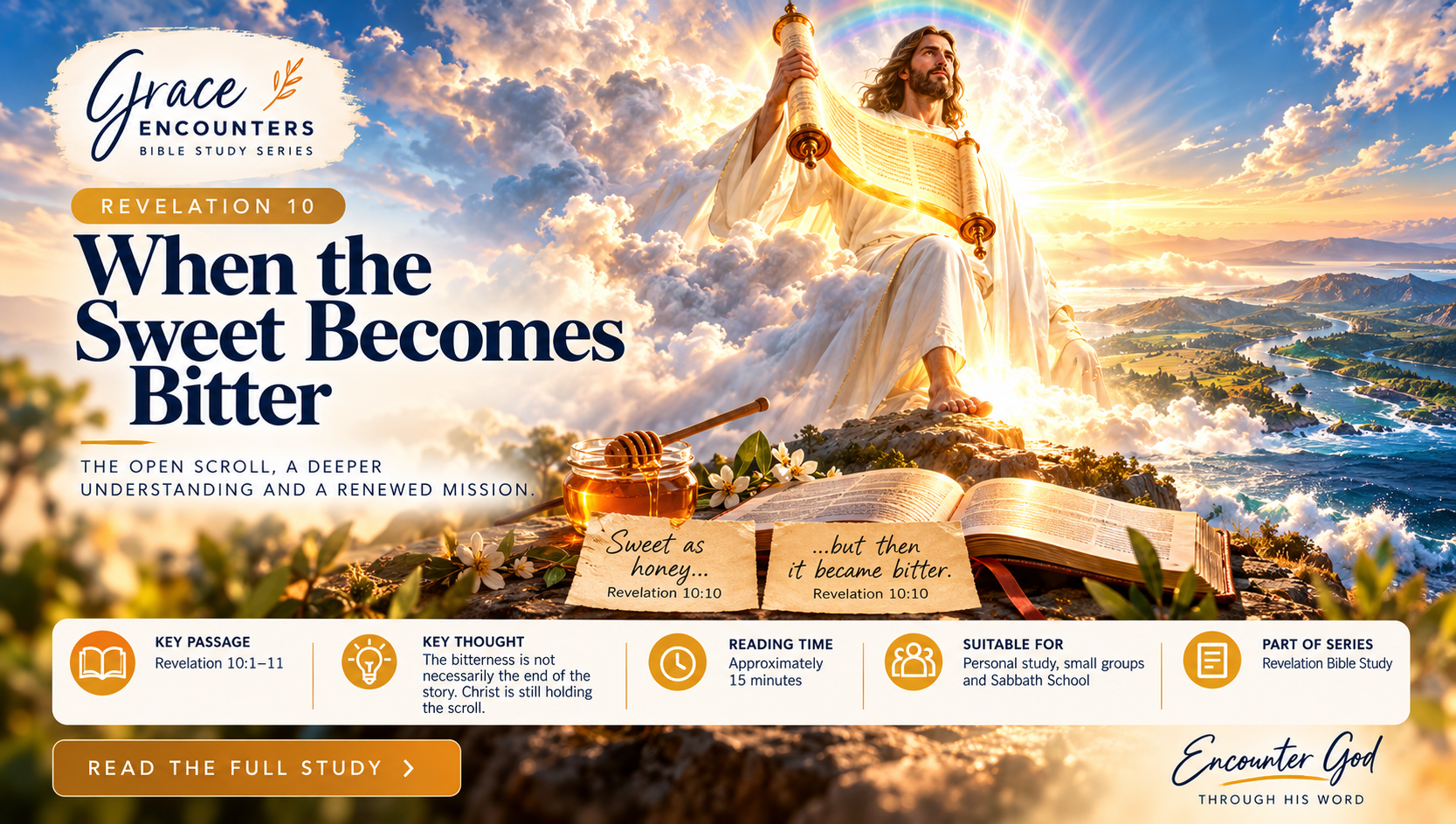
The Open Scroll, a Deeper Understanding, and a Renewed Mission
Key Passage: Revelation 10:1–11
Key Thought: The bitterness is not necessarily the end of the story. Christ is still holding the scroll.
Reading Time: Approximately 15 minutes
Suitable For: Personal study, small groups, and Sabbath School
Part of Series: Grace Encounters Revelation Bible Study
Introduction: Between the Sixth and Seventh Trumpets
Revelation 10 comes at an important pause in the trumpet sequence.
The sixth trumpet has sounded, but the seventh has not yet begun. As happened between the sixth and seventh seals, Revelation pauses before the final trumpet and allows us to see something happening behind the scenes.
After the disturbing imagery of Revelation 9, the scene changes dramatically.
John sees a mighty Angel descending from heaven. He holds a little open scroll. He places one foot upon the sea and the other upon the earth. Seven thunders speak. A solemn announcement is made concerning time. Then John is commanded to take the little scroll and eat it.
It tastes like honey.
Then it becomes bitter.
But Revelation 10 does not end with the bitterness.
John receives another command:
“Thou must prophesy again before many peoples, and nations, and tongues, and kings.”
Revelation 10:11, KJV
That little word again changes the whole chapter.
There is life after disappointment.
There is truth beyond misunderstanding.
There is mission after failure.
And above it all stands Jesus, still holding the scroll.
1. The Mighty Angel: Christ Is Still in Control
“And I saw another mighty angel come down from heaven, clothed with a cloud: and a rainbow was upon his head, and his face was as it were the sun, and his feet as pillars of fire.”
Revelation 10:1, KJV
The imagery immediately reminds us of the glorified Christ in Revelation 1.
His face shines like the sun. His feet are associated with fire. He is surrounded by heavenly glory. The rainbow recalls the throne scene of Revelation 4 and God’s covenant faithfulness. His voice is like the roar of a lion.
Ellen G. White identifies this mighty Angel directly with Christ:
“The mighty angel who instructed John was no less a personage than Jesus Christ.”
The symbolism is significant.
We have just come through Revelation 9 with its smoke, darkness, destruction, demonic powers, suffering and human rebellion.
Then Revelation 10 shows us Jesus.
And look at where He stands:
“He set his right foot upon the sea, and his left foot on the earth.”
Revelation 10:2, KJV
This is the posture of sovereignty.
Christ does not appear as someone desperately trying to regain control of a world that has slipped from His hands.
He stands over land and sea.
The message is powerful:
Do not mistake chaos for the absence of a King.
The smoke may obscure our view of Him.
It cannot remove Him.
Evil may appear powerful.
It is not sovereign.
History may seem out of control.
It is not outside the knowledge or authority of Christ.
The throne has not been vacated.
2. The Little Book Is Open
John notices something in the Angel’s hand:
“And he had in his hand a little book open.”
Revelation 10:2, KJV
The word open is important.
To understand why, we need to return to Daniel.
At the conclusion of Daniel’s prophecies, Daniel is told:
“But thou, O Daniel, shut up the words, and seal the book, even to the time of the end.”
Daniel 12:4, KJV
Daniel’s book is sealed until the time of the end.
In Revelation 10, John sees a book that is now open.
The connection becomes even stronger when we compare Daniel 12 with Revelation 10.
In Daniel 12:7, the heavenly messenger raises his hands towards heaven and swears by Him who lives forever. The oath concerns prophetic time.
In Revelation 10:5–6, the mighty Angel raises His hand towards heaven and swears by the One who lives forever. Once again, the announcement concerns time.
The parallels are striking.
Daniel: the book is sealed until the time of the end.
Revelation: the book is now open.
Something that could not previously be fully understood is now being opened for study.
3. The Seven Thunders: God Has Not Told Us Everything
“And when he had cried, seven thunders uttered their voices.”
Revelation 10:3, KJV
John evidently understands what they say because he prepares to write it down.
Then heaven stops him.
“Seal up those things which the seven thunders uttered, and write them not.”
Revelation 10:4, KJV
That is remarkable.
Revelation is a book of unveiling, yet here God deliberately chooses not to unveil something.
There is an important principle here for Bible study.
God has revealed what we need to know.
He has not revealed everything that can be known.
Our responsibility is therefore not to fill every biblical silence with speculation.
There are mysteries God has chosen not to explain yet.
Faith can live with unanswered questions.
Sometimes reverence means allowing God to remain silent where He has chosen silence.
4. “There Should Be Time No Longer”
The Angel then raises His hand towards heaven:
“And sware by him that liveth for ever and ever, who created heaven, and the things that therein are, and the earth… and the sea… that there should be time no longer.”
Revelation 10:6, KJV
This cannot mean that literal time immediately ceases.
Revelation continues. John still has work to do. The seventh trumpet still has to sound. Further prophetic events remain.
The language therefore directs us back to the prophetic setting of Daniel.
Daniel had been told that his prophecies were sealed until “the time of the end”.
Within the historicist Adventist understanding of prophecy, the great prophetic periods were now reaching their fulfilment.
The 1,260-year prophecy points to the period ending in 1798.
The 2,300-day prophecy of Daniel 8:14 points forward to 1844.
Daniel’s previously sealed prophecies began to receive extraordinary attention as people across different parts of the world studied biblical prophecy and became convinced that they were living in the time of the end.
The little book was being opened.
And what people discovered in it seemed wonderfully sweet.
5. The Mystery of God Will Be Finished
Revelation 10 does not merely speak about prophetic time.
Verse 7 says:
“The mystery of God should be finished, as he hath declared to his servants the prophets.”
Revelation 10:7, KJV
The goal of prophecy is not endless prediction.
History is moving somewhere.
God’s redemptive purpose will reach its completion.
The great controversy will not continue forever.
Sin will not continue forever.
Suffering will not continue forever.
Death will not continue forever.
God is bringing the story towards restoration.
This is important because prophecy can easily become an intellectual exercise in dates, symbols, kingdoms and calculations.
But the mystery of God is ultimately about His redemptive purpose.
Revelation is leading us towards the day when God’s dwelling will once again be with humanity and the separation caused by sin will be gone.
Prophecy therefore exists to lead us towards Jesus, not merely towards information about the future.
6. “Take It, and Eat It Up”
John now receives a strange instruction:
“Take it, and eat it up.”
Revelation 10:9, KJV
He is not merely told to read the scroll.
He must eat it.
This imagery appears elsewhere in Scripture.
Ezekiel is commanded to eat the scroll given to him, and it tastes like honey (Ezekiel 3:1–3).
Jeremiah says:
“Thy words were found, and I did eat them; and thy word was unto me the joy and rejoicing of mine heart.”
Jeremiah 15:16, KJV
Eating God’s Word means more than intellectually understanding it.
It means internalising it.
The message becomes part of you.
You do not merely possess the Word.
The Word begins to possess you.
That distinction becomes crucial in Revelation 10.
The people represented in this prophetic experience were not merely calculating dates as an academic exercise.
They believed the message.
They preached it.
They sacrificed for it.
They organised their lives around it.
They longed for its fulfilment.
They had eaten the Book.
7. Sweet as Honey: Jesus Is Coming
“It was in my mouth sweet as honey.”
Revelation 10:10, KJV
Why was it sweet?
Perhaps the simplest answer is also the most beautiful:
Jesus is coming.
Imagine believing that after years of studying prophecy.
Imagine believing that soon you would actually see Him.
No more waiting.
No more funerals.
No more suffering.
No more separation.
No more wrestling with sin.
No more wondering when He will return.
Jesus is coming.
The nineteenth-century Advent awakening extended beyond the movement that eventually became Seventh-day Adventism. People in different places and denominations were studying biblical prophecy and becoming convinced that Christ’s return was near.
William Miller and those associated with the Millerite movement concluded from their study of Daniel’s 2,300-day prophecy that the end of that period was associated with Christ’s return.
Their expectation eventually centred on 22 October 1844.
For those who genuinely loved Jesus, what message could have tasted sweeter?
The prophetic Book had opened.
And its message seemed to say:
You are going home.
8. Then the Sweet Became Bitter
John continues:
“And as soon as I had eaten it, my belly was bitter.”
Revelation 10:10, KJV
22 October 1844 passed.
Jesus did not return.
The sweetness became profound bitterness.
People who had waited for Christ were devastated.
And this is where the imagery of Revelation 10 becomes deeply emotional.
Sweet: Jesus is coming.
Bitter: We got it wrong.
Yet we need to notice something very important.
God had described both experiences beforehand.
The prophecy contains the sweetness.
And the prophecy contains the bitterness.
God knew about the disappointment before His people ever experienced it.
The disappointment did not surprise Jesus.
And before John ever tastes the bitterness, Christ is already standing there with the open Book in His hand.
That changes how we see the whole experience.
9. They Were Wrong, but They Were Not Abandoned
There is something deeply beautiful about what God does next.
He does not tell John:
Throw the Book away.
He does not say:
Everything was false.
He does not say:
You misunderstood, therefore I am finished with you.
Instead:
“Thou must prophesy again.”
Revelation 10:11, KJV
The disappointment drove sincere believers back to Scripture.
They studied again.
They prayed again.
They questioned their assumptions again.
And gradually they came to believe that their error had not necessarily been the prophetic period, but their understanding of what was supposed to happen at its conclusion.
They had interpreted the cleansing of the sanctuary in Daniel 8:14 as the cleansing of the earth by fire at Christ’s Second Coming.
Their renewed study directed their attention elsewhere.
Towards the biblical sanctuary.
And ultimately towards Jesus and His ministry as our High Priest in the heavenly sanctuary.
This is one of the most important lessons in Revelation 10:
Sincere people can misunderstand something and still be sincerely following God.
God is able to correct His people without abandoning them.
The mistake does not have to be the end of the relationship.
Sometimes it becomes the doorway to deeper understanding.
10. From Disappointment to the Sanctuary
The transition between Revelation 10 and Revelation 11 is striking.
Revelation 10 ends:
“Thou must prophesy again.”
Then Revelation 11 begins:
“Rise, and measure the temple of God, and the altar, and them that worship therein.”
Revelation 11:1, KJV
The movement is difficult to miss:
Daniel → prophetic time → expectation → sweetness → disappointment → bitterness → renewed study → sanctuary → renewed mission.
The bitter experience sent them back to Scripture.
Scripture sent them to the sanctuary.
And the sanctuary sent them back to Jesus.
That is crucial.
The sanctuary is not primarily about buildings, furniture, compartments or prophetic charts.
The sanctuary reveals what Jesus is doing for humanity.
The disappointment ultimately opened a deeper understanding of Christ.
What initially looked like the collapse of everything they believed became the beginning of a much deeper discovery.
Even the bitterness eventually led to good news.
11. “Prophesy Again”: The Grace of Another Beginning
Perhaps one of the most beautiful words in Revelation 10 is simply:
Again.
“Thou must prophesy again.”
Their misunderstanding had not disqualified them.
Their disappointment had not cancelled their calling.
Their tears had not terminated their mission.
God still had work for them.
There is extraordinary grace in that.
God can take people who misunderstood, were devastated by their misunderstanding, returned to His Word and say:
I still have something for you to do.
There is life after disappointment.
There is ministry after failure.
There is truth after misunderstanding.
There is another chapter after the bitter one.
With God, there can be an again.
12. When Following God Is Not a Smooth Road
This is where Revelation 10 moves beyond nineteenth-century Adventist history and becomes intensely personal.
Following God does not guarantee a smooth road.
In fact, there are seasons when it seems that one problem follows another.
Income disappears.
Something breaks.
A relationship becomes difficult.
A diagnosis frightens us.
A prayer appears unanswered.
A carefully made plan collapses.
And eventually we begin to ask:
Lord, what more can happen?
When enough things go wrong at once, circumstances begin demanding our attention.
Without realising it, we can start looking more at the storm than at Jesus.
Revelation 10 gives us a remarkable picture.
The experience can be bitter while Christ is still completely in control.
The bitterness does not mean Jesus has disappeared.
It does not mean He has stopped leading.
It does not mean His promises have failed.
And faith does not require us to pretend that bitter things taste sweet.
John says plainly:
It became bitter.
There are moments when the honest prayer is:
“Lord, this hurts. I don’t understand.”
But bitterness does not have to become the conclusion.
Because Christ is still standing there.
13. Stay in My Word
What do we do when everything seems uncertain?
We go back to Scripture.
Not necessarily because Scripture will tell us exactly how tomorrow’s financial problem will be solved, what unexpected door will open, or how a particular crisis will end.
Scripture gives us something more fundamental.
It reminds us Who is holding the scroll.
God says:
“Declaring the end from the beginning…”
Isaiah 46:10, KJV
I cannot see the end.
He can.
I do not know what tomorrow holds.
He does.
I cannot see a solution.
That does not mean God cannot see one.
Jesus tells us that our heavenly Father already knows what we need (Matthew 6:31–32).
Hebrews reminds us:
“I will never leave thee, nor forsake thee.”
Hebrews 13:5, KJV
Romans tells us that nothing can separate us from the love of God in Christ Jesus (Romans 8:35–39).
When circumstances make us forget what God is like, Scripture brings us back.
Stay in My Word.
Not because the Bible makes every difficult circumstance disappear.
Because the Word keeps directing our eyes back towards Jesus.
14. Peace Before the Problem Is Solved
Paul writes:
“And the peace of God, which passeth all understanding, shall keep your hearts and minds through Christ Jesus.”
Philippians 4:7, KJV
Notice what Paul does not promise.
He does not say every problem will immediately disappear.
He promises that God’s peace will guard our hearts and minds.
That is why it surpasses understanding.
Ordinary peace says:
Everything is all right, therefore I have peace.
The peace Jesus gives can say:
Everything is not all right yet, but I have peace because I know Him.
The problem can still exist.
The finances can still be unresolved.
The phone can still be broken.
Tomorrow can still be uncertain.
And yet there can be peace.
Not because everything has been solved.
Because we know Who is holding the scroll.
15. Relationship Before Explanation
This brings us back to something that has repeatedly surfaced throughout our journey through Revelation.
Sometimes God gives us an explanation.
Sometimes He does not.
But He gives us Himself.
We often want God to tell us what He is doing.
Sometimes His answer is simply to remind us Who He is.
That is not a lesser answer.
It is the foundation of faith.
Job had questions.
David had questions.
The prophets had questions.
The disciples repeatedly misunderstood what Jesus was doing.
Biblical faith is not the absence of questions.
The important question is what we do with our questions.
Do they drive us away from God?
Or do they drive us back to Him?
Revelation 10 shows us people whose bitter disappointment sent them back to the Book.
And there they discovered that Jesus had never left.
16. Keep Eating the Book
Perhaps this is one of Revelation 10’s most practical lessons:
Do not stop eating the Book because life became bitter.
Keep reading.
Keep praying.
Keep asking.
Keep seeking Jesus.
Keep allowing Scripture to correct what you have misunderstood.
Keep allowing God’s Word to remind you of what circumstances have made you forget.
Some of the Word will taste like honey.
Some experiences of life will be bitter.
But keep eating the Book.
Because the same Jesus who holds the scroll also knows what comes after the bitterness.
We may not know what happens next.
He does.
17. The Open Book and the Open Heart
There is another lesson hidden within this chapter.
If the Book is open, our hearts must also remain open.
Sometimes we become so attached to our understanding of Scripture that correction feels threatening.
The Millerite disappointment reminds us that sincere conviction and perfect understanding are not the same thing.
God’s Word must remain greater than our interpretation of God’s Word.
That requires humility.
The question is not:
Can I defend what I have always believed?
The deeper question is:
Lord, what are You actually saying?
A genuine encounter with Scripture must leave us teachable.
When God shows us that we have misunderstood something, the appropriate response is not despair.
It is deeper study.
The open Book invites an open heart.
18. Revelation 10 Is Ultimately About Jesus
It would be easy to finish this chapter thinking mainly about Daniel, prophetic dates, William Miller, 1844, the Great Disappointment and the sanctuary.
All of those things matter to the Adventist understanding of Revelation 10.
But they are not the centre.
Jesus is.
Jesus holds the Book.
Jesus opens what was sealed.
Jesus stands over land and sea.
Jesus knows the sweetness.
Jesus knows the bitterness.
Jesus does not abandon His disappointed people.
Jesus sends them back to Scripture.
Jesus directs their attention towards His heavenly ministry.
Jesus gives them another mission.
Jesus says:
Again.
The central question of Revelation is therefore never merely:
What does this prophecy predict?
It is also:
What does this prophecy reveal about Jesus?
And Revelation 10 reveals a Christ who remains with His people even when they misunderstand Him.
He corrects without abandoning.
He teaches without humiliating.
He restores after disappointment.
He gives another opportunity after failure.
He continues leading when His people cannot yet understand where He is taking them.
That is the Jesus standing over the land and the sea.
What Revelation 10 Reveals About God
Christ is sovereign.
His feet stand upon land and sea. Evil has not wrested the world from His control.
Christ reveals truth at the appropriate time.
Daniel’s sealed prophecy becomes an open Book at the time of the end.
God has not revealed everything.
The seven thunders remind us that some things remain in God’s keeping. Faith does not require an answer to every question.
God knows the end from the beginning.
The sweetness and bitterness were already present in the prophetic picture. The disappointment did not surprise Him.
Christ does not abandon sincere people when they misunderstand.
He leads them back to Scripture.
God can use disappointment to deepen understanding.
The bitterness drove His people back to the Word, towards the sanctuary, and ultimately towards a deeper understanding of Jesus.
Correction is not rejection.
“Prophesy again” demonstrates that being corrected by God does not mean being discarded by God.
Jesus remains the centre of prophecy.
Prophecy is not ultimately about dates, beasts, kingdoms or calculations.
Revelation is the revelation of Jesus Christ.
Grace Encounter: When the Sweet Becomes Bitter
There will be moments in our journey with God when what once seemed sweet becomes bitter.
A prayer seems unanswered.
A door closes.
Something we thought God was doing turns out differently from what we expected.
We may even discover that we misunderstood Him.
Revelation 10 tells us what to do then.
Go back to the Book.
Not to prove that we were right.
To find Jesus again.
And perhaps we will discover that He was standing there all along.
The bitterness was real.
But so was His presence.
The disappointment was real.
But so was His sovereignty.
The questions were real.
But so was His Word.
And somewhere beyond the bitterness may be God’s beautiful word:
Again.
Again, I will lead you.
Again, I will teach you.
Again, I will restore you.
Again, I will use you.
Again, there is something I want you to discover about Me.
So today, if life tastes bitter, keep eating the Book.
Stay in His Word.
Keep your eyes on Jesus rather than the storm.
You do not have to know how every problem will be solved.
You do not have to understand everything God is doing.
You only need to know Who is holding the scroll.
The mighty Angel still stands over land and sea.
The Book is still in His hand.
His Word is still trustworthy.
His mission is not finished.
And neither is your story.
The bitterness is not necessarily the end.
Questions for Reflection
- What does the description of the mighty Angel in Revelation 10 teach me about Christ’s authority and character?
- Are there circumstances in my life that have become so large that they are obscuring my view of Jesus?
- How do I respond when God does not reveal everything I want to know?
- Have I ever confused my interpretation of God’s Word with God’s Word itself?
- When something I believed or expected did not happen, did the disappointment drive me away from God or deeper into Scripture?
- Is there something in my life that currently tastes bitter?
- What promises in Scripture remind me that Christ is still present even when I cannot understand what He is doing?
- Where might God be saying to me, “Again”?
- Am I still “eating the Book”, allowing God’s Word to become part of me rather than merely collecting information about it?
- Above all, what has Revelation 10 shown me about Jesus?
Prayer
Father,
There are times when Your Word tastes like honey and following You seems so clear.
And there are other times when life becomes bitter and we cannot understand what You are doing.
When those seasons come, keep us close to Jesus.
Forgive us when circumstances become larger in our vision, than Christ.
When we cannot see the solution, remind us that our inability to see it does not mean that You cannot.
Keep us in Your Word.
Teach us not to be afraid when we discover that we have misunderstood something. Give us humble, teachable hearts that are willing to return to Scripture and allow You to teach us again.
When disappointment comes, do not let bitterness drive us away from You.
Let it drive us deeper into Your presence.
Give us the peace that surpasses understanding. Guard our hearts and minds in Christ Jesus even before our circumstances change.
When we do not understand what You are doing, remind us Who You are.
And when we think our usefulness is over, remind us of that beautiful word:
Again.
Lead us again.
Teach us again.
Correct us again.
Restore us again.
Use us again.
Above everything else, keep our eyes upon Jesus.
Because when we cannot understand the scroll, we can still trust the One holding it.
In Jesus’ name,
Amen.
Scripture for Furhter Thought
Take time to explore these passages alongside this study. Compare Scripture with Scripture, follow the connections, and allow the Bible to illuminate its own message.
The sealed and opened book
Daniel 8:14; Daniel 12:4–10; Revelation 10:1–7
Eating God’s Word
Jeremiah 15:16; Ezekiel 2:8–3:3; Revelation 10:8–10
Christ’s sovereignty
Psalm 24:1; Matthew 28:18; Revelation 1:12–18; Revelation 10:1–3
The sanctuary after the disappointment
Daniel 7:9–14; Daniel 8:14; Hebrews 8:1–2; Hebrews 9:11–12; Revelation 10:11–11:1
Peace when the answer is not yet visible
Isaiah 46:9–10; Matthew 6:25–34; Romans 8:35–39; Philippians 4:6–7; Hebrews 13:5–6
God’s people misunderstanding while God continues to lead
Luke 24:13–35; John 20:9; Acts 1:6–8
The mystery of God fulfilled
Romans 16:25–27; Ephesians 1:9–10; Colossians 1:25–27; Revelation 10:7; Revelation 21:1–5
The Thread Through Revelation
Revelation 9: The smoke may obscure the Light, but it cannot extinguish it.
Revelation 10: When the experience becomes bitter, keep eating the Book. Christ is still holding the scroll.
Revelation 11: The story now moves towards the temple, the witnesses, and the sounding of the seventh trumpet.
Next Study
Revelation 11: Measuring the Temple, the Two Witnesses, and the Seventh Trumpet
The command to “prophesy again” leads directly into the temple of God.
The disappointment has not ended the journey.
It has redirected our eyes towards the sanctuary, towards God’s witnesses, and once again towards Jesus.
Encounter God Through His Word.