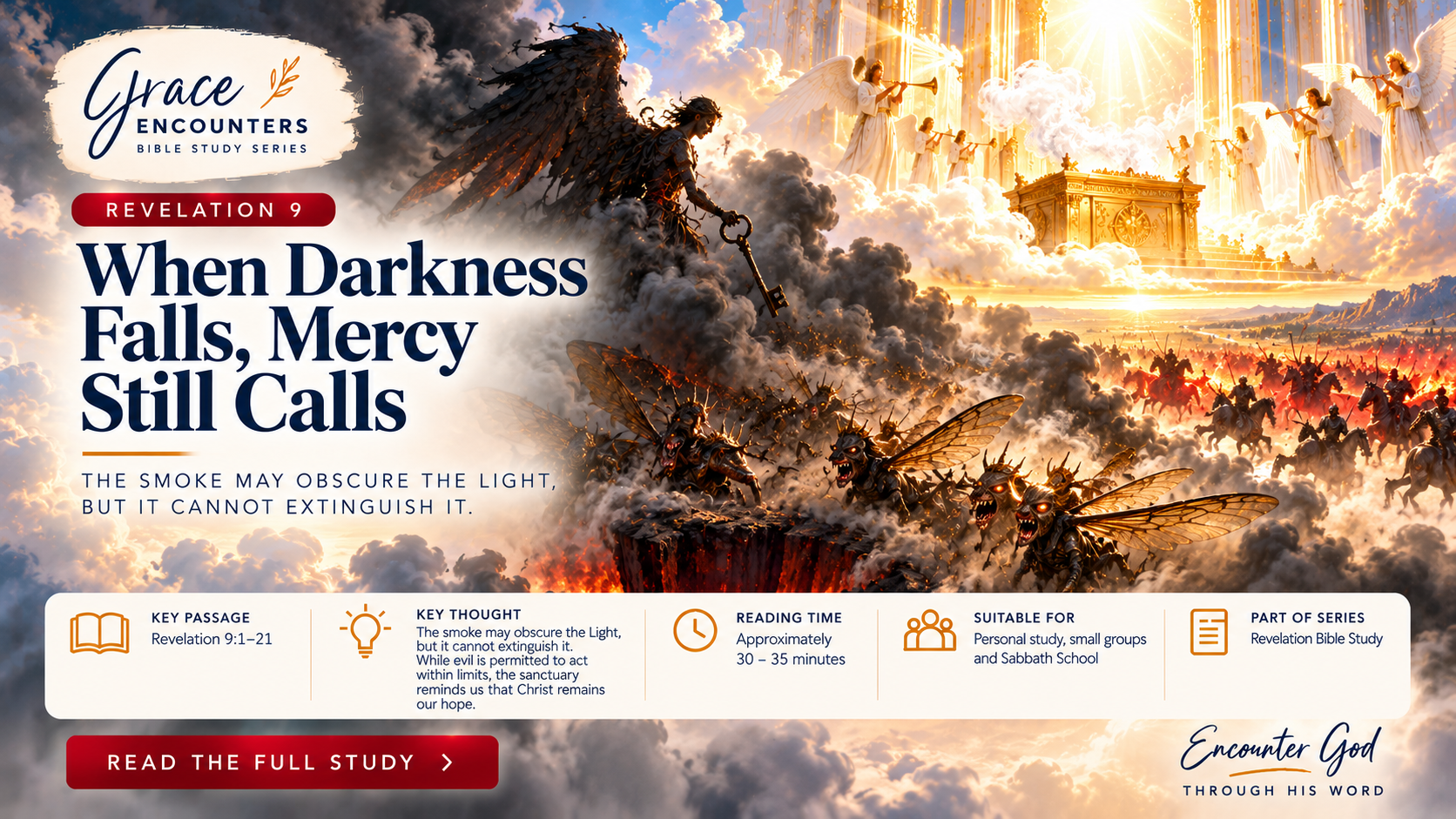
GRACE ENCOUNTERS | REVELATION BIBLE STUDY SERIES
Key Passage: Revelation 9:1–21 (KJV)
Key Thought: The smoke may obscure the Light, but it cannot extinguish it. While evil is permitted to act within limits, the heavenly sanctuary reminds us that Christ remains our hope. The greatest danger is not the darkness surrounding us, but a heart that no longer responds when God calls.
Reading Time: Approximately 30–35 minutes
Introduction – When the Trumpets Become Woes
In Revelation 8, we stood before the golden altar in the heavenly sanctuary.
We watched the incense rise before God’s throne together with the prayers of His people.
We discovered that before the trumpet judgements unfolded, heaven had already heard the cries of the faithful.
The sanctuary reminded us that Jesus Christ continues His ministry on behalf of humanity.
We also explored the first four trumpets, their Old Testament connections, and their possible historical fulfilments.
Throughout that study, one principle became increasingly important:
God’s judgements must always be understood in the light of His character.
He is love.
He is just.
He is merciful.
He does not delight in destruction.
And He does not abandon His children.
Now, as Revelation 9 begins, the imagery becomes considerably more disturbing.
The fifth trumpet sounds.
A star falls from heaven.
The abyss opens.
Smoke rises and darkens the sun.
Strange locust-like creatures emerge, bringing torment upon humanity.
Then the sixth trumpet sounds.
A voice comes from the four horns of the golden altar before God.
Four angels are released at the Euphrates, and a terrifying army brings further destruction.
Yet perhaps the most heartbreaking words in the chapter are found near its conclusion:
“And the rest of the men which were not killed by these plagues yet repented not…”
— Revelation 9:20
After everything they have experienced, they still refuse to repent.
This raises a deeply important question.
What happens when a human heart becomes so hardened that even the consequences of rebellion no longer lead it back to God?
But Revelation 9 is not merely a chapter about darkness, destruction and judgement.
It is also a chapter about divine restraint, the protection of God’s people, the heavenly sanctuary, and the continuing invitation to repentance.
As we study these two trumpets, we must examine the biblical symbols, consider the historicist interpretations, and understand their place within the larger prophetic picture.
But above all, we must remember that Revelation is the revelation of Jesus Christ.
And somewhere within this frightening vision, we will discover something deeply reassuring.
While smoke rises from the abyss on earth, incense rises before God in heaven.
The darkness has not extinguished the Light.
And mercy is still calling.
1. The Fifth Trumpet – The Fallen Star and the Abyss (Revelation 9:1)
“And the fifth angel sounded, and I saw a star fall from heaven unto the earth: and to him was given the key of the bottomless pit.”
The fifth trumpet introduces the first of the three woes announced in Revelation 8:13.
John sees a star that has fallen from heaven.
Unlike the falling star of the third trumpet, this star is described personally. A key is given to him.
Who is the fallen star?
Throughout Scripture, stars can represent angels or spiritual beings.
In Revelation 1:20, the seven stars represent the angels of the seven churches.
Jesus says in Luke 10:18:
“I beheld Satan as lightning fall from heaven.”
Revelation 12:7–9 also describes Satan’s expulsion from heaven.
These passages provide a possible biblical connection between the fallen star and Satan.
However, Revelation 9 does not explicitly identify the star as Satan, and Adventist interpreters have understood the symbol differently.
The identification should therefore be treated as an interpretation rather than an established statement of the passage.
The key is given
One detail is particularly important.
The key is not described as something the fallen star possesses independently.
It is given to him.
Throughout Revelation, destructive powers are repeatedly described as receiving authority or being permitted to act.
This does not mean that God approves of their motives.
It means that evil does not possess unlimited authority.
We encountered this principle during our study of Job.
In Job 1–2, Satan was permitted to test Job, but boundaries were established.
Satan intended destruction.
God did not share Satan’s intentions.
And Job’s suffering did not mean that God had abandoned him.
This distinction is essential to our understanding of the great controversy.
God’s permission is not the same as His approval of evil.
Understanding the abyss
The Greek word abyssos refers to the abyss or bottomless deep.
We encounter it elsewhere in Scripture.
In Luke 8:31, demons plead not to be sent into the abyss.
In Revelation 11:7 and 17:8, the beast is associated with the abyss.
In Revelation 20:1–3, Satan is confined in the abyss.
These passages associate the abyss with chaos, confinement and forces opposed to God.
Its meaning must be understood within the context of each passage rather than assuming it always refers to precisely the same location or event.
The great controversy connection
There is an interesting contrast between Revelation 9 and Revelation 20.
In Revelation 9, the abyss is opened.
In Revelation 20, Satan is bound and confined.
Whatever the precise identity of the fallen star, the larger message remains consistent.
Evil may be permitted to act.
But it cannot overthrow God’s purposes.
The authority of evil is temporary. God’s sovereignty is eternal.
2. The Smoke From the Abyss – When Darkness Obscures the Light (Revelation 9:2)
“And he opened the bottomless pit; and there arose a smoke out of the pit, as the smoke of a great furnace; and the sun and the air were darkened by reason of the smoke of the pit.”
When the abyss opens, smoke rises like the smoke of a great furnace.
It becomes so dense that the sun and the air are darkened.
The imagery is striking.
The source of darkness is not the sun itself.
The darkness comes from something that rises between the observer and the light.
Light and darkness in Scripture
Throughout the Bible, light is associated with God, truth, life and spiritual understanding.
Jesus declares:
“I am the light of the world: he that followeth me shall not walk in darkness, but shall have the light of life.”
— John 8:12
Psalm 119:105 tells us:
“Thy word is a lamp unto my feet, and a light unto my path.”
And 2 Corinthians 4:4 describes how minds can become blinded to the light of the gospel.
These passages help us understand why darkness can serve as an image of spiritual deception and obscurity.
The smoke in Revelation 9 may therefore suggest forces that obscure truth and understanding.
However, John does not explicitly identify the smoke as false doctrine, and we must be careful not to make the symbol say more than Scripture establishes.
The smoke does not extinguish the sun
There is a distinction in this vision that became especially meaningful during our study.
The smoke darkens the sun.
But the sun has not ceased to exist.
The source of light remains.
It is the ability to see that has been affected.
This provides a powerful spiritual illustration.
There are times when our circumstances become so overwhelming that we struggle to see God’s hand in our lives.
We may experience grief, uncertainty, disappointment or fear.
We may pray and receive no immediate answer.
We may not understand why God permits certain things to happen.
And sometimes we begin to mistake our inability to see Him clearly for His absence.
But God’s character has not changed.
His promises remain.
His love remains.
The smoke may obscure our view of the Light, but it cannot extinguish the Light itself.
The gradation of darkness
During our study, we pictured a landscape filled with smoke.
Near its source, the smoke is thick and dark.
Visibility is poor.
The surroundings are difficult to distinguish.
But as we move away from the source of the smoke and towards the light, the atmosphere gradually becomes clearer.
The smoke may still be present, but it no longer dominates everything we see.
This is a devotional illustration, not a description of different levels of smoke explicitly given by John.
Yet it expresses an important biblical principle.
When we intentionally remain in God’s presence through prayer, Scripture, surrender and trust, we develop a clearer understanding of His character.
This does not mean that we will always understand our circumstances.
We may still experience confusion.
We may still struggle.
We may still have days when we cannot see tomorrow.
But we can learn to interpret our circumstances through what we know about God rather than interpreting God’s character through our circumstances.
Psalm 36:9 says:
“For with thee is the fountain of life: in thy light shall we see light.”
A lamp does not necessarily illuminate the entire road.
It gives enough light for the next step.
And sometimes that is exactly what faith requires.
The closer we remain to the Light, the less the darkness determines what we see.
3. The Locusts – An Army Emerging From the Smoke (Revelation 9:3)
“And there came out of the smoke locusts upon the earth: and unto them was given power, as the scorpions of the earth have power.”
From the smoke emerge locusts.
But these are not ordinary insects.
They possess power like that of scorpions.
To understand this imagery, we must return to the Old Testament.
The locust plague in Egypt
In Exodus 10, locusts form part of God’s judgements upon Egypt.
They devastate the land and consume what remains after the earlier plagues.
The imagery is associated with overwhelming destruction.
The locust army in Joel
Joel 1–2 describes a devastating locust invasion.
The language moves between agricultural destruction and the imagery of an invading army.
Joel 2:4 says:
“The appearance of them is as the appearance of horses; and as horsemen, so shall they run.”
This closely resembles the language John uses in Revelation 9:7.
The connection suggests that John draws upon established biblical imagery of locusts as an overwhelming force of judgement.
Why these are not ordinary locusts
Ordinary locusts destroy vegetation.
But the locusts in Revelation 9 are specifically forbidden to harm grass, trees or anything green.
Their target is humanity.
Their power is compared with the sting of scorpions.
The imagery therefore points beyond a literal agricultural plague.
It describes a destructive force operating within limits established in the vision.
4. The Seal of God – Protected in the Midst of Judgement (Revelation 9:4)
“And it was commanded them that they should not hurt the grass of the earth, neither any green thing, neither any tree; but only those men which have not the seal of God in their foreheads.”
This verse takes us directly back to Revelation 7.
Before the destructive winds are released, the servants of God are sealed in their foreheads.
Now, during the fifth trumpet, those bearing God’s seal are excluded from the torment inflicted by the locusts.
The connection with Revelation 7
In Revelation 7, we discovered that God knows those who belong to Him.
The seal represents divine ownership, loyalty and allegiance.
Within the wider prophetic picture, the forehead becomes associated with the mind, worship and settled commitment.
Later, Revelation 13 and 14 develop the contrast between the seal of God and the mark of the beast.
The central issue is allegiance.
Whom do we worship?
Whose authority do we recognise?
Whom do we trust?
Daniel’s decision before the crisis
This brought us back to Daniel 1:8:
“But Daniel purposed in his heart that he would not defile himself…”
Daniel made his decision before the greatest tests of his faith.
He did not wait until the crisis to decide whether God was trustworthy.
His allegiance was already settled.
Daniel’s decision and the prophetic sealing are not identical concepts.
Nevertheless, they illustrate a shared spiritual principle.
Faithfulness is cultivated through an ongoing relationship with God.
We do not wait until the smoke becomes overwhelming before deciding whom we will trust.
We seek Christ now.
We learn His character now.
We allow His Word to shape our thinking now.
Then, when circumstances become confusing, we can return to what we already know about Him.
What does God’s protection mean?
The protection described in Revelation 9:4 applies specifically to the locust torment.
It does not mean that God’s people will never experience hardship, persecution or death.
Throughout Scripture, faithful believers suffer.
Job suffered.
Daniel faced danger.
The apostles experienced persecution.
And Jesus Himself endured the cross.
But suffering does not mean that God has abandoned His people.
God knows those who belong to Him, even when they are surrounded by darkness.
5. Five Months of Torment – Understanding Prophetic Time (Revelation 9:5–6)
“And to them it was given that they should not kill them, but that they should be tormented five months: and their torment was as the torment of a scorpion, when he striketh a man.”
The locusts are permitted to torment people for five months.
But they are not permitted to kill them.
Verse 6 describes the anguish as so severe that people seek death but cannot find it.
The language communicates extreme suffering.
Yet once again, the destructive power is limited.
Its duration is specified.
Its actions are restricted.
Its authority is not unlimited.
The traditional historicist interpretation
Traditional Protestant historicist interpreters, including early Adventists, associated the fifth trumpet with the rise and expansion of Islamic powers and their effects upon the former Roman Empire.
Within this approach, the five months are interpreted through the year-day principle.
Five prophetic months, calculated as thirty days each, produce 150 prophetic days.
Applying the year-day principle gives 150 literal years.
The traditional Millerite chronology associated this period with approximately AD 1299–1449.
However, the precise historical starting point and fulfilment remain debated.
The Andrews Study Bible perspective
The Andrews Study Bible identifies three possible interpretations of the five months:
- A period associated with the natural lifespan or activity of locusts.
- An allusion to the 150 days of the Flood in Genesis 7:24 and 8:3.
- A prophetic period of 150 years.
The Flood connection is particularly interesting.
During the Flood, judgement came upon the world, yet Noah and his family were preserved.
In Revelation 9, judgement occurs, yet those bearing God’s seal are excluded from the locust torment.
The parallel does not prove that the five months refer to the Flood.
But it deserves consideration.
Why we must interpret prophetic time carefully
Throughout our studies, we have recognised the importance of the 1,260-year and 2,300-year prophecies.
These periods form part of the traditional Adventist understanding of the prophetic framework of Daniel and Revelation.
However, we should not automatically apply the same calculation to every symbolic time expression without examining its context.
The question is not merely whether a calculation is possible.
It is whether the calculation is supported by the passage, the larger prophetic framework and the historical evidence.
Scripture must guide our interpretation of history, rather than our preferred historical interpretation determining the meaning of Scripture.
6. The Appearance of the Locust Army (Revelation 9:7–10)
“And the shapes of the locusts were like unto horses prepared unto battle; and on their heads were as it were crowns like gold, and their faces were as the faces of men.”
John now describes the locusts in greater detail.
They resemble horses prepared for battle.
They have something resembling golden crowns.
Their faces are like human faces.
Their hair is like women’s hair.
Their teeth are like lions’ teeth.
They wear breastplates resembling iron.
Their wings sound like chariots and horses rushing into battle.
And their tails possess the power to inflict torment.
A composite picture of military power
The imagery combines human, animal and military features.
It creates the impression of an organised, formidable and terrifying force.
The connection with Joel 2 remains especially important.
Joel also describes locusts using the language of horses, armies and battle.
John appears to draw upon this prophetic tradition.
The traditional historical interpretation
Historicist interpreters have associated various features of the locust army with mounted forces from the East.
Within the traditional interpretation, the imagery has been connected with Arab and Islamic military expansion.
Some commentators have attempted to identify individual features with particular military practices, clothing or equipment.
These proposed correspondences should be examined carefully.
The biblical text clearly presents a symbolic army.
It does not explicitly identify the army with a named nation or religious community.
What the imagery communicates
The locusts are numerous.
They are organised.
They are equipped for battle.
Their movement is overwhelming.
And their power is destructive.
Yet they remain subject to limits.
Even the most formidable forces in the vision cannot act independently of the boundaries established within God’s prophetic purposes.
7. Abaddon and Apollyon – The Destroyer (Revelation 9:11)
“And they had a king over them, which is the angel of the bottomless pit, whose name in the Hebrew tongue is Abaddon, but in the Greek tongue hath his name Apollyon.”
The locusts have a king over them.
He is described as the angel of the bottomless pit.
His name is Abaddon in Hebrew and Apollyon in Greek.
Both names convey the idea of destruction or a destroyer.
Who is the destroyer?
Some interpreters identify this figure directly with Satan.
Others understand the name as personifying the destructive power represented by the locust army.
The passage does not explicitly settle every question concerning his identity.
But the meaning of the names is significant.
The power associated with the abyss is characterised by destruction.
The contrast with Christ
Jesus says in John 10:10:
“I am come that they might have life, and that they might have it more abundantly.”
The contrast is striking.
The destroyer brings destruction.
Christ gives life.
The forces of evil seek to ruin what God has created.
Christ came to redeem and restore.
This contrast helps us understand the spiritual conflict running throughout Revelation.
The great controversy is not merely a contest between rival powers.
It is a conflict involving fundamentally different characters and purposes.
Christ’s purpose is restoration. The destroyer’s purpose is destruction.
8. The First Woe Has Passed (Revelation 9:12)
“One woe is past; and, behold, there come two woes more hereafter.”
The fifth trumpet concludes.
But the vision is not finished.
Two more woes remain.
The first four trumpets described judgements affecting the earth, sea, rivers and heavenly lights.
The fifth trumpet has introduced a more direct description of human torment.
The sixth trumpet will intensify the imagery further.
The seventh trumpet, announced in Revelation 11, will bring the sequence towards its climactic declaration of God’s kingdom.
The progression reminds us that the great controversy is moving towards its conclusion.
Yet the continued sounding of the trumpets also reminds us that the final end has not yet arrived.
Within the historicist understanding, the trumpets unfold while Christ’s heavenly ministry continues.
The final plagues, described later in Revelation, belong to the period after the close of probation.
This distinction matters.
The trumpets contain warnings within the unfolding history of a world where repentance remains possible.
9. The Sixth Trumpet – A Voice From the Golden Altar (Revelation 9:13)
“And the sixth angel sounded, and I heard a voice from the four horns of the golden altar which is before God.”
The sixth trumpet begins with a remarkable detail.
Before John sees the Euphrates, the four angels or the terrifying army, he hears a voice from the golden altar.
The vision returns us to the sanctuary.
The altar of incense
In Revelation 8, we studied the golden altar of incense.
We discovered that incense was offered together with the prayers of God’s people.
Exodus 30:1–10 describes the earthly altar.
It stood before the veil separating the Holy Place from the Most Holy Place.
Incense was offered there morning and evening.
The altar was associated with prayer, worship and the sanctuary ministry.
What do the four horns represent?
The golden altar had a horn projecting from each of its four corners.
In Scripture, horns frequently symbolise strength, power and authority.
Psalm 18:2 describes God as the horn of our salvation.
Luke 1:69 uses similar language.
But the horns of the altar also carry additional sanctuary associations.
In Leviticus 4:7 and 18, sacrificial blood was applied to the horns of the altar.
The horns were therefore associated with the sacrificial system and the provision of atonement.
We also find people seeking refuge by taking hold of the horns of the altar.
Adonijah did this in 1 Kings 1:50.
These associations do not mean that each of the four horns has a separate symbolic meaning.
Scripture does not assign individual meanings to them.
Rather, the altar as a whole reminds us of sacrifice, mercy, prayer and divine authority.
The significance of the sequence
The sixth trumpet does not begin with the Euphrates.
It begins before God.
This gives us an important sequence:
Prayer → Intercession → Atonement → Divine authority → Judgement
The destructive forces described later in the trumpet do not possess ultimate authority.
The voice comes from the heavenly sanctuary.
The judgement unfolds within the framework of God’s sovereignty.
And this brought us to one of the most meaningful discoveries in our study.
While smoke rises from the abyss on earth, incense rises before God in heaven.
The darkness below has not removed the ministry of heaven above.
Christ has not abandoned humanity.
10. The Four Angels and the Euphrates (Revelation 9:14)
“Saying to the sixth angel which had the trumpet, Loose the four angels which are bound in the great river Euphrates.”
The voice commands the sixth angel to release four angels bound at the Euphrates.
The imagery raises several questions.
Why four angels?
Why are they bound?
And why is the Euphrates significant?
The four angels
Revelation 7 also describes four angels restraining destructive winds.
There, the angels hold back the winds until God’s servants are sealed.
Revelation 9 describes four angels who are bound and then released.
The passages are not necessarily describing the same angels.
However, both contain the theme of destructive forces being restrained until an appointed time.
This connection reinforces a principle we have repeatedly encountered.
Evil does not possess unrestricted authority.
The Euphrates in biblical history
The Euphrates was one of the great rivers of the ancient Near East.
It was closely associated with Mesopotamia and ancient Babylon.
In the Old Testament, powers from the region of the Euphrates were frequently involved in the history of Israel and Judah.
The river therefore carries associations with great empires, invasion and judgement.
Revelation returns to the Euphrates in Revelation 16:12, where its waters are dried up during the sixth bowl.
The two passages should be compared carefully, although they need not describe the same event.
The historicist interpretation
Traditional historicist interpreters associated the Euphrates with Turkish and Ottoman powers.
Within that framework, the sixth trumpet was understood as describing the expansion and influence of the Ottoman Empire.
Other Adventist interpreters understand the Euphrates more symbolically, connecting it with Babylon, opposition to God and the release of destructive forces.
The passage does not explicitly identify the Ottoman Empire.
That identification belongs to the historical interpretation and must be evaluated against the biblical imagery and historical evidence.
11. The Appointed Hour, Day, Month and Year (Revelation 9:15)
“And the four angels were loosed, which were prepared for an hour, and a day, and a month, and a year, for to slay the third part of men.”
The angels are released at a specified time.
The wording emphasises preparation, appointment and limitation.
The traditional prophetic calculation
Historicist interpreters have applied the year-day principle to the expression.
Using a prophetic year of 360 days and a month of 30 days, the calculation becomes:
- One year: 360 prophetic days.
- One month: 30 prophetic days.
- One day: 1 prophetic day.
- One hour: 1/24 of a prophetic day.
Applying the year-day principle produces approximately 391 years and 15 days.
Josiah Litch and other Millerite interpreters associated this period with Ottoman history.
Litch’s prediction concerning events in 1840 became particularly significant to the Millerite movement.
Ellen White and Josiah Litch
In The Great Controversy, chapter 18, Ellen White discusses Josiah Litch’s interpretation and the prediction associated with 11 August 1840.
She records how the apparent fulfilment of that prediction strengthened confidence in the Millerite proclamation.
However, Ellen White did not provide a detailed verse-by-verse explanation of Revelation 9.
Her account should therefore not be presented as a direct endorsement of every symbolic identification or historical calculation proposed by later commentators.
The Andrews Study Bible perspective
The Andrews Study Bible acknowledges the traditional historicist calculation while also recognising that the time expression may refer to a precisely appointed moment rather than a duration of 391 years.
This distinction is important.
The text clearly indicates that the destructive activity occurs within a divinely appointed framework.
The precise chronological interpretation remains debated.
Our approach to prophetic interpretation
We should neither dismiss the historicist interpretation simply because scholars disagree about it nor accept it without examination.
Instead, we ask:
Does the calculation fit the language of the passage?
Does it fit the larger prophetic framework?
Does it correspond convincingly with historical events?
And does it remain consistent with Scripture as a whole?
A prophetic interpretation must be supported by more than an interesting calculation.
12. The Army of Two Hundred Million (Revelation 9:16–19)
“And the number of the army of the horsemen were two hundred thousand thousand: and I heard the number of them.”
John hears the number of the mounted troops.
Two hundred thousand thousand represents two hundred million.
The number communicates an overwhelming force.
John then describes the horses and riders in extraordinary language.
The riders wear breastplates of fiery red, blue and sulphur-yellow.
The horses have heads resembling lions.
Fire, smoke and brimstone proceed from their mouths.
Their destructive power is associated with both their mouths and their tails.
The symbolism of the army
The imagery combines military power with terrifying, almost supernatural features.
The horses are not described as ordinary animals.
Their appearance communicates destruction, fear and overwhelming force.
The fire, smoke and brimstone also recall the language of divine judgement elsewhere in Scripture.
The traditional historicist interpretation
Historicist commentators have associated the sixth trumpet with Ottoman military expansion.
Some have connected the imagery of fire and smoke with the development and use of firearms and artillery.
However, these historical correspondences remain interpretive proposals.
The biblical text does not explicitly identify the army with a particular empire or military technology.
What we can establish
The army is immense.
Its destructive power is extraordinary.
Its activity is limited.
And the judgement affects a third of humanity.
This repeated fraction connects us with the earlier trumpets.
The judgement is serious, but it is not presented as the final destruction of all humanity.
The language continues to communicate restraint.
13. Yet They Repented Not – The Tragedy of a Hardened Heart (Revelation 9:20–21)
“And the rest of the men which were not killed by these plagues yet repented not of the works of their hands, that they should not worship devils, and idols of gold, and silver, and brass, and stone, and of wood…”
The chapter ends with one of its most sobering statements.
The survivors do not repent.
They continue worshipping demons and idols.
They refuse to turn from murder, sorcery, sexual immorality and theft.
After all the suffering and destruction, their hearts remain unchanged.
Why is repentance mentioned?
If destruction were the only concern of the passage, John would not necessarily need to tell us whether the survivors repented.
But he specifically records their refusal.
This reveals that repentance is central to the theological message of the sixth trumpet.
The chapter does not explicitly state that every judgement is intended solely to produce repentance.
Nevertheless, the emphasis on humanity’s response shows that the refusal to repent is part of the tragedy.
The connection with Revelation 16
Later, during the final plagues, we encounter similar language.
Revelation 16:9 says:
“And they repented not to give him glory.”
Revelation 16:11 again describes people refusing to repent of their deeds.
There appears to be a progression.
Humanity experiences increasingly serious consequences.
Yet rebellion can become increasingly entrenched.
A heart can become so hardened that even suffering no longer awakens the desire to return to God.
The issue of worship
Revelation 9:20 specifically mentions the worship of demons and idols.
This connects with the larger theme of worship and allegiance that becomes increasingly prominent in Revelation 13 and 14.
The question is not merely whether humanity recognises the existence of God.
It is whether humanity will surrender to Him.
Whom do we worship?
Whose authority do we recognise?
What occupies the place in our hearts that belongs to God?
The greatest danger is not merely the trouble surrounding us, but a heart that no longer responds when God calls.
14. Understanding God’s Judgements – Blessings, Discipline and Consequences
During our study, we returned to a principle that has become increasingly important in our understanding of God’s character.
Sometimes God works in our hearts through blessings.
Sometimes He teaches us through waiting.
Sometimes He corrects us.
And sometimes He permits us to experience the consequences of our choices.
God’s goodness leads to repentance
Romans 2:4 tells us:
“The goodness of God leadeth thee to repentance.”
God’s kindness, patience and mercy are intended to draw us towards Him.
He does not delight in our destruction.
Ezekiel 33:11 declares:
“I have no pleasure in the death of the wicked; but that the wicked turn from his way and live…”
God’s discipline can produce growth
Hebrews 12:11 explains that discipline can produce the peaceable fruit of righteousness.
God’s correction is not evidence that He has ceased to love His children.
It may be part of His work of restoration.
When God permits consequences
Romans 1 repeatedly describes God giving people over to the choices they persistently make.
In the parable of the prodigal son, the father allows his son to leave.
He does not force him to remain.
The son experiences the consequences of his decisions.
Yet when he returns, the father receives him with compassion.
This does not mean that every hardship is a divine judgement.
Job’s experience teaches us that suffering does not necessarily indicate personal wrongdoing.
Nor should we assume that every tragedy has been deliberately sent by God to teach someone a lesson.
But Scripture does reveal that God can work through difficult circumstances to awaken, correct and restore.
God’s eternal purpose
Jesus says in John 10:10 that He came to give life more abundantly.
But abundant life does not mean a life without suffering.
It means a life grounded in relationship with Him.
God’s desire is not merely to make our temporary existence comfortable.
He desires to save us for eternity.
He sees beyond the difficulties of the present world.
He knows what sin ultimately produces.
And He continues to call humanity away from destruction.
The God who warns is the same God who longs to save.
15. Christ Our Intercessor – The Sanctuary Is Still Open
One of the most meaningful connections in our study came from Revelation 9:13.
The sixth trumpet begins at the golden altar before God.
The altar reminds us of the sanctuary ministry.
And the sanctuary points us to Jesus Christ.
Jesus ever lives to make intercession
Hebrews 7:25 declares:
“Wherefore he is able also to save them to the uttermost that come unto God by him, seeing he ever liveth to make intercession for them.”
Romans 8:34 also describes Christ making intercession for us.
Hebrews 4:14–16 invites us to approach the throne of grace with confidence because we have a great High Priest.
These passages establish a fundamental truth.
Our salvation has never depended upon our ability to stand independently of Jesus.
From beginning to end, salvation rests upon His grace, righteousness and saving work.
While there is smoke on earth, there is incense in heaven
This contrast became one of the central discoveries of our study.
In the fifth trumpet, smoke rises from the abyss and darkens the sun.
In the sixth trumpet, a voice comes from the golden altar before God.
And Revelation 8 has already shown us incense rising with the prayers of God’s people.
The imagery is not identical, and the passages should not be collapsed into one symbol.
But their contrast provides a beautiful devotional connection.
Smoke rises from the abyss and obscures.
Incense rises before God with the prayers of His people.
And Christ remains our High Priest.
While terrible things unfold on earth, the sanctuary reminds us that heaven has not abandoned humanity.
Mercy is still calling
Revelation 9 ends with the words:
“Yet repented not.”
That statement is heartbreaking because the trumpet judgements belong to the period before the final close of probation in the traditional Adventist understanding.
Repentance remains possible.
God continues to call.
The sanctuary reminds us of the provision He has made for forgiveness and reconciliation.
The tragedy is that people refuse to respond.
And this raises a deeply personal question.
When God speaks to me, how willing am I still to repent?
16. The Close of Probation – When Humanity’s Choices Are Settled
Our discussion of Christ’s intercession led us to consider the close of probation.
Within the traditional Adventist understanding of the heavenly sanctuary, Christ’s mediatorial ministry concerning sin reaches its conclusion before His return.
Revelation 22:11 declares:
“He that is unjust, let him be unjust still: and he which is filthy, let him be filthy still: and he that is righteous, let him be righteous still: and he that is holy, let him be holy still.”
Immediately afterwards, Jesus says:
“And, behold, I come quickly…”
— Revelation 22:12
Is the close of probation an arbitrary deadline?
We considered the illustration of the Comrades Marathon.
Imagine a runner who has spent the entire day running.
After many exhausting hours, the runner approaches the finish line.
Only a few metres remain.
Then the final whistle sounds.
The runner has not crossed the line in time.
The race is over.
It would be tragic to imagine salvation operating in precisely that way.
As though someone has spent a lifetime sincerely responding to God’s grace, only to be rejected because an arbitrary deadline arrived moments before they reached Him.
That is not the picture of God’s character we discover in the gospel.
Within the Adventist understanding, the close of probation marks the point at which humanity’s choices have become finally settled.
It is not about God searching for a technical reason to exclude someone from His kingdom.
God does not force anyone to love Him.
He respects the freedom He has given humanity.
The final settling of allegiance
Revelation 22:11 describes the resulting condition.
The righteous remain righteous.
The rebellious remain rebellious.
Their choices have become settled.
This is why the repeated refusal to repent in Revelation 9 is so serious.
Every act of resistance can contribute to the hardening of the heart.
Every response to grace can deepen our relationship with Christ.
Our daily choices matter.
Not because we earn salvation through them.
But because they reveal the direction of our allegiance.
17. Standing Without an Intercessor – But Never Without Christ
A concern sometimes arises from the Adventist expression that God’s people will stand “without an intercessor” during the final time of trouble.
Without careful explanation, this can sound as though Jesus supports His people throughout their lives but withdraws His presence at the moment they need Him most.
That would contradict the broader biblical promises of Christ’s faithfulness.
What changes at the close of probation?
The particular mediatorial ministry associated with dealing with unresolved sin and undecided cases reaches its conclusion.
But that does not mean Christ abandons His people.
Jesus promises:
“I will not leave you comfortless: I will come to you.”
— John 14:18
And in Matthew 28:20:
“I am with you alway, even unto the end of the world.”
The conclusion of one phase of Christ’s heavenly ministry should not be confused with the end of His relationship with His children.
The sanctuary phase changes. The relationship does not.
Jacob’s time of trouble
Genesis 32 describes Jacob wrestling through the night.
He struggles without initially recognising the One with whom he is wrestling.
Yet he refuses to let go without receiving a blessing.
Jeremiah 30:7 describes a time of trouble for Jacob, from which he will be saved.
Within Adventist eschatology, Jacob’s experience provides an important illustration of the final time of trouble.
God’s people may experience fear, anguish and the apparent absence of God.
But apparent absence is not actual abandonment.
Jacob thought he was wrestling with an enemy.
He was, in fact, holding onto God.
Righteousness by faith
This distinction is essential.
The final crisis does not require God’s people to become spiritually self-sufficient.
Their endurance remains dependent upon divine grace.
Even their settled allegiance is the fruit of Christ’s work in their lives.
Philippians 1:6 reminds us that God will complete the good work He has begun.
Jesus does not save us through grace and then require us to finish the journey through our own strength.
The One who begins the work of salvation is faithful to complete it.
The Holy Spirit and the final crisis
Scripture warns that persistent resistance to God can harden the human heart.
It also teaches that the Holy Spirit convicts, guides and strengthens God’s people.
Within traditional Adventist eschatology, the withdrawal of God’s restraining Spirit from the rebellious world is associated with the final crisis.
However, we should be careful not to claim more about the Spirit’s precise activity after probation closes than Scripture explicitly reveals.
What we can affirm is that God’s people are not abandoned.
Their security remains in Christ.
Their faithfulness remains the fruit of His grace.
And His promises remain trustworthy.
18. Revelation 9 Within the Larger Prophetic Picture
Revelation 9 does not stand alone.
The fifth and sixth trumpets form part of a much larger prophetic sequence.
In Revelation 7, God’s servants are sealed.
In Revelation 8, the first four trumpets sound.
In Revelation 9, the fifth and sixth trumpets introduce the first two woes.
In Revelation 10, the mighty angel and the little book become central to the vision.
In Revelation 11, the seventh trumpet announces the triumph of God’s kingdom.
Later, Revelation 12–14 develops the great controversy and the final issue of worship and allegiance.
Revelation 15–16 describes the seven last plagues.
And Revelation 21–22 reveals the restoration of all things.
The relationship with Daniel
Throughout our studies, we have repeatedly returned to Daniel.
The 1,260-year period appears in several forms in Daniel and Revelation.
The 2,300 evenings and mornings of Daniel 8 form part of the Adventist understanding of the heavenly sanctuary and the pre-Advent judgement.
These prophetic periods provide an important framework for historicist interpretation.
However, the five months and the hour, day, month and year of Revelation 9 must still be examined within their own context.
We should not assume that every prophetic time expression must be interpreted identically.
Ellen White and the trumpets
Ellen White discusses Josiah Litch’s interpretation of the Ottoman Empire in The Great Controversy.
She records the influence of his prediction upon the Millerite movement.
However, she does not provide a complete verse-by-verse interpretation of Revelation 9.
This distinction allows us to respect the historical development of Adventist prophetic interpretation while continuing to test proposed fulfilments against Scripture and history.
The central issue of Revelation
As the prophetic story unfolds, one question becomes increasingly prominent.
Whom do we worship?
Revelation 9:20 describes humanity continuing in idolatry.
Revelation 13 describes the worship of the beast.
Revelation 14 calls humanity to worship the Creator.
And Revelation 22 reveals the final condition of those who have chosen their allegiance.
The issue is not merely religious information.
It is relationship, worship and trust.
Prophecy is not simply about knowing what will happen. It is about knowing the God who holds the future.
19. The Great Controversy – Why God Restrains Evil
One theme appears repeatedly throughout Revelation 9.
The destructive powers are limited.
The key is given.
The locusts are instructed.
They are forbidden to kill.
Their torment lasts for a specified period.
The four angels are bound until an appointed time.
And the destruction affects a third of humanity.
These details remind us that evil does not possess unlimited authority.
The connection with Job
During our study of Revelation 8, we returned repeatedly to Job.
Satan accused Job of serving God only because God had blessed him.
He claimed that Job’s faithfulness depended upon the protection surrounding him.
God permitted Satan to test Job, but established boundaries.
Job suffered terribly.
Yet his suffering did not mean that God had abandoned him.
And Satan’s destructive intentions were not God’s intentions.
This distinction remains important in Revelation 9.
The fact that God permits destructive forces to act does not mean that He approves of their motives.
Why does God permit evil to continue?
This question belongs to the heart of the great controversy.
God has created beings capable of genuine love and meaningful choice.
Love cannot be forced.
Throughout history, humanity has repeatedly experienced the consequences of rejecting God’s ways.
Yet God continues to reveal His character, extend mercy and call people to repentance.
The trumpets remind us that evil is restrained.
The final judgement reminds us that evil will not continue forever.
And the cross reveals the lengths to which God has gone to save humanity.
God’s restraint reveals His patience
The repeated limitations in Revelation 9 should not be understood as proof that every individual act of suffering has a direct divine purpose.
But within the prophetic vision, the restraints demonstrate that destructive powers do not possess ultimate control.
God remains sovereign.
And His purposes move steadily towards the final restoration of all things.
The God who permits evil for a limited time is also the God who will bring evil to its final end.
Grace Encounter – When I Cannot See Tomorrow
There is an image from this study that has stayed with me.
I picture the smoke rising from the abyss.
At the bottom, where the smoke is thickest, everything is dark.
The surroundings are obscured.
It is difficult to see where the path leads.
But as I imagine moving upwards, away from the source of the smoke and towards the light, the darkness gradually becomes less overwhelming.
The smoke is still there.
But it no longer determines everything I can see.
And I began to think about my own relationship with God.
There are days when life feels like that smoke.
Days when I cannot understand what is happening.
Days when I do not know what tomorrow will bring.
Days when I pray, but the answers are not immediately clear.
And sometimes the uncertainty becomes so overwhelming that it affects the way I see everything else.
But then I remember something.
The smoke has not extinguished the sun.
God has not changed.
His character has not changed.
His promises have not changed.
And perhaps the question is not whether I can remove all the smoke from my circumstances.
Perhaps the question is where I choose to stand.
Am I intentionally remaining close to the Light?
Am I spending time in His Word?
Am I allowing Him to shape my understanding?
Am I learning to trust His character even when I cannot understand His purposes?
Psalm 36:9 says:
“In thy light shall we see light.”
That is what I want.
I do not necessarily need to see the entire road ahead.
I want to know that I am walking with Him.
And as we continued studying Revelation 9, another picture began to emerge.
The sixth trumpet begins at the golden altar before God.
That detail moved me deeply.
Because while terrible things are happening on earth, John directs our attention back to the sanctuary.
Back to the place associated with prayer, mercy and atonement.
Back to the ministry that points us to Jesus Christ.
And suddenly the contrast became beautiful.
While there is smoke on earth, there is incense in heaven.
The darkness below has not silenced the ministry above.
Jesus remains our hope.
Hebrews 7:25 tells us that He ever lives to make intercession.
And that brought me to something else that matters deeply to me.
I cannot imagine Jesus walking with me throughout my life, sustaining me through every difficulty, forgiving me when I fail, strengthening me when I am weak, and then abandoning me at the moment I need Him most.
That is not the Jesus I have come to know through His Word.
The sanctuary phase may change.
But His love does not.
His faithfulness does not.
His promises do not.
And my salvation has never depended upon my ability to stand independently of Him.
It rests upon His righteousness.
His grace.
His saving power.
That is what righteousness by faith means to me.
And then I come to the final verses of Revelation 9.
“Yet repented not.”
Those words trouble me more than the locusts, the horses or the terrifying armies.
Because they describe people who have experienced so much and still refuse to turn towards God.
And I find myself asking a deeply personal question.
Could my heart ever become so hardened that I stop listening when God speaks?
Could I become so determined to have my own way that I no longer recognise His correction?
Could I become so accustomed to resisting His voice that even the consequences of my choices no longer lead me back to Him?
That thought makes me want to pray.
Not merely for protection from difficult circumstances.
But for a heart that remains tender towards God.
A heart willing to listen.
Willing to repent.
Willing to surrender.
Willing to be changed.
Because I do not want to spend my life learning about prophecy while failing to respond to the God who gave it.
I want to know Him.
I want His Word to shape my understanding of His character.
I want to remain close enough to recognise His voice.
And I want my allegiance to be settled, not through fear of what is coming, but through love for the One who has already given everything to save me.
Perhaps that is the greatest lesson I want to carry from Revelation 9.
I may not be able to control how much smoke surrounds me, but I can choose where I stand.
I can choose to remain close to Jesus.
I can choose to trust Him when I cannot see tomorrow.
I can choose to respond when He calls.
And I can rest in the assurance that the One who has held me throughout my life will not abandon me when the darkness becomes thickest.
The smoke may change what I can see.
But it cannot change who God is.
It cannot change who I belong to.
And it cannot change how firmly He holds history.
Closing Prayer – Lord, Keep My Heart Near the Light
Heavenly Father,
Thank You for the privilege of opening Your Word and discovering more of who You are.
Lord, Revelation 9 contains frightening images.
The abyss opens.
Smoke rises.
Darkness spreads.
And humanity experiences terrible suffering.
Yet even in this solemn chapter, You remind us that evil does not possess unlimited authority.
You remain sovereign.
You establish boundaries.
And Your purposes will be fulfilled.
Father, there are days when the smoke of uncertainty, disappointment, fear and sorrow becomes so thick that I struggle to see the road ahead.
Sometimes I do not understand what You are doing.
Sometimes I cannot see tomorrow.
And sometimes I allow my circumstances to obscure what I know about Your character.
Please draw me closer to Jesus, the Light of the world.
Teach me to remain intentionally in Your presence.
Help me to seek You through Your Word.
Teach me to recognise Your voice.
And when I cannot understand Your purposes, remind me of Your faithfulness.
Lord, keep my heart tender.
When You correct me, help me to listen.
When Your Word reveals something that needs to change, give me the willingness to surrender.
When I experience the consequences of my choices, help me to turn towards You rather than away from You.
Do not allow pride, fear or self-dependence to harden my heart.
Father, the words “yet repented not” trouble me.
I never want those words to describe my response to Your voice.
Please keep me willing to repent.
Willing to learn.
Willing to be changed.
And willing to follow wherever You lead.
Lord Jesus, thank You for being my great High Priest.
Thank You that You ever live to make intercession for those who come to God through You.
Thank You that my salvation does not depend upon my ability to stand alone.
Thank You that Your grace is sufficient.
Your righteousness is enough.
And Your love does not fail.
As we continue studying prophecy, protect us from becoming so absorbed in identifying historical events that we lose sight of You.
Let everything we discover draw us into a deeper relationship with You.
Settle our allegiance in You.
Not through fear of what is coming.
But through love for the One who has already given everything to save us.
And when the final storms of this earth arrive, may we be found holding firmly to Jesus.
When we cannot see tomorrow, give us enough light for the next step.
When the smoke surrounds us, remind us that the sun has not gone out.
And while there is still time, keep our hearts open to Your voice.
In Jesus’ precious name,
Amen.
Scriptures for Further Study
Take time to explore these passages alongside this study. Compare Scripture with Scripture, follow the connections, and allow the Bible to illuminate its own message.
The Fifth Trumpet and the Abyss
- Revelation 9:1–12
- Luke 10:18
- Revelation 12:7–9
- Revelation 20:1–3
- Exodus 10:12–15
- Joel 2:1–11
- Genesis 7:24; 8:3
The Seal of God and Settled Allegiance
- Revelation 7:1–4
- Daniel 1:8
- Revelation 12:17
- Revelation 13:11–18
- Revelation 14:1–12
- John 8:12
- Psalm 36:9
- Psalm 119:105
The Sanctuary and Christ’s Intercession
- Exodus 30:1–10
- Leviticus 4:7, 18
- Psalm 141:1–2
- Revelation 8:3–5
- Revelation 9:13–14
- Hebrews 4:14–16
- Hebrews 7:23–28
- Hebrews 8:1–5
- Romans 8:26–34
Repentance and God’s Character
- Ezekiel 33:11
- Romans 1:18–32
- Romans 2:4
- Hebrews 3:15
- Hebrews 12:5–11
- Luke 15:11–32
- Revelation 9:20–21
- Revelation 16:9–11
Prophetic Time and the Final Crisis
- Daniel 7:25
- Daniel 8:14
- Daniel 12:7
- Revelation 11:2–3
- Revelation 12:6, 14
- Revelation 13:5
- Revelation 22:11–12
- Genesis 32:24–30
- Jeremiah 30:7
- Matthew 28:20
- John 14:18
- Philippians 1:6
Further Reading
- Ellen G. White, The Great Controversy, Chapter 18, “An American Reformer”, for the discussion of Josiah Litch and the 1840 prediction.
- Andrews Study Bible: Light. Depth. Truth. (2010), notes on Revelation 9, particularly p. 1671.
- Uriah Smith, Daniel and the Revelation, for the traditional historicist interpretation of the fifth and sixth trumpets.
- Ranko Stefanović, Revelation of Jesus Christ, for alternative Adventist interpretations of the trumpet sequence.
- Seventh-day Adventist Biblical Research Institute, studies on the interpretation of the seven trumpets.
- Ellen G. White, Steps to Christ, Chapter 11, “The Privilege of Prayer”, for the relational meaning of prayer and communion with God.
Continue Your Study
Next: Revelation 10 – The Mighty Angel and the Little Book
In Revelation 10, John sees a mighty angel descending from heaven, clothed with a cloud and crowned with a rainbow. He holds a little book open in his hand.
The imagery introduces another important stage in the prophetic story.
The little book, the seven thunders and the command to prophesy again invite us to examine the relationship between Daniel and Revelation, the prophetic time periods, and the mission entrusted to God’s people.
Encounter God Through His Word.
Grace Encounters | graceencounters.org.za