When the Sanctuary Closes, God’s Faithfulness Remains
Scripture reading: Revelation 15:1–8
Key verse: Revelation 15:3
Reading time: Approximately 16–20 minutes
Key thought: God’s final judgements do not mean that He has stopped loving humanity. And when Christ’s heavenly ministry of intercession for sin reaches its completion, His children will not be abandoned. The God who has kept them throughout their lives will remain faithful until their final deliverance.
Introduction: Before the Judgement, Look at the Lamb
Revelation 15 contains only eight verses, yet it marks one of the most solemn transitions in the entire book.
The final warnings have been given. Humanity has been called to worship the Creator rather than the beast. Revelation 14 has described the final harvest of the earth.
Now John sees seven angels preparing to pour out the seven last plagues.
We might expect the chapter to begin with destruction, fear and judgement.
Instead, before describing the plagues, God shows John something extraordinary.
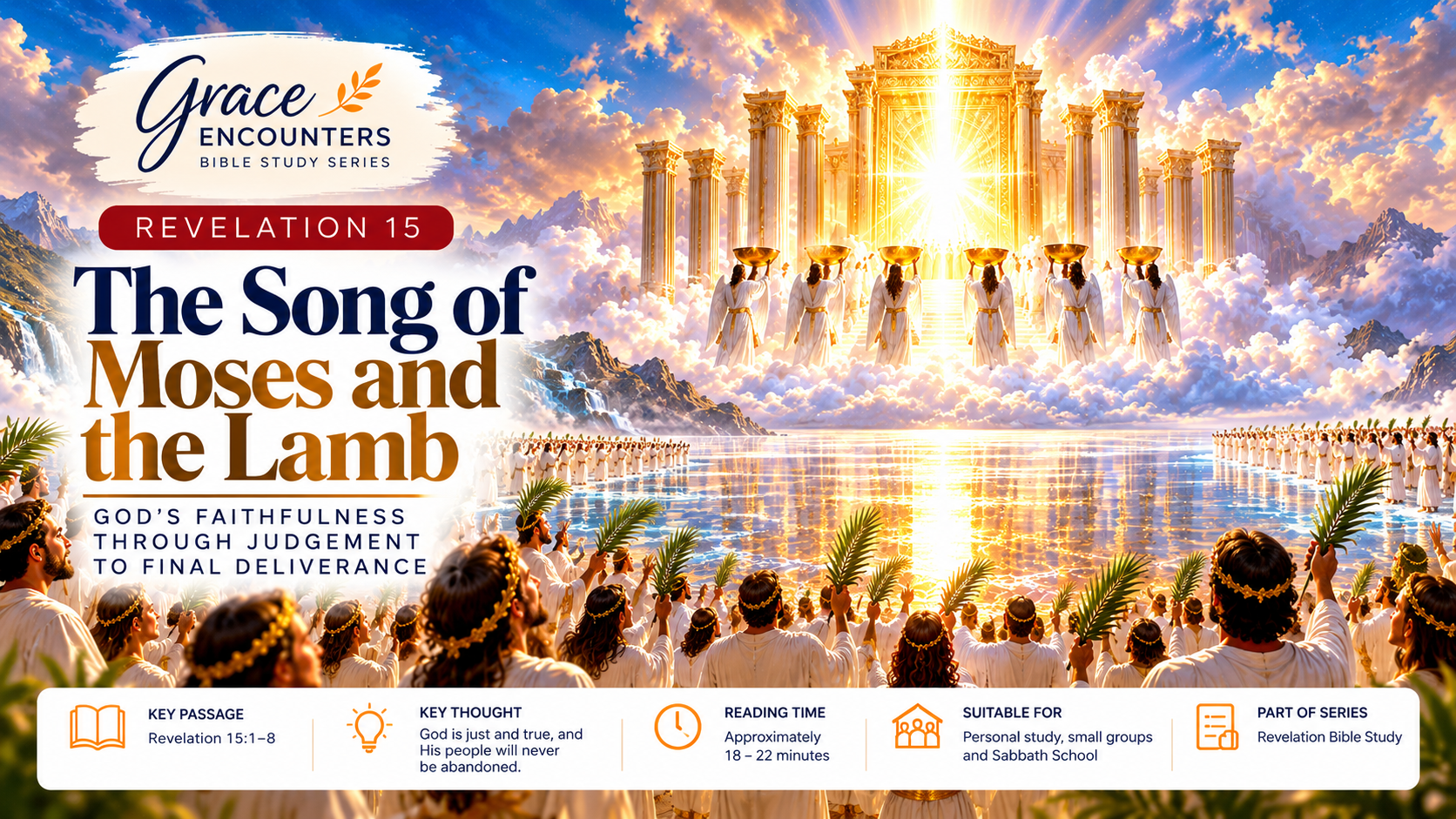
The redeemed are standing beside a sea of glass.
And they are singing.
They have overcome the beast, his image, his mark and the number of his name. They have endured the final conflict over worship and allegiance.
Yet their song is not about their suffering.
It is not about their courage.
It is about God.
“Great and marvellous are thy works, Lord God Almighty; just and true are thy ways, thou King of saints.”
Revelation 15:3, KJV
Before Revelation shows us the final expression of God’s judgement, it reminds us of His character.
His ways are just.
His ways are true.
And the Lamb remains at the centre of the story.
1. The Seven Last Plagues: Revelation 15:1
John begins:
“And I saw another sign in heaven, great and marvellous, seven angels having the seven last plagues; for in them is filled up the wrath of God.”
Revelation 15:1, KJV
The word last is significant.
These plagues bring God’s final judicial response to persistent rebellion towards its completion.
But to understand their significance, we must return to the first great deliverance of God’s people: the Exodus from Egypt.
The ten plagues of Egypt
When Moses confronted Pharaoh, the issue was not simply the freedom of an enslaved nation.
It was also a confrontation between the authority of the living God and Egypt’s religious and political system.
Pharaoh asked:
“Who is the LORD, that I should obey his voice to let Israel go?”
Exodus 5:2, KJV
The plagues answered that question.
In Exodus 12:12, God declared that He would execute judgement against the gods of Egypt.
The Egyptians worshipped various deities associated with the Nile, fertility, livestock, the sun and the natural world.
The plagues demonstrated that these supposed sources of life, protection and prosperity were powerless before the Creator.
The Nile became blood.
Frogs overwhelmed the land.
Livestock died.
Darkness covered Egypt, a particularly significant judgement in a civilisation where solar worship held an important place.
Finally, the death of the firstborn struck at the very heart of Egypt’s royal power and succession.
Not every plague can confidently be linked to one particular Egyptian deity. Nevertheless, Scripture explicitly presents the Exodus as God’s judgement against Egypt’s gods.
The underlying issue was worship and authority.
Who was truly God?
The first three plagues and the final seven
There is another detail worth examining.
During the first three Egyptian plagues, Scripture does not explicitly distinguish between the Egyptians and the Israelites.
It is therefore possible that both populations experienced them, although the text does not state this conclusively.
Before the fourth plague, however, God announced:
“And I will sever in that day the land of Goshen, in which my people dwell, that no swarms of flies shall be there.”
Exodus 8:22, KJV
From this point, Scripture repeatedly describes God distinguishing His people from Egypt.
Israel’s livestock were spared during the fifth plague (Exodus 9:4–6).
Goshen was spared the hail (Exodus 9:26).
Israel had light during the darkness (Exodus 10:23).
And during the final plague, the blood of the Passover lamb marked the households that would be spared (Exodus 12:13).
This produces an interesting pattern:
- The first three plagues have no explicitly recorded distinction.
- During the final seven, God begins explicitly distinguishing and protecting His people.
Revelation also describes seven last plagues.
Although Scripture does not explicitly state that Revelation’s seven plagues correspond numerically to Egypt’s final seven, the connection deserves careful consideration.
Revelation deliberately uses Exodus imagery.
Both accounts involve oppressive powers, contested worship, divine judgements and the deliverance of God’s people.
The parallel also raises an important question for our next study:
If the Egyptian plagues exposed the powerlessness of Egypt’s false gods, might the seven last plagues expose the false objects of trust and worship within end-time Babylon?
We will explore that question when we study Revelation 16.
For now, Revelation 15 directs our attention to something more important.
God knows those who belong to Him.
2. What Does the Wrath of God Mean?
The expression “the wrath of God” can be difficult to reconcile with the character of Jesus.
We have seen Christ’s compassion, His patience with sinners and His tears over Jerusalem.
How should we understand the wrath of this same God?
Returning to the Greek
The Greek word translated wrath in Revelation 15:1 is thymos (θυμός).
It can convey anger, fury, strong indignation or wrath.
Some translations use words such as indignation to communicate its meaning.
The Greek word does not literally mean judgement, however.
Therefore, we should not replace the biblical word with judgement and claim that this is its direct translation.
But within the context of Revelation 15, God’s wrath is expressed through His final judicial action against evil.
A helpful explanatory paraphrase would be:
“In these seven last plagues, God’s righteous indignation against persistent evil reaches its final judicial expression.”
The Greek verb translated “filled up” is related to teleō, meaning to complete, accomplish or bring something to its intended conclusion.
The emphasis is not that God has suddenly lost His temper.
His response to evil is reaching its appointed completion.
Does God stop loving those He judges?
This question takes us directly to the heart of God’s character.
Jesus wept over Jerusalem.
He knew the consequences of its rejection of Him, yet His response was not cold indifference.
“O Jerusalem, Jerusalem… how often would I have gathered thy children together… and ye would not!”
Matthew 23:37, KJV
Those final words are heartbreaking.
“Ye would not.”
God’s love does not disappear because people reject Him.
Consider the love of a parent.
A child may make terrible choices. Those choices may have serious consequences. A parent may be unable to prevent those consequences.
But love does not necessarily cease.
If imperfect human beings can experience such enduring love, how much greater is the love of God?
Scripture nevertheless teaches that God actively judges evil. His final judgement is not merely the passive consequence of human choices.
He will not permit sin, cruelty, oppression and suffering to continue eternally.
His judgement is consistent with His holiness, justice and love.
The God who judges is the same God who gave His Son to save humanity.
That is why the redeemed can sing:
“Just and true are Thy ways.”
They have come to understand that God’s final judgement does not contradict His character.
It vindicates His justice.
3. The Sea of Glass: Revelation 15:2
John continues:
“And I saw as it were a sea of glass mingled with fire: and them that had gotten the victory over the beast… stand on the sea of glass, having the harps of God.”
Revelation 15:2, KJV
The scene is remarkable.
These are the people who have overcome the beast’s system of deception and coercion.
Revelation 13 described the pressure placed upon those who refused to worship the beast.
They faced economic exclusion and the threat of death.
Yet Revelation 15 shows them victorious.
The sea of glass recalls the heavenly throne scene in Revelation 4:6.
Its appearance mingled with fire has prompted various interpretations, including associations with divine glory, judgement and the trials through which God’s people have passed.
The text does not explicitly explain the fire, so we should avoid being dogmatic about its symbolism.
What is clear is the identity of those standing there.
They have overcome.
And they are worshipping.
The suffering does not have the final word
There is something deeply moving about this picture.
After the greatest crisis in human history, the redeemed are not sitting beside the sea of glass rehearsing their suffering.
They are not celebrating their own strength.
They are glorifying God.
Their suffering was real.
Their trials were real.
But the centre of their testimony is God’s faithfulness.
The trauma does not have the final word.
God does.
4. The Song of Moses and the Lamb: Revelation 15:3–4
“And they sing the song of Moses the servant of God, and the song of the Lamb.”
Revelation 15:3, KJV
Why Moses?
Because the first great Exodus points towards the final deliverance.
After Israel crossed the Red Sea, Moses and the Israelites sang a song of praise.
“I will sing unto the LORD, for he hath triumphed gloriously.”
Exodus 15:1, KJV
They had stood trapped between Pharaoh’s army and the sea.
Humanly speaking, there was no escape.
But God made a way.
And on the other side, they sang.
Their song was not about how cleverly they had escaped.
It was about what God had done.
Revelation brings that imagery into the final conflict.
But now the song is called the Song of Moses and the Lamb.
The final Exodus is accomplished through Jesus Christ.
What do the redeemed sing?
Their song declares:
“Great and marvellous are thy works, Lord God Almighty; just and true are thy ways… Who shall not fear thee, O Lord, and glorify thy name? for thou only art holy.”
Revelation 15:3–4, KJV
The song acknowledges God’s works, His justice, His truth and His holiness.
It also declares that all nations will come and worship before Him because His judgements have been revealed.
This anticipates the universal acknowledgement of God’s righteousness.
Throughout the great controversy, Satan has challenged God’s character and government.
But the redeemed testify that God has been just and true.
The final song is not about humanity’s greatness.
It is about the Lamb.
5. The Heavenly Sanctuary Opens: Revelation 15:5–7
John now turns his attention to the heavenly sanctuary.
“And after that I looked, and, behold, the temple of the tabernacle of the testimony in heaven was opened.”
Revelation 15:5, KJV
The seven angels emerge from the temple, clothed in pure, bright linen and wearing golden girdles.
One of the four living creatures gives them seven golden bowls filled with the wrath of God.
The sanctuary imagery is important.
Throughout Revelation, the heavenly sanctuary has been associated with God’s throne, worship, the prayers of the saints, judgement and Christ’s ministry.
Now the sanctuary becomes the setting for the preparation of the final plagues.
The imagery recalls the tabernacle of the Old Testament, where God’s presence dwelt among His people.
It also brings to mind the Day of Atonement, or Yom Kippur, when the sanctuary was cleansed and the covenant community was called to solemn self-examination.
Within the historic Seventh-day Adventist understanding of prophecy, Christ’s heavenly ministry includes a final phase of judgement and the completion of His priestly intercession concerning sin.
Revelation 15 leads us towards the conclusion of that ministry.
6. When the Sanctuary Is Filled With Smoke: Revelation 15:8
“And the temple was filled with smoke from the glory of God, and from his power; and no man was able to enter into the temple, till the seven plagues of the seven angels were fulfilled.”
Revelation 15:8, KJV
This is one of the most solemn verses in the chapter.
The imagery recalls two earlier events.
When the wilderness tabernacle was completed, God’s glory filled it so completely that Moses could not enter (Exodus 40:34–35).
When Solomon’s temple was dedicated, the priests could not continue ministering because the glory of God filled the house (2 Chronicles 5:13–14).
In Revelation 15, the heavenly sanctuary is likewise filled with God’s glory.
But John adds an important detail.
No one can enter until the seven plagues are completed.
Does this mark the close of probation?
Within the historic Adventist interpretation, Revelation 15:8 is understood as depicting the completion of Christ’s intercessory ministry and the close of human probation.
The seven angels have emerged from the sanctuary.
They have received the bowls.
The sanctuary becomes inaccessible.
Then, in Revelation 16:1, the command is given to pour out the plagues.
The sequence therefore places the closure of the sanctuary before the plagues begin, with that condition continuing throughout them.
We should recognise that the verse itself does not explicitly use the expression close of probation. This understanding comes from reading the sanctuary imagery alongside the broader prophetic framework of Revelation, Daniel and Hebrews.
In that interpretation, the time for changing one’s final allegiance has ended.
The gospel appeal has accomplished its work.
Human decisions have become settled.
The final judgements now follow.
But this raises a question that must never be overlooked.
Does the completion of Christ’s intercessory ministry mean that God’s people must face the final crisis without Jesus?
Absolutely not.
7. Christ’s Intercession Ends, but His Presence Never Does
This distinction is essential.
Hebrews 7:25 tells us:
“Wherefore he is able also to save them to the uttermost that come unto God by him, seeing he ever liveth to make intercession for them.”
Romans 8:34 also speaks of the risen Christ interceding for believers.
These passages affirm the enduring sufficiency of Christ’s saving work and His living ministry on behalf of His people.
Within the Adventist understanding of the close of probation, His priestly intercession concerning the forgiveness of sin and the determination of humanity’s final destiny reaches its conclusion.
But the completion of that particular ministry does not mean Christ ceases to love, sustain or remain present with His redeemed.
His work of intercession for sin reaches its completion. His relationship with His children does not.
There is no longer a case being decided.
But there is still a Saviour who keeps His people.
The promise Jesus made
Jesus said:
“Lo, I am with you alway, even unto the end of the world.”
Matthew 28:20, KJV
And Hebrews 13:5 records the promise:
“I will never leave thee, nor forsake thee.”
Nothing in Revelation 15 cancels those promises.
The final generation will not survive because they have become sufficiently righteous to live independently of Christ.
They will stand because their lives are entirely dependent upon Him.
The difference is not that Jesus once sustained them and must now leave them to sustain themselves.
Rather, His ministry concerning sin has reached its completion, while His faithful care for His redeemed continues.
There will come a time when Christ’s intercessory ministry for sin is complete. There will never come a time when His children must face anything without Him.
8. The Prayer of Jesus in John 17
This understanding becomes especially precious when we return to Jesus’ prayer shortly before His crucifixion.
In John 17, Jesus prayed for His disciples.
But He also prayed for those who would later believe through their testimony.
That includes believers throughout the generations.
He prayed:
“I pray not that thou shouldest take them out of the world, but that thou shouldest keep them from the evil.”
John 17:15, KJV
Notice what Jesus did not request.
He did not ask the Father to remove His followers from every difficult circumstance.
He asked that they be kept.
Kept, not abandoned.
Jesus then prayed:
“That they all may be one; as thou, Father, art in me, and I in thee, that they also may be one in us.”
John 17:21, KJV
And again:
“I in them, and thou in me, that they may be made perfect in one.”
John 17:23, KJV
The security of God’s people is grounded in their relationship with Christ.
Their hope is not that they will become independent of Him.
It is that they will remain united with Him.
That is why the close of probation should never be taught as though believers must eventually become strong enough to survive without Jesus.
The One who prayed for His followers to be kept will not abandon them in their greatest hour of need.
9. The Seal of God: These Are Mine
The Exodus parallel also helps us understand the seal of God.
In Revelation 7, the destructive winds are restrained until God’s servants have been sealed.
The seal identifies those who belong to God.
Revelation 14 describes the faithful as having the Father’s name in their foreheads.
The mark of the beast and the seal of God represent opposing allegiances.
But the seal also carries an assurance of divine ownership and protection.
It says something profoundly personal:
These are Mine.
Just as God distinguished His people during the latter plagues in Egypt, Revelation presents the final plagues as judgements directed against the rebellious world rather than against God’s faithful people.
Revelation 16:2 explicitly identifies the recipients of the first plague as those who bear the mark of the beast and worship his image.
The seal does not mean that God’s children will never experience suffering or hardship.
It does mean that their final destiny is secure in Him.
They are not forgotten.
They are not abandoned.
They belong to the Lamb.
Psalm 91 gives beautiful language to this assurance:
“I will be with him in trouble; I will deliver him, and honour him.”
Psalm 91:15, KJV
God does not merely promise deliverance.
He promises His presence.
10. Preparing for the Future by Knowing Jesus Today
One of the most personal discoveries in this chapter is that preparation for the final crisis involves more than understanding prophecy.
Understanding Revelation matters.
We should study its symbols, its warnings and its description of the final conflict.
But prophetic knowledge alone cannot sustain a relationship with God.
We need to know the One whom prophecy reveals.
There is a difference between knowing what may happen and knowing Who will be with us when it happens.
Learning from the dark places
When we look back over our lives, we may remember experiences we would never willingly choose to repeat.
Times of grief.
Times of fear.
Times when the future seemed uncertain.
Times when we could not understand what God was doing.
Yet sometimes those very experiences become the places where we most clearly recognise His faithfulness.
Job did not understand the suffering he experienced.
But he declared:
“For I know that my redeemer liveth.”
Job 19:25, KJV
He did not say that he understood everything.
He knew his Redeemer.
And that is the foundation of faith.
We do not need to pretend that suffering is easy.
We do not need to deny our tears.
But we can remember that God has remained faithful through every experience He has brought us through.
Faith remembers
David remembered the lion and the bear when he faced Goliath.
Israel was repeatedly instructed to remember God’s deliverance from Egypt.
The Psalms frequently recall God’s past faithfulness during present distress.
Remembering is an important part of trusting.
Not because the next trial will resemble the previous one.
But because God’s character does not change.
When another dark road comes, faith can say:
I recognise this Presence.
I have met Him in dark places before.
He did not leave me then.
He will not leave me now.
This is not confidence in our ability to endure.
It is confidence in the faithfulness of God.
11. Practising the Muscles of Faith
Perhaps the preparation God desires is taking place in our ordinary lives.
Every disappointment becomes an opportunity to turn towards Him.
Every unanswered question becomes an invitation to trust.
Every uncertain tomorrow becomes another opportunity to remember His faithfulness.
The goal is not to develop a faith that never experiences fear.
It is to develop the habit of turning towards Jesus whenever fear comes.
To seek Him so naturally that it becomes like breathing.
To wake each morning with gratitude.
To learn to worship before worrying.
To rest in His character when His purposes are difficult to understand.
And to remember that the One who has kept us in the past remains faithful today.
We do not need to know that we will be strong enough for everything the future may bring.
We need to know Jesus.
The essential preparation for the final crisis is not independence from Christ, but an ever-deepening dependence upon Him.
12. Grace Encounters: The Song We Are Learning Now
Revelation 15 begins with judgement approaching.
But the chapter’s most beautiful picture is not of the plagues.
It is of the redeemed singing.
They have passed through the final conflict.
They have experienced God’s deliverance.
And now they stand beside the sea of glass.
They do not sing about their own achievements.
They sing about His faithfulness.
Perhaps our lives today are rehearsals for that song.
Every time we discover that God is faithful, we learn another part of it.
Every time He carries us through something we thought we could not endure, we have another reason to praise Him.
And one day, when faith becomes sight, we will understand far more fully than we do now.
Then our testimony will not be about how strong we were.
It will be about how faithful He was.
The worst chapter in human history will not ultimately become a story about the power of Satan.
It will become another testimony to the faithfulness of God and the victory of the Lamb.
A Prayer: He Will Hold Me Fast
Father,
Keep my eyes on Jesus.
Teach me to look towards You so naturally that seeking You becomes like breathing.
When I wake each morning, let my first awareness be of Your goodness, Your mercy and Your faithfulness.
Exercise the muscles of my faith now.
In small disappointments, teach me to trust You.
In uncertainty, teach me to rest in You.
When prayers seem unanswered, teach me to wait for You.
And when I cannot understand what You are doing, remind my heart of what it already knows:
My Redeemer lives.
You have been faithful before.
You are faithful today.
You will still be faithful tomorrow.
Father, make gratitude the instinctive language of my heart.
Give me joy that does not depend upon circumstances and peace that does not require explanations.
When difficult days come, do not let fear become the place where my eyes settle.
Turn them back to Jesus.
When I cannot see the road ahead, remind me that I do not need to see the whole road.
I only need to know the One who walks it with me.
And Lord, when my faith feels weak,
Hold me fast.
You promised never to leave or forsake Your children.
Jesus prayed that we would not be taken out of the world, but that You would keep us in it.
So keep me, Father.
Keep my heart tender.
Keep me close enough to hear Your voice.
Keep me looking towards the Lamb.
And if one day I must walk through circumstances darker than anything I have ever known, let something deep within me recognise Your presence and say:
I know this God.
I have met Him in dark places before.
He did not leave me then.
He will not leave me now.
May my life become a rehearsal for the song beside the sea of glass.
Until gratitude becomes more natural than fear.
Until worship becomes more natural than worry.
And when everything is finally over, may my testimony not be about how strong I was, but about how faithful You were.
“Great and marvellous are Thy works, Lord God Almighty; just and true are Thy ways.”
Keep my eyes on Jesus until faith becomes sight.
In Jesus’ precious name,
Amen.
Scripture for Further Thought
Take time to explore these passages alongside this study. Compare Scripture with Scripture, follow the connections, and allow the Bible to illuminate its own message.
The Exodus and divine protection
- Exodus 5:1–2: Pharaoh challenges God’s authority.
- Exodus 7–12: The ten plagues of Egypt.
- Exodus 12:12–13: Judgement upon Egypt’s gods and the Passover lamb.
- Exodus 15:1–21: The Song of Moses.
The heavenly sanctuary and Christ’s ministry
- Exodus 40:34–35: God’s glory fills the tabernacle.
- 2 Chronicles 5:13–14: God’s glory fills Solomon’s temple.
- Daniel 7:9–14: The heavenly judgement scene.
- Hebrews 7:25: Christ’s intercession.
- Hebrews 8–9: Christ’s heavenly priestly ministry.
God’s promise to keep His people
- Psalm 91:1–16: Dwelling under the protection of the Most High.
- John 17:11–23: Jesus prays for His followers.
- Romans 8:31–39: Nothing can separate us from the love of God.
- Hebrews 13:5: God’s promise never to forsake His people.
- Revelation 7:1–4: The sealing of God’s servants.
- Revelation 14:1–5: The Lamb and His faithful followers.
The final judgement and deliverance
- Revelation 14:6–20: The final messages and harvest.
- Revelation 15:1–8: The Song of Moses and the Lamb.
- Revelation 16:1–21: The seven last plagues.
Questions for Personal Reflection
- When I look back over difficult experiences, can I identify moments when God sustained me?
- Do I sometimes confuse God’s judgement against evil with a loss of His love?
- How does Jesus’ prayer in John 17 change my understanding of the final time of trouble?
- Am I preparing for the future primarily by gathering prophetic information, or by developing a deeper relationship with Jesus?
- What spiritual habits can help me turn towards Christ more naturally when difficulties arise?
- If my life were a song of testimony, would its central theme be my suffering or God’s faithfulness?
Continue the Journey
Previous study: Revelation 14 — The Final Call to Worship the Creator
Next study: Revelation 16 — The Seven Last Plagues: The Final Judgements and the Deliverance of God’s People
As we move into Revelation 16, we will return to the Exodus and examine whether the seven last plagues, like the Egyptian plagues, expose the false worship and misplaced trust of a world in rebellion against God.
But we carry one assurance with us:
The Lamb who has walked with His people throughout history will not abandon them in its final crisis.
Grace Encounters — Meeting Jesus in His Word.