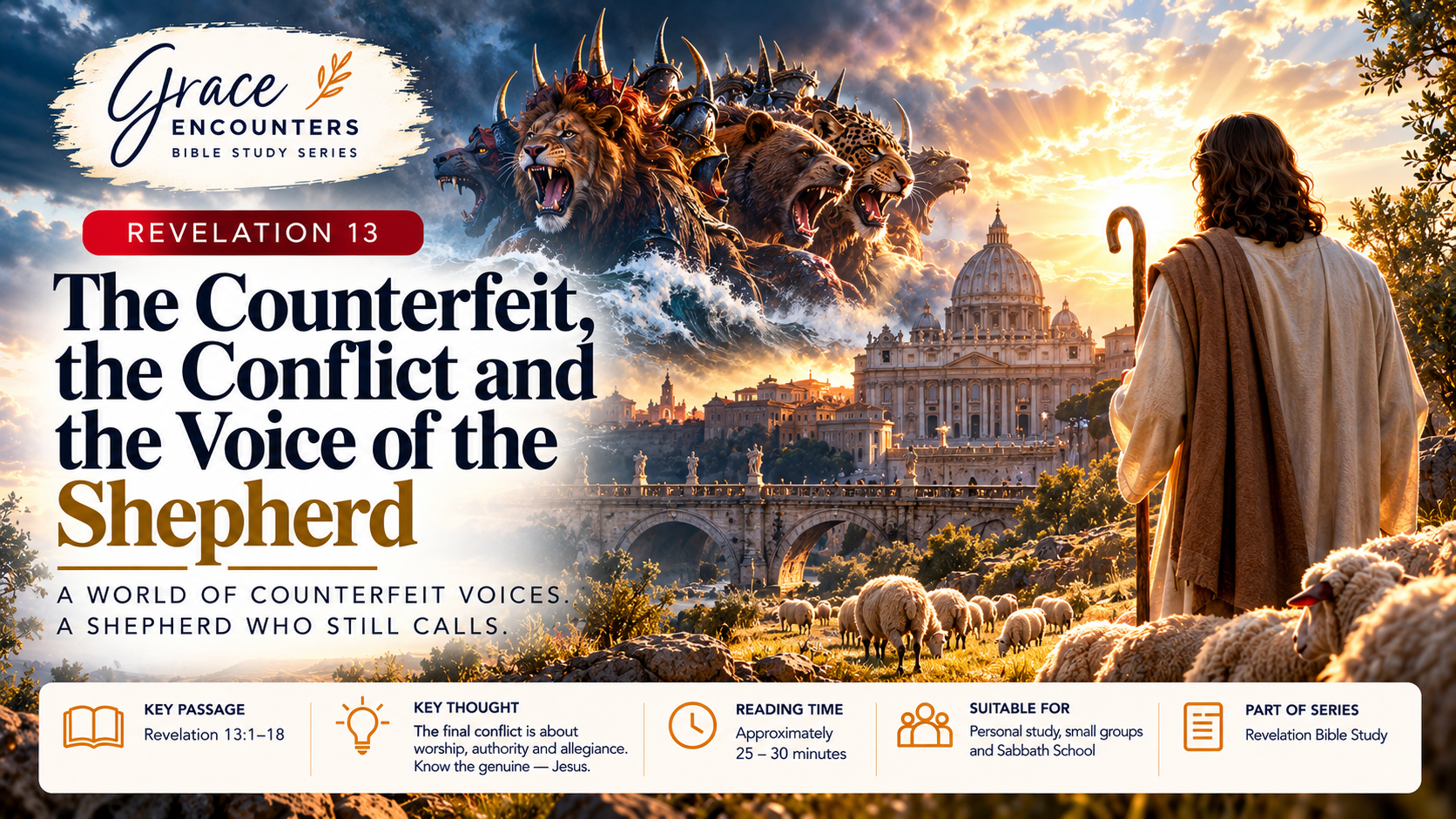
A Grace Encounters Bible Study | Revelation 13:1–18
Key Scripture: Revelation 13:1–18
Reading time: Approximately 25–30 minutes
Key Thought: The final conflict in Revelation is not simply about political powers, religious institutions or prophetic events. It is about worship, authority and allegiance. Satan seeks to counterfeit what belongs to God, but our greatest protection against deception is knowing Jesus, His Word and His character.
Introduction: The Conflict Behind the Counterfeit
Revelation 13 is one of the most discussed and sometimes most misunderstood chapters in Scripture.
It introduces two beasts, a deadly wound, a period of forty-two months, an image, a mark, restrictions on buying and selling, and the mysterious number 666.
These symbols have generated centuries of debate. Protestant Reformers, historicist interpreters and Seventh-day Adventist scholars have studied them extensively.
But before we attempt to identify the powers described, we must establish an essential principle:
Let Scripture interpret Scripture.
Prophetic symbols should not be assigned meanings simply because those meanings support a preferred interpretation. We must first ask what the Bible itself reveals.
Revelation 13 also belongs to a larger story.
In Revelation 12, Satan, represented by the dragon, attempts to destroy Christ. Having failed, he persecutes the woman and ultimately turns against the remaining members of her offspring.
Revelation 12:17 describes them as those who:
“Keep the commandments of God, and have the testimony of Jesus Christ.” (KJV)
Revelation 13 reveals how the dragon continues that conflict through earthly powers.
Yet the central issue is not the greatness of Satan’s power.
It is the question of who receives our worship.
1. The Beast Rising From the Sea (Revelation 13:1–2)
John sees a beast emerging from the sea, possessing seven heads, ten horns and ten crowns. Its appearance combines the characteristics of a leopard, a bear and a lion.
The dragon gives this beast his power, throne and great authority.
What does a beast represent?
Daniel 7 provides the starting point.
Daniel sees four beasts rising from the sea. The angel explains:
“These great beasts, which are four, are four kings, which shall arise out of the earth.” (Daniel 7:17, KJV)
Daniel 7:23 identifies the fourth beast as a fourth kingdom.
Therefore, in this prophetic setting, a beast represents a ruling power or kingdom.
The ten horns are likewise explained:
“And the ten horns out of this kingdom are ten kings that shall arise.” (Daniel 7:24, KJV)
The horns represent kings or ruling powers arising from the kingdom.
What does the sea represent?
Revelation 17:15 associates waters with peoples, multitudes, nations and languages.
Daniel 7 also depicts the beasts emerging from a turbulent sea.
Together, these passages support understanding the sea as a setting of populated nations and political upheaval.
However, Revelation 17 directly interprets the waters in its own vision. Applying that meaning to Revelation 13 is a reasonable contextual connection rather than an explicit definition supplied in chapter 13.
Why the leopard, bear and lion?
Daniel 7 describes four successive kingdoms, traditionally identified in historicist interpretation as:
- Babylon, represented by the lion.
- Medo-Persia, represented by the bear.
- Greece, represented by the leopard.
- Rome, represented by the terrifying fourth beast.
John describes the animals in reverse order: leopard, bear and lion.
The imagery suggests that the Revelation 13 beast incorporates characteristics of the preceding kingdoms.
This is not simply another political power. It represents a concentration of worldly authority opposed to God’s kingdom.
The dragon’s authority
Revelation 13:2 tells us that the dragon gives the beast its power, throne and authority.
Revelation 12:9 has already identified the dragon as Satan.
Therefore, the ultimate spiritual source of the beast’s authority is the dragon.
This does not mean that every person associated with the historical institution represented by the beast knowingly serves Satan. Prophetic symbolism addresses the character and activities of the power being described, not the spiritual condition of every individual within it.
The essential question is whether an earthly authority remains subject to God or begins claiming authority that belongs to Him.
2. The Deadly Wound and Its Healing (Revelation 13:3–4)
John sees one of the beast’s heads apparently wounded to death.
The wound is healed, and the world marvels and follows the beast.
The Greek language is particularly interesting.
The word used for the wound comes from sphazō, meaning to slaughter or slay.
It is related to the language used of the Lamb who was slain in Revelation 5:6.
This creates a striking contrast.
Christ was slain and lives.
The beast appears to receive a fatal wound and subsequently recovers.
Christ is worthy of worship because of His sacrifice and victory.
The beast’s recovery produces wonder and worship.
The imagery suggests a counterfeit of Christ’s death and victorious life.
The historical interpretation
Within Protestant historicism, particularly the later Adventist interpretation, the wound has been associated with the events of 1798.
French revolutionary forces under General Louis-Alexandre Berthier entered Rome. The Roman Republic was proclaimed, papal temporal government was displaced, and Pope Pius VI was removed from Rome.
Pius VI subsequently died in exile in France in 1799.
These events constituted a severe blow to papal political authority.
However, the papacy did not cease to exist in 1798. Pius VII was elected in 1800.
The distinction matters because Revelation describes a death-like wound followed by recovery, not necessarily the complete disappearance of an institution.
Was the wound healed in 1929?
The Lateran Treaty of 1929 established Vatican City as a sovereign state and resolved the long-standing dispute between the Holy See and the Italian government.
Historicist Adventist interpreters frequently associate this event with the healing of the wound.
However, Revelation does not specify 1929.
The restoration of papal influence may be understood as a historical process rather than an event completed on one date.
The prophetic emphasis is on the beast’s recovery and the extraordinary allegiance associated with it.
3. The Question of Worship (Revelation 13:4)
John records the world’s response:
“Who is like unto the beast? who is able to make war with him?” (Revelation 13:4, KJV)
This language echoes questions Scripture reserves for God.
Exodus 15:11 asks:
“Who is like unto thee, O LORD, among the gods?” (KJV)
The name Michael also carries the meaning, “Who is like God?”
Revelation therefore presents a profound counterfeit.
The question that should direct worship towards the Creator is now directed towards an earthly power.
The beast is not merely exercising authority. It is receiving allegiance and worship that belong to God.
This is the central conflict of Revelation 13.
4. Blasphemy Against God (Revelation 13:5–6)
The beast receives a mouth speaking great things and blasphemies.
John says that it blasphemes God’s name, His tabernacle and those who dwell in heaven.
What is blasphemy?
The Greek word blasphēmia refers to slander, abusive speech or speech that dishonours someone. When directed against God, it involves dishonouring His name or making claims that violate His divine authority.
Scripture provides important examples.
In John 10:33, Jesus’ opponents accuse Him of blasphemy because, in their understanding, He was a man claiming to be God.
Their accusation was false because Jesus truly is divine. Nevertheless, the incident shows that claiming divine status was regarded as blasphemous when made by someone who was merely human.
In Mark 2:5–7, Jesus forgives the paralysed man’s sins.
The scribes object:
“Who can forgive sins but God only?” (Mark 2:7, KJV)
Again, Jesus possesses the authority He exercises.
But the principle is important: divine prerogatives cannot legitimately be claimed independently of God.
Why does John mention the tabernacle?
This was one of the most significant discoveries in our study.
The earthly sanctuary was the place where the sacrificial and priestly system illustrated God’s provision for dealing with sin.
The sinner brought a sacrifice.
The priest ministered on behalf of the sinner.
The sacrificial blood represented the cost of atonement.
God provided forgiveness and reconciliation.
Leviticus 4 repeatedly connects the priestly ministry of atonement with forgiveness.
But the earthly sanctuary pointed towards something greater.
Hebrews 8:1–2 identifies Jesus as our High Priest and Minister of the heavenly sanctuary.
Hebrews 7:25 teaches that He lives to intercede for those who come to God through Him.
And 1 Timothy 2:5 declares:
“For there is one God, and one mediator between God and men, the man Christ Jesus.” (KJV)
Jesus is our Sacrifice.
Jesus is our High Priest.
Jesus is our Mediator.
Through Jesus we receive forgiveness and reconciliation with God.
The sanctuary and the counterfeit
If Christ’s heavenly ministry is central to salvation, then any religious system that claims independent divine prerogatives or displaces Christ’s unique mediatorial authority raises serious theological questions.
This is an important part of the historicist Protestant critique of papal claims.
However, Revelation 13:6 does not explicitly describe a particular practice of confession, priesthood or absolution. The connection must be developed through biblical theology and historical examination.
We should also distinguish Christ’s unique authority to forgive sins from the biblical ministry of believers who proclaim forgiveness in His name.
The deeper issue is whether human religious authority points sinners directly to Christ or claims a position that properly belongs to Him.
And we must remember the original purpose of the sanctuary:
“And let them make me a sanctuary; that I may dwell among them.” (Exodus 25:8, KJV)
God’s desire has always been to dwell with His people.
The sanctuary was never merely about religious procedures.
It was about restoring a broken relationship.
5. The Forty-Two Months (Revelation 13:5)
John says the beast receives authority to continue for forty-two months.
The same prophetic period appears elsewhere in Scripture.
| Scripture | Prophetic period |
|---|---|
| Daniel 7:25 | Time, times and half a time |
| Revelation 11:2 | Forty-two months |
| Revelation 11:3 | 1,260 days |
| Revelation 12:6 | 1,260 days |
| Revelation 12:14 | Time, times and half a time |
| Revelation 13:5 | Forty-two months |
Using the symbolic prophetic convention of thirty-day months:
42 months × 30 days = 1,260 days.
Three and a half prophetic years likewise equal 1,260 days.
The day-year principle
Numbers 14:34 and Ezekiel 4:6 contain examples in which days symbolise years.
Historicist interpreters apply this principle to the symbolic periods of Daniel and Revelation, understanding the 1,260 days as 1,260 years.
The Bible establishes the use of day-year symbolism in particular prophetic settings. Its application to Revelation 13 is an interpretative conclusion, not an explicit statement in the chapter.
AD 538–1798
The traditional Adventist historicist interpretation identifies the 1,260 years with the period AD 538–1798.
AD 538 is associated with the withdrawal of the Ostrogoths from their siege of Rome, during the Byzantine reconquest under Justinian.
AD 1798 is associated with the French overthrow of papal temporal government in Rome.
The dates produce an interval of 1,260 years.
However, the historical developments were gradual.
The Ostrogoths were not completely destroyed in 538, and papal supremacy did not suddenly appear fully developed that year.
Therefore, the dates should be presented as a historicist interpretation of the prophetic period, supported by particular historical milestones, rather than dates explicitly supplied by Scripture.
6. The Reformation and the Prophetic Interpretation
An important part of our study was recognising that the historicist understanding of Antichrist did not originate with Seventh-day Adventism.
During the Protestant Reformation, Martin Luther and other Reformers identified the papacy with the antichristian power described in Scripture.
They connected passages such as Daniel 7, 2 Thessalonians 2 and Revelation with the development of ecclesiastical authority within Christianity.
The Reformers did not agree on every prophetic detail.
Nor did they all use the later Adventist chronology of AD 538–1798.
Nevertheless, the broader interpretation existed centuries before the Seventh-day Adventist Church was established.
Isaac Newton, writing long before Adventism, also interpreted the 1,260 prophetic days as years and connected the prophetic power with developments in papal history.
He considered different chronological starting points.
This demonstrates that the historicist framework and the precise dating of its fulfilment are related but separate questions.
What should we conclude?
The historicist interpretation deserves serious examination because of its longstanding biblical and historical arguments.
But our confidence must ultimately rest on Scripture, not simply on the authority of Reformers, Adventist pioneers or modern commentators.
We must test every interpretation against the Word of God.
7. War Against the Saints (Revelation 13:7)
John writes:
“And it was given unto him to make war with the saints, and to overcome them…” (Revelation 13:7, KJV)
Daniel 7:21 uses remarkably similar language concerning the little horn.
This is another strong connection between the two prophecies.
Throughout history, religious and political powers have sometimes combined their authority to compel conformity.
The historicist interpretation sees the medieval persecution of dissenting Christians as part of the fulfilment of these prophecies.
But persecution also raises a personal question.
What happens when remaining faithful to God becomes costly?
This question becomes increasingly important in the second half of Revelation 13.
8. The Beast Rising From the Earth (Revelation 13:11–12)
John sees another beast rising from the earth.
Unlike the first beast, it has two horns like a lamb.
But it speaks like a dragon.
The contrast is striking.
Its appearance suggests gentleness or innocence.
Its speech reveals the dragon’s character.
The historicist interpretation
Seventh-day Adventist historicism traditionally identifies this second beast with the United States of America.
Within that interpretation, its emergence from the earth contrasts with the first beast’s emergence from the populated sea, and its two lamb-like horns are commonly associated with civil and religious liberty.
Its later dragon-like speech is interpreted as the use of coercive political power to enforce religious conformity.
This identification is not explicitly named in Revelation. It is a historical interpretation based on the beast’s characteristics and its place in the prophetic sequence.
Appearance versus character
The second beast introduces another important warning.
Something can appear gentle, Christian and morally respectable while exercising authority in a manner contrary to Christ.
Jesus warned about false prophets who appear in sheep’s clothing but inwardly are ravening wolves (Matthew 7:15).
The true test is not appearance alone.
It is the character revealed through words, actions and allegiance.
9. The Image of the Beast (Revelation 13:13–15)
The second beast performs great signs and deceives those who dwell on the earth.
It then directs people to make an image of the first beast.
The image is given power to speak and to cause those who refuse to worship it to be killed.
What is an image?
An image represents or resembles something else.
Within the historicist interpretation, the image of the beast represents a religious-political arrangement that reproduces the coercive characteristics of the first beast.
Religious authority seeks the support of civil power to enforce its demands.
The critical issue is not simply that religious people participate in public life.
It is the use of coercive authority to compel religious worship or conscience.
The danger of deceptive signs
Revelation 13:13–14 describes signs that deceive.
This reminds us that supernatural manifestations, impressive events and apparent miracles are not sufficient proof that a message comes from God.
Jesus Himself warned about deceptive signs in Matthew 24:24.
The Bible directs us to test spiritual claims against God’s revealed truth.
A message that contradicts God’s Word does not become true because it is accompanied by an extraordinary sign.
10. The Mark of the Beast (Revelation 13:16–17)
John describes a mark received on the right hand or forehead.
Without it, people cannot buy or sell.
This is where the prophecy becomes intensely practical.
The forehead and the hand
The forehead is associated with the mind, convictions and allegiance.
The hand naturally suggests actions and outward conduct.
Within the historicist understanding, the two locations represent different forms of submission.
A person may accept a false system because they believe in its authority.
Another may comply outwardly because resistance is too costly.
Revelation does not explicitly define the forehead and hand in these terms, but the interpretation is consistent with the broader biblical symbolism of thoughts, allegiance and actions.
There is an important contrast.
God’s servants are sealed in their foreheads (Revelation 7:3).
The beast’s mark may be received on the forehead or the hand.
The contrast invites us to consider the difference between genuine allegiance and outward conformity.
What about the Sabbath and Sunday?
Within Seventh-day Adventist historicism, the final mark of the beast is connected with enforced Sunday observance in opposition to God’s Sabbath commandment.
The biblical foundation for this interpretation includes:
- The Sabbath as a memorial of creation (Exodus 20:8–11).
- The Sabbath as a sign of God’s sanctifying work (Ezekiel 20:12).
- The little horn’s attempt to change times and law (Daniel 7:25).
- The call to worship the Creator (Revelation 14:7).
- The contrast between God’s commandments and the beast’s authority (Revelation 14:9–12).
Historically, Sunday observance developed within Christianity over several centuries. Constantine’s civil Sunday-rest legislation in AD 321 and later ecclesiastical regulations are important evidence of that development.
However, Revelation 13 does not explicitly use the words Sabbath, Sunday or Sunday law.
The identification is a conclusion drawn from the wider historicist interpretation of biblical prophecy.
It is also important to distinguish present-day Sunday worshippers from the prophetic warning about future coercion.
A person’s current day of worship is not, by itself, proof that they have received the mark of the beast.
The biblical controversy concerns informed allegiance, worship and obedience when God’s authority is brought into conflict with human demands.
11. Buying and Selling: When Faithfulness Becomes Costly
Revelation 13:17 declares that no one may buy or sell without the required mark, name or number.
We spent considerable time reflecting on this.
Economic exclusion is a powerful form of coercion.
A person may be willing to endure criticism or social rejection.
But what happens when obedience to conscience threatens their employment, livelihood or ability to provide food for their family?
The pressure becomes intensely personal.
Someone may reason:
I don’t agree with this, but I cannot lose my job.
I have children to feed.
Surely God will understand if I comply outwardly.
This is where the distinction between the forehead and hand becomes particularly meaningful in the historicist reading.
The person may not inwardly agree with the false authority, yet outwardly act in conformity with its demands.
Daniel’s three friends
Daniel 3 gives us a remarkable biblical example.
Nebuchadnezzar commanded everyone to bow before the golden image.
Shadrach, Meshach and Abednego refused.
They could have attempted to disguise their refusal.
They could have bent down while pretending to adjust their clothing.
They might have argued that outward compliance did not reflect their inward convictions.
But they understood that worship involved both allegiance and action.
Their answer was extraordinary:
“But if not, be it known unto thee, O king, that we will not serve thy gods, nor worship the golden image which thou hast set up.” (Daniel 3:18, KJV)
But if not.
They trusted God’s ability to deliver them.
But their obedience did not depend on whether He chose to deliver them from the furnace.
Their loyalty belonged to God.
From economic pressure to persecution
Revelation 13 describes both economic exclusion and the threat of death.
History demonstrates that coercive systems can escalate when lesser forms of pressure fail to secure conformity.
Nevertheless, we should not claim that every modern economic restriction is a direct fulfilment of Revelation 13.
The prophecy specifically connects these restrictions with enforced worship and allegiance to the beast.
That distinction is essential.
The warning is not that every development in government, finance or technology is automatically prophetic.
The warning is that economic and political power can become instruments of religious coercion.
And when that happens, God’s people will need a faith that cannot be purchased, intimidated or negotiated away.
12. The Number 666 (Revelation 13:18)
John concludes:
“Here is wisdom. Let him that hath understanding count the number of the beast: for it is the number of a man; and his number is Six hundred threescore and six.” (KJV)
The number 666 has generated numerous interpretations.
Some interpreters associate it with numerical values assigned to names or titles.
Others emphasise its symbolic relationship to human imperfection and counterfeit claims to divine completeness.
The historicist tradition has included attempts to associate the number with papal titles, particularly Vicarius Filii Dei. Such calculations depend on the selected title and numerical method and should not be presented as an independently established identification.
The text itself calls for wisdom and understanding.
We should therefore resist sensational claims based on speculative calculations.
The number belongs within the larger prophetic portrait.
The beast seeks authority and worship that belong to God.
The essential issue remains the same:
Will humanity worship the Creator or the counterfeit?
13. The Seal of God and the Character of Christ
Revelation 13 becomes clearer when read alongside Revelation 14.
In Revelation 14:1, the Lamb stands on Mount Zion with those who have His Father’s name written in their foreheads.
The contrast is deliberate.
The beast has its mark.
God’s people bear His name.
In Scripture, a name frequently communicates identity and character.
God’s people are identified by their relationship with Him.
This reminds us that true worship cannot be reduced to outward religious observance.
A person may observe the Sabbath while remaining distant from the heart of God.
Another may possess extensive prophetic knowledge without experiencing genuine surrender.
The Sabbath is a sign of the God who creates, delivers and sanctifies.
But the sign must never replace the relationship to which it points.
We are not saved by knowing the correct prophetic interpretation. We are saved through Jesus Christ.
And those who belong to Him are called to follow Him in faith and obedience.
14. The Remnant: A People Who Follow the Lamb
Revelation 12:17 describes the remnant in terms of God’s commandments and the testimony of Jesus.
Revelation 14:12 describes the saints through their perseverance, obedience and faith in Jesus.
These characteristics matter more than a denominational label alone.
Within Adventist theology, the remnant has a particular prophetic mission. Yet Scripture also recognises God’s people beyond the boundaries of any one visible religious organisation.
Revelation 18:4 contains the appeal:
“Come out of her, my people.” (KJV)
Notice that God calls them My people even before they respond to the invitation.
God knows those who belong to Him.
The final conflict is not an invitation to despise people who worship differently.
It is a call to recognise God’s authority, respond to His truth and remain faithful to Jesus.
15. Recognising the Counterfeit: A Lesson From the Bank
During our study, I remembered something from my years working as a bank teller.
We were trained to recognise counterfeit money.
But the most important part of that training was becoming familiar with genuine banknotes.
We handled them.
We studied them.
We learnt their appearance, texture and characteristics.
The more familiar we became with the genuine article, the easier it was to recognise something false.
And that brought Revelation 13 into a completely different light.
Jesus warned that deception would become extraordinarily convincing.
Matthew 24:24 speaks of false christs and false prophets who would perform great signs and wonders, threatening to deceive even the elect, if that were possible.
The danger of a counterfeit is that it resembles the genuine.
It may use familiar religious language.
It may quote Scripture.
It may claim to act in God’s name.
It may even appear to promote goodness and righteousness.
But its character, claims or methods ultimately contradict God’s revealed truth.
So how do we prepare?
We must know the genuine.
We must know Jesus.
My sheep hear My voice
Jesus says:
“My sheep hear my voice, and I know them, and they follow me.” (John 10:27, KJV)
He does not say that His sheep have memorised every possible stranger’s voice.
They know His.
And that is where our study became deeply personal.
There are so many voices competing for our attention.
Political voices.
Religious voices.
Cultural voices.
Philosophical voices.
Voices that claim authority over truth.
Voices that insist that anything beyond human explanation must be rejected.
Reason is a gift from God, and Scripture encourages careful examination.
But there is a difference between using reason to understand God’s revelation and placing human reason above God Himself.
Our finite understanding cannot become the final judge of the infinite God.
We must think carefully, examine Scripture and test spiritual claims.
But above everything, we must know the One who speaks through His Word.
Remember Me
And through all the noise, Scripture brings us back to the same divine invitation.
In Exodus 20:2, God reminds Israel that He brought them out of bondage.
I am your Deliverer.
In Exodus 20:8–11, He commands them to remember the Sabbath because He created heaven and earth.
I am your Creator.
In Ezekiel 20:12, He identifies the Sabbath as a sign that He sanctifies His people.
I am your Sanctifier.
In Revelation 5:9, the Lamb is worthy because He was slain and redeemed His people through His blood.
I am your Redeemer.
Creator.
Deliverer.
Redeemer.
Sanctifier.
The God who made us is the God who came to rescue us.
And He is the God who continues His work of restoration in our lives.
16. The Heart of the Conflict: Whose Voice Will I Follow?
After studying beasts, horns, historical dates, persecution and religious authority, we arrived at a remarkably simple question.
What am I listening to?
Am I listening to the noise of the world?
Am I allowing human authority, fear, convenience or popular opinion to determine my allegiance?
Or am I listening to the Shepherd?
Jesus says:
“Come unto me, all ye that labour and are heavy laden, and I will give you rest.” (Matthew 11:28, KJV)
Come.
Not when you have understood every prophecy.
Not when you have answered every theological question.
Not when you have made yourself worthy.
Come to Me.
That invitation reveals the character of the true Shepherd.
The beast seeks worship through deceptive authority and coercion.
Jesus invites us into a relationship of trust, love and willing surrender.
The beast threatens those who refuse its demands.
Jesus gave His life for those He came to save.
The beast directs allegiance towards itself.
Jesus continually reveals the Father.
The contrast could hardly be greater.
And perhaps the greatest preparation for the final deception is not spending our lives anxiously investigating every counterfeit.
Perhaps it is becoming so deeply acquainted with Jesus that when another voice contradicts His Word or misrepresents His character, we recognise that it is not Him.
Know His Word.
Know His character.
Know His grace.
Know His heart.
Know His voice.
Grace Encounters: What Revelation 13 Reveals About God’s Heart
Revelation 13 contains frightening imagery.
It describes persecution, deception, coercion and a worldwide conflict over worship.
But the chapter is not intended to leave God’s children paralysed by fear.
It reveals the methods of the counterfeit so that we can recognise the difference between Satan’s authority and God’s character.
And it reminds us that the dragon’s power is neither unlimited nor eternal.
The Lamb has already won the decisive victory.
Jesus is our Creator, Redeemer, High Priest and Shepherd.
He knows His sheep.
He calls them by name.
And they know His voice.
The most important question is therefore not simply whether I can identify the beast.
It is whether I know the Lamb.
Because when the noise becomes deafening, when obedience becomes costly and when counterfeit voices sound increasingly convincing, I want to recognise the voice of Jesus.
And I want to be able to say:
That is my Shepherd.
I know His voice.
And I will follow Him.
A Prayer for Discernment and Faithfulness
Heavenly Father,
Thank You for giving us Your Word.
Thank You that You have not left us without guidance in a world where truth and deception are so often intertwined.
Lord Jesus, I do not want merely to know about You.
I want to know You.
Teach me Your voice.
Teach me Your character.
Help me recognise Your heart in Scripture and in the way You have revealed the Father.
Give me wisdom to examine what I hear and courage to reject anything that contradicts Your truth.
Do not allow fear, convenience, pressure or human approval to take the place that belongs to You.
When obedience becomes costly, remind me of Daniel’s three friends, who trusted You even when they did not know whether they would escape the furnace.
When the world becomes noisy, draw me back to Your Word.
When I am tempted to depend upon my own understanding, teach me to trust You.
And when I hear You calling, let my heart recognise the Shepherd.
You are my Creator.
You are my Deliverer.
You are my Redeemer.
You are the One who sanctifies me.
Keep my eyes fixed on Jesus.
And by Your grace, let me remain faithful to Him.
In Jesus’ precious name,
Amen.
Bible Marking: Ten Important Connections
| Passage | What to remember |
|---|---|
| Daniel 7:17, 23–25 | Beasts represent kingdoms; horns represent ruling powers; the little horn persecutes |
| Revelation 12:9, 17 | The dragon is Satan, who makes war against God’s faithful people |
| Revelation 13:1–4 | The sea beast receives authority from the dragon and becomes an object of worship |
| John 10:33; Mark 2:7 | Blasphemy may involve false claims to divine identity or prerogatives |
| Hebrews 7:25; 8:1–2 | Jesus is our heavenly High Priest and Intercessor |
| Revelation 11:2–3; 12:6, 14 | Forty-two months, 1,260 days and three and a half times are connected prophetic periods |
| Revelation 13:11–15 | The second beast uses deceptive signs and promotes enforced worship |
| Revelation 13:16–18 | The mark and economic restrictions concern allegiance and coercion |
| Daniel 3:16–18 | Faithfulness to God does not depend on escaping earthly consequences |
| John 10:27; Revelation 14:12 | God’s people recognise the Shepherd and remain faithful to Him |
Remember this: The safest way to recognise the counterfeit is to know the genuine. Study prophecy carefully, but above all, know Jesus.
Scripture for Further Study
Take time to explore these passages alongside this study. Compare Scripture with Scripture, follow the connections, and allow the Bible to illuminate its own message.
- Daniel 2 and 7: The succession of earthly kingdoms.
- Daniel 3: Worship, coercion and faithfulness.
- Daniel 8: The sanctuary and the little horn.
- 2 Thessalonians 2: The man of sin and religious deception.
- Exodus 20:1–17: God’s authority, deliverance and commandments.
- Ezekiel 20:12, 20: The Sabbath as a sign.
- Hebrews 4, 7–10: Christ’s priesthood, mediation and atonement.
- Matthew 24:4–25: Jesus’ warnings about deception.
- John 10:1–30: The Good Shepherd and His sheep.
- Revelation 12–14: The conflict between the dragon, the beast and the Lamb.
Continue Your Study
Next: Revelation 14 | The Three Angels’ Messages: Heaven’s Final Appeal
Revelation 13 describes the counterfeit and its demand for worship.
Revelation 14 answers with heaven’s invitation to worship the Creator, receive the everlasting gospel and remain faithful to Jesus.
The next chapter does not begin with another earthly threat.
It begins with the Lamb standing on Mount Zion.
And that is where our eyes belong.
Grace Encounters | A journey through Scripture, discovering the heart of God.