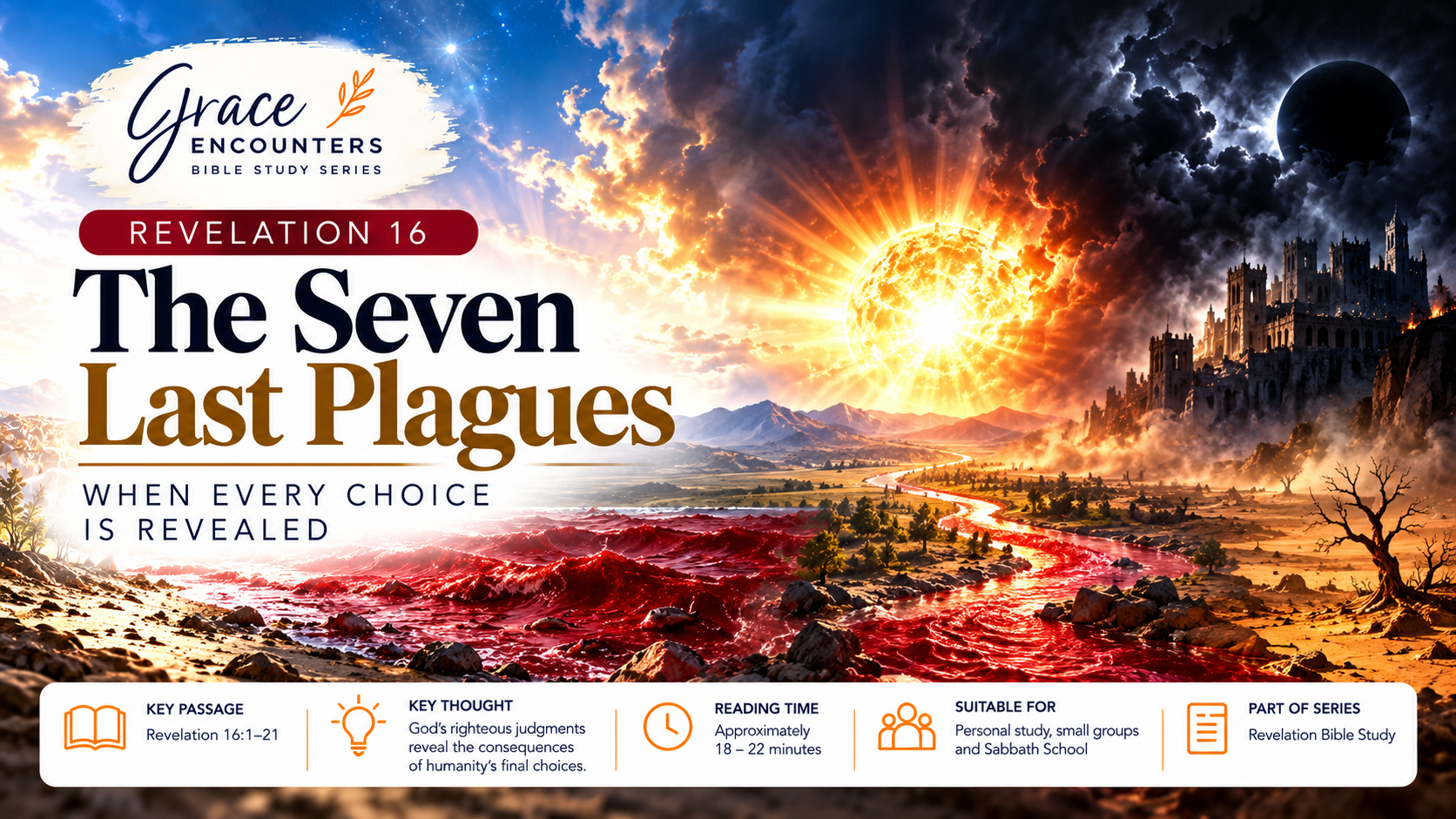
Bible Study | Grace Encounters | All Things New
Scripture: Revelation 16:1–21
Reading time: Approximately 18–22 minutes
Key thought: The seven last plagues reveal the consequences of humanity’s final choices. Yet even in judgment, Scripture invites us to recognise the righteousness of God, the faithfulness of the Lamb, and the importance of knowing Jesus before the final crisis comes.
Introduction: Before the Plagues, God Shows Us the Victory
Revelation 16 is one of the most solemn chapters in Scripture.
Seven angels pour out seven bowls of God’s wrath. Painful sores afflict humanity. The sea and rivers become blood. The sun scorches the earth. Darkness falls upon the beast’s kingdom. The Euphrates dries up, the nations gather for the final conflict, and Babylon faces judgment.
It is a frightening picture.
But before we begin studying these events, we must remember where God took us in Revelation 15.
He showed John the redeemed standing on the sea of glass, singing the song of Moses and the Lamb.
They had gained the victory over the beast, his image and his mark. Their journey had not been easy, but they were standing in the presence of God.
And they were singing.
“Great and marvellous are Your works, Lord God Almighty! Just and true are Your ways, O King of the saints!” (Revelation 15:3, NKJV).
Only after showing John the victory does God reveal the seven last plagues.
Perhaps there is something deeply comforting in that order.
Before God shows us the final crisis, He shows us the final outcome for those who belong to Jesus.
The Lamb is victorious.
And those who follow Him will stand with Him.
1. When the Sanctuary Closes: Revelation 16:1
Revelation 16 begins with a command from the heavenly temple:
“Go and pour out the bowls of the wrath of God on the earth” (Revelation 16:1).
To understand this command, we must return briefly to Revelation 15:8.
The heavenly temple had become filled with the glory and power of God, and no one could enter until the seven plagues were completed.
Within the Seventh-day Adventist understanding of prophecy, this represents the close of Christ’s heavenly intercessory ministry and the close of human probation.
The time for humanity’s final decision has passed.
The everlasting gospel has been proclaimed. The three angels’ messages have warned the world against false worship. God’s final appeal has gone out.
Now the consequences of those decisions unfold.
This distinction is important.
The seven last plagues are different from the seven trumpets.
The trumpets portray limited judgments that serve, among other purposes, as warnings. They call humanity to repentance.
The seven last plagues come after the final decisions have been made.
They are not another opportunity to reconsider allegiance.
They reveal the outcome of choices already settled.
God’s justice and the light we have received
There is a question we must address before continuing.
What about sincere people who have been deceived?
What about those who genuinely love God but have never understood certain biblical truths?
Would God condemn them simply because they did not possess the same knowledge as someone else?
Scripture gives us an important principle.
Jesus taught that accountability corresponds to the knowledge and opportunity a person has received (Luke 12:47–48).
Paul also explains that God judges with perfect knowledge of the human heart (Romans 2:12–16).
God is neither arbitrary nor unjust.
Revelation 14:6 pictures the everlasting gospel being proclaimed to every nation, tribe, tongue and people.
And Revelation 18:4 contains one of the most tender appeals in the entire book:
“Come out of her, My people.”
Notice those words.
My people.
God has people in Babylon.
They may be surrounded by religious confusion. They may have inherited beliefs that do not fully reflect biblical truth. Yet God knows their hearts.
He calls them His people even before they have come out.
The distinction between sincere deception and deliberate rejection matters.
God does not require every person to possess identical theological knowledge. But Scripture gives us reason to trust that He will provide sufficient light and opportunity for a genuine response to Him.
The final crisis is not about God finding technical reasons to exclude sincere seekers.
It is about humanity’s response to the Creator and His revealed truth.
Before the plagues, God calls.
Before judgment, He warns.
Before the door closes, He invites.
And His invitation is always rooted in love.
2. The First Plague: Painful Sores — Revelation 16:2
The first angel pours his bowl upon the earth.
Painful, malignant sores appear upon those who have received the mark of the beast and worshipped his image.
Notice how specific Revelation is.
The plague falls upon those identified with the beast’s system of worship.
This connects directly with the warning of the third angel in Revelation 14:9–10.
The issue has always been worship and allegiance.
Whose authority do we recognise?
Whom do we trust?
Whom do we obey?
The connection with Egypt
The first plague recalls the boils that afflicted Egypt in Exodus 9:8–11.
Pharaoh repeatedly resisted God’s appeals to release His people.
The Egyptian plagues exposed the inability of Egypt’s gods and rulers to provide ultimate security.
Likewise, the final plagues expose the inability of the beast’s system to protect those who trust it.
The system that demanded allegiance cannot save its followers.
There is a lesson here.
Whatever we place above God eventually proves inadequate.
Political power, religious institutions, financial security and human authority cannot take the place of the Creator.
Only Jesus can save.
3. The Second and Third Plagues: The Waters Become Blood — Revelation 16:3–7
The second angel pours his bowl upon the sea, and it becomes like the blood of a dead man.
Every living creature in the sea dies.
The third angel pours his bowl upon the rivers and springs, and they become blood.
These scenes recall the first plague upon Egypt, when the Nile turned to blood (Exodus 7:17–21).
But Revelation adds something extraordinary.
An angel declares:
“You are righteous, O Lord, the One who is and who was and who is to be, because You have judged these things” (Revelation 16:5).
The angel explains that those responsible for shedding the blood of God’s saints and prophets now face a judgment corresponding to their actions.
Then another voice responds from the altar:
“Even so, Lord God Almighty, true and righteous are Your judgments” (Revelation 16:7).
The altar remembers
We have heard a voice associated with the altar before.
In Revelation 6:9–10, the martyrs cried out:
“How long, O Lord?”
They had suffered because of their faithfulness to God.
Their lives had been taken, and justice appeared delayed.
Now, in Revelation 16, the altar speaks again.
God’s judgments are declared righteous.
The cry for justice has not been forgotten.
God has not overlooked the suffering of His people.
He has not forgotten a single injustice.
How can a loving God bring judgment?
This is perhaps one of the most difficult questions in Revelation.
We have spent many mornings studying the love of God, the sacrifice of Jesus, His patience and His longing to save.
How do we reconcile that God with the judgments described here?
We must remember that love and justice are not enemies.
A God who never confronts evil would leave its victims without justice.
A God who allows cruelty, persecution and oppression to continue indefinitely would not be demonstrating love towards those who suffer.
God’s judgments do not mean that His character has changed.
They reveal that evil will not be permitted to continue forever.
Yet we must also remember that the God who judges is the God who gave His Son to save humanity.
The cross reveals how seriously God takes both sin and salvation.
Jesus did not come because God was reluctant to love us.
Jesus came because God already loved us.
The seven last plagues must therefore be understood in the light of Calvary.
The Judge is also the One who gave Himself for the world.
4. The Fourth Plague: Scorching Heat — Revelation 16:8–9
The fourth angel pours his bowl upon the sun.
People are scorched with intense heat.
Then Revelation tells us something more disturbing than the suffering itself.
They blaspheme God’s name.
They refuse to repent or give Him glory.
Notice the connection with Revelation 14:7.
The first angel’s message had called humanity to fear God and give Him glory.
Now, in Revelation 16:9, those who rejected that appeal still refuse to give Him glory.
Their response reveals the condition of their hearts.
When life squeezes us, what comes out?
There is a simple illustration that captures this principle.
If you squeeze an orange, you get orange juice.
If you squeeze a lemon, you get lemon juice.
Why?
Because what is inside the fruit comes out when pressure is applied.
The same principle applies to our spiritual lives.
When life squeezes us, what comes out?
When we experience disappointment, financial pressure, illness, betrayal or fear, what does our response reveal?
Does bitterness emerge?
Anger?
Distrust?
Or does our heart turn towards Jesus?
In Revelation 15, we see people who have endured extraordinary pressure.
They have faced persecution, coercion and the threat of death.
Yet when we hear them speak, they are praising God.
“Just and true are Your ways.”
In Revelation 16, another group experiences pressure.
And what comes out?
Blasphemy.
The pressure reveals what has been forming within.
Jesus said:
“For out of the abundance of the heart the mouth speaks” (Matthew 12:34).
But we must understand this carefully.
A redeemed person can still cry, struggle, become frightened or ask difficult questions.
David did.
Job did.
Peter failed terribly.
The difference is not that God’s children never experience distress.
The difference is where their hearts ultimately turn.
Job wrestled with God.
David cried out to God.
Peter returned to Jesus.
The people described in Revelation 16 turn against God.
We cannot manufacture the fruit of the Spirit
This brings us back to righteousness by faith.
We cannot produce Christlike character merely by trying harder to behave correctly under pressure.
We need Jesus living within us.
Galatians 5:22–23 describes the fruit of the Spirit:
Love, joy, peace, longsuffering, kindness, goodness, faithfulness, gentleness and self-control.
These are not qualities we manufacture independently of Christ.
They grow through our relationship with Him.
As we spend time with Jesus, surrender our hearts and allow the Holy Spirit to transform us, His character increasingly becomes visible in our lives.
And when pressure comes, there is something of Him to be revealed.
Perhaps the most important question is not:
“How will I survive the seven last plagues?”
Perhaps it is:
“Am I allowing Jesus to fill my heart today?”
Because the preparation for the final crisis begins with our relationship with Him now.
5. The Fifth Plague: Darkness Over the Beast’s Kingdom — Revelation 16:10–11
The fifth angel pours his bowl upon the throne of the beast.
Its kingdom becomes filled with darkness.
People suffer intensely, yet they continue to blaspheme God and refuse to repent.
The darkness recalls the ninth plague upon Egypt (Exodus 10:21–23).
But the location of this judgment is particularly significant.
It falls upon the throne of the beast.
In Revelation 13:2, the dragon gives the beast its power, throne and great authority.
Now that authority is directly challenged.
The system that claimed the right to direct human worship is exposed as powerless before God.
The darkness may also symbolise the collapse of its claims to spiritual enlightenment and authority. The passage does not require us to choose between every physical and symbolic dimension.
What matters is that the beast’s kingdom cannot protect its followers.
Why do they still refuse to repent?
Revelation 16:11 repeats the observation made in verse 9.
They do not repent.
We must not confuse suffering with repentance.
Pain can expose our need, but pain does not automatically produce surrender.
Pharaoh witnessed God’s power repeatedly, yet his heart remained resistant.
Likewise, the people in Revelation 16 recognise that God is involved in these judgments, but they continue to oppose Him.
Knowing that God exists is not the same as loving Him.
Recognising His power is not the same as surrendering to His authority.
This is one of the most solemn lessons in the chapter.
Repeated resistance to the Holy Spirit can harden the heart.
The time to surrender is when His voice is calling.
The time to know Jesus is now.
6. The Sixth Plague: The Euphrates Dries Up — Revelation 16:12
The sixth angel pours his bowl upon the great river Euphrates.
Its water dries up, preparing the way for the kings from the east.
To understand this imagery, we must return to ancient Babylon.
The fall of ancient Babylon
The Euphrates flowed through Babylon and formed an important part of its security and prosperity.
In the biblical account of Babylon’s downfall, God identifies Cyrus as the ruler who would accomplish His purpose (Isaiah 44:27–45:1).
Historically, the diversion of the Euphrates was associated with the Persian conquest of Babylon.
The city that appeared secure was vulnerable.
And its fall became part of God’s deliverance of His people from captivity.
Revelation uses Babylon as a symbol of the final religious-political system that opposes God.
Revelation 17:15 explains that waters can represent peoples, multitudes, nations and tongues.
Within the Adventist historicist interpretation, the drying up of the Euphrates therefore points to the withdrawal of support from end-time Babylon.
The powers and peoples upon which Babylon depended turn against her.
Revelation 17:16 describes this reversal more explicitly.
The system that appeared invincible begins to collapse from within.
The kings from the east
In the Old Testament, deliverance from Babylon was associated with Cyrus, whom God raised up to fulfil His purpose.
In Revelation, the imagery points beyond ancient Cyrus to the ultimate deliverance of God’s people.
The kings from the east are interpreted by many Adventist commentators in connection with Christ and the heavenly deliverance that accompanies His return.
This interpretation follows the broader biblical pattern, although Revelation 16 does not explicitly identify these kings.
The central assurance remains clear:
Babylon will fall, and God will deliver His people.
7. The Three Unclean Spirits: The Final Deception — Revelation 16:13–14
John sees three unclean spirits, resembling frogs, coming from the mouths of:
- The dragon
- The beast
- The false prophet
They perform signs and gather the rulers of the world for the final conflict.
These three powers recall the counterfeit alliance developed in Revelation 12 and 13.
The dragon represents Satan.
The beast represents the religious-political power that receives authority from the dragon.
The false prophet is connected with the deceptive activity of the second beast of Revelation 13.
Together, they seek to unite the world in opposition to God.
Why frogs?
The imagery recalls the plague of frogs in Egypt (Exodus 8:1–15).
It also draws attention to deception and counterfeit supernatural activity.
These spirits come from the mouths of the three powers.
Throughout Scripture, the mouth is associated with speech, proclamation and teaching.
The final deception therefore involves persuasive messages as well as miraculous signs.
This brings us back to something we considered during Revelation 13.
Not everything supernatural comes from God.
Not every impressive religious experience is evidence of truth.
And not every open door is necessarily God’s direction.
Jesus warned that false christs and false prophets would perform signs capable of deceiving many (Matthew 24:24).
Revelation 13:13–14 similarly describes deceptive signs.
Our safeguard is not simply the ability to recognise spectacular events.
Our safeguard is knowing God’s Word and knowing the character of Jesus.
Learning to recognise the genuine
There is an illustration from banking that helps explain this.
When bank tellers learn to identify counterfeit notes, an important part of their training involves becoming thoroughly familiar with genuine currency.
The more intimately they know the genuine, the more readily they recognise what is false.
The same principle applies spiritually.
If we spend all our time studying deception but very little time with Jesus, we may become experts in frightening possibilities without becoming deeply rooted in truth.
But when we know the genuine Shepherd, we become better equipped to recognise voices that do not belong to Him.
Jesus said:
“My sheep hear My voice, and I know them, and they follow Me” (John 10:27).
That is the relationship we need.
Not merely information about Jesus.
A living relationship with Him.
8. Armageddon: The Final Conflict Over Allegiance — Revelation 16:14–16
The unclean spirits gather the kings of the earth for the battle of the great day of God Almighty.
The place is called Armageddon.
The name is commonly associated with the Hebrew expression meaning “mountain of Megiddo”, although its precise linguistic and geographical significance is debated.
Megiddo was associated with important conflicts in Israel’s history.
Yet Revelation presents the final conflict as far more than a military battle in one geographical location.
The surrounding chapters consistently focus upon worship, loyalty and authority.
Who receives humanity’s allegiance?
The Creator or the beast?
The Lamb or the dragon?
The final conflict is therefore fundamentally spiritual, although it has worldwide consequences.
We should be cautious about interpreting every contemporary political or military development as the fulfilment of Armageddon.
Scripture must guide our understanding of events, rather than current events determining what we want Scripture to mean.
Jesus interrupts the gathering
In the middle of this frightening description, Jesus speaks:
“Behold, I am coming as a thief. Blessed is he who watches, and keeps his garments, lest he walk naked and they see his shame” (Revelation 16:15).
This is remarkable.
John is describing the gathering of the world for the final conflict.
And suddenly Jesus addresses His people.
He does not give them a military strategy.
He does not tell them to calculate the movements of armies.
He tells them to watch and keep their garments.
What are these garments?
Throughout Revelation, clothing carries important spiritual meaning.
In Revelation 3:18, Jesus counsels Laodicea to receive white garments from Him.
In Revelation 7:14, the redeemed have washed their robes in the blood of the Lamb.
In Revelation 19:8, the bride is clothed in fine linen, associated with the righteous acts of the saints.
The garments point us towards the righteousness that comes through Jesus and is reflected in the lives of His people.
The warning is therefore deeply relational.
Remain in Christ.
Do not abandon the righteousness He provides.
Do not become spiritually careless.
Do not exchange dependence upon Jesus for confidence in yourself.
My allegiance is to the Lamb
This became one of the most personal moments in our study.
The world may be gathering under deceptive powers, but God’s people are called to a different allegiance.
My allegiance is not ultimately to a religious institution, a political leader or a human system.
My allegiance is to the Lamb.
And my confidence is not that I am strong enough to stand.
My confidence is that Jesus is able to keep me.
Jude 24 reminds us that God is able to keep us from stumbling and present us faultless before His glory with exceeding joy.
That is where our hope belongs.
We do not overcome because we are naturally stronger than everyone else.
We overcome through the Lamb.
My allegiance is to the Lamb. My righteousness is in Christ. My confidence is in His ability to hold me fast.
9. The Seventh Plague: “It Is Done!” — Revelation 16:17–21
The seventh angel pours his bowl into the air.
A loud voice comes from the temple, from the throne, declaring:
“It is done!”
The earth experiences an unprecedented earthquake.
The great city is divided.
The cities of the nations fall.
Babylon comes into remembrance before God.
Islands flee, mountains disappear, and enormous hailstones fall.
The imagery describes the collapse of the world order that has opposed God.
Nothing humanity has constructed in rebellion against Him can stand forever.
Three declarations worth comparing
At Calvary, Jesus declared:
“It is finished!” (John 19:30).
In Revelation 16:17, the voice from the throne declares:
“It is done!”
And in Revelation 21:6, God again declares:
“It is done!”
These declarations occur in different contexts and should not be treated as though they describe the same event.
Yet together they reveal the certainty of God’s redemptive purpose.
At the cross, Christ completed His sacrificial work.
In Revelation 16, the final judgments reach their culmination.
In Revelation 21, the promise of a renewed creation stands fulfilled.
The story does not end with Babylon.
It ends with God dwelling among His people.
10. Babylon Remembered: The Writing on the Wall
Revelation 16:19 tells us that Babylon is remembered before God and receives the cup of His wrath.
This takes us back to Daniel 5.
Belshazzar held a great feast.
He commanded that the sacred vessels taken from God’s temple in Jerusalem be brought into the celebration.
The king and his guests drank from vessels that had been dedicated to the worship of God while praising their idols.
Then a mysterious hand wrote upon the wall:
MENE, MENE, TEKEL, UPHARSIN.
Daniel interpreted the message.
Babylon’s days had been numbered.
Its kingdom had been weighed and found wanting.
Its dominion would be divided.
That very night, Belshazzar was killed and Babylon fell.
The cup of Babylon
The connection with Revelation is striking.
In Revelation 14:8, Babylon makes the nations drink the wine of her fornication.
In Revelation 17:4, she holds a golden cup filled with abominations.
But in Revelation 16:19, Babylon herself receives a cup.
The system that intoxicated the nations with deception now faces divine judgment.
Ancient Babylon misused the sacred vessels of God.
Prophetic Babylon similarly misrepresents divine authority and draws worship away from the Creator.
And just as ancient Babylon’s apparent security could not prevent its fall, end-time Babylon cannot escape the judgment of God.
The writing is on the wall.
But the purpose of studying this prophecy is not to rejoice over destruction.
It is to recognise the danger of placing our trust in anything that takes the place of God.
11. The Final Response: They Still Blaspheme God
Revelation 16 ends with a disturbing observation.
Despite the devastation, people continue to blaspheme God.
This echoes the responses recorded during the fourth and fifth plagues.
The chapter begins with the consequences of rejecting God.
It ends by revealing the settled character of that rejection.
The final judgments do not produce a transformed heart.
They reveal what humanity has chosen.
And here we return to our illustration.
When an orange is squeezed, orange juice comes out.
When a lemon is squeezed, lemon juice comes out.
When life squeezes us, what comes out?
This question is not intended to make us fearful of every weakness.
God understands our struggles.
He knows our frailty.
He remembers that we are dust.
But He also invites us into a relationship that changes us from within.
The preparation for the final crisis is not primarily a matter of accumulating prophetic information.
It is allowing the Holy Spirit to form the character of Jesus in us.
The more we behold Him, the more we become like Him (2 Corinthians 3:18).
And when the pressure comes, may our response increasingly reflect the One who lives within us.
12. The Greater Exodus: God Delivers His People
There is one final connection we must not overlook.
The seven last plagues deliberately recall the plagues upon Egypt.
In Exodus, God confronted an oppressive power and delivered His people from slavery.
In Revelation, God confronts the final powers of deception and oppression and delivers those who belong to the Lamb.
Both accounts involve false claims to authority.
Both involve hardened hearts.
Both reveal the inability of human power to resist the purposes of God.
And both lead us towards deliverance.
But Revelation adds something wonderful.
The redeemed sing the song of Moses and the Lamb.
The Exodus from Egypt was a mighty act of deliverance.
The deliverance accomplished through Jesus is greater still.
He does not merely free us from earthly oppression.
He frees us from the dominion of sin.
He restores our relationship with the Father.
He prepares us for a world in which evil will never rise again.
That is why the redeemed sing.
Not because they enjoyed the suffering.
Not because they were fascinated by judgment.
But because they have experienced the faithfulness of God.
The Lamb has brought them home.
Grace Encounters: What Is Filling My Heart?
After studying Revelation 16, I find myself returning to one deeply personal question.
What comes out of me when life squeezes me?
I cannot always control the circumstances that surround me.
I cannot prevent every disappointment, loss or painful experience.
Sometimes life becomes so difficult that I wonder how much more I can carry.
But I can come to Jesus.
I can spend time in His Word.
I can surrender my fears, frustrations and disappointments to Him.
I can ask Him to change what is happening inside my heart.
And I can trust Him to complete the work He has begun.
Revelation 16 is not merely a warning about events that will one day shake the earth.
It is an invitation to examine where our confidence rests today.
Am I trusting in my own ability to remain faithful?
Am I trusting in religious knowledge?
Am I trusting in human institutions or circumstances?
Or am I trusting in Jesus?
There is a profound difference between knowing about God and knowing Him.
The people in Revelation 16 recognise His power, but their hearts remain opposed to Him.
The redeemed know Him, and their song reflects that relationship.
“Just and true are Your ways.”
That is the kind of faith I want.
Not a faith that depends upon everything going well.
Not a faith that disappears when circumstances become difficult.
But a faith rooted in knowing the heart of God.
And I want to remember that even my ability to remain faithful comes from Him.
He is the One who holds me.
He is the One who changes me.
He is the One who will bring His children home.
The greatest preparation for the final crisis is not knowing everything that will happen. It is knowing the One who will hold us through it.
A Prayer
Heavenly Father,
As I study these solemn scenes in Revelation, I am reminded that You are both loving and just.
You have never been indifferent to the suffering of Your children.
You have never forgotten those who have been persecuted for Your name.
And You have never stopped calling people to Yourself while the door of mercy remains open.
Lord, I do not want to know only about You.
I want to know You.
I want to recognise Your voice.
I want to trust Your heart even when I cannot understand Your ways.
Please search my heart.
Show me where I am still depending upon myself.
Show me where fear, bitterness, pride or unbelief have taken root.
And replace those things with Your love.
Fill me with Your Holy Spirit.
Let the fruit of the Spirit grow in my life.
So that when life squeezes me, what comes out will increasingly reflect Jesus.
When I am afraid, teach me to trust.
When I am hurt, teach me to forgive.
When I am disappointed, teach me to remain faithful.
When I am weak, remind me that Your strength is sufficient.
And when the world around me becomes uncertain, keep my eyes fixed upon the Lamb.
My allegiance is to Jesus.
My righteousness is found in Him.
My hope is in His promise to hold me fast.
Lord, let me be a light to those who are still searching for You.
May my life leave a trail of grace that helps someone else find Your heart.
And one day, by Your grace, may I stand among those who sing:
“Great and marvellous are Your works, Lord God Almighty! Just and true are Your ways.”
In the precious name of Jesus,
Amen.
Key Lessons from Revelation 16
- God’s judgments are righteous. He does not act arbitrarily or forget the suffering of His people.
- God respects human choice. The final plagues follow the close of probation, after humanity’s response to His appeals has become settled.
- Sincere seekers matter to God. He knows those who belong to Him, even when they are surrounded by religious confusion.
- False systems cannot provide ultimate security. The beast’s authority collapses under divine judgment.
- Pressure reveals character. What comes out when life squeezes us reflects what has been forming in our hearts.
- Deception is overcome by knowing the genuine. Familiarity with Jesus and His Word is essential to spiritual discernment.
- Our allegiance belongs to the Lamb. We stand through Christ’s righteousness and sustaining grace.
- Babylon will fall, but God’s kingdom will remain. The final outcome belongs to Jesus.
Scripture for Further Thought
Take time to explore these passages alongside this study. Compare Scripture with Scripture, follow the connections, and allow the Bible to illuminate its own message.
The Exodus and the plagues: Exodus 7–12; Psalm 105:26–38
God’s justice and human accountability: Deuteronomy 32:4; Luke 12:47–48; Romans 2:12–16
The three angels’ messages: Revelation 14:6–12
The close of probation: Revelation 15:5–8; Revelation 22:11
The cry for justice: Revelation 6:9–11; Revelation 16:5–7
The fall of Babylon: Daniel 5; Isaiah 44:27–45:1; Jeremiah 50–51; Revelation 17–18
The final deception: Matthew 24:23–27; 2 Thessalonians 2:9–12; Revelation 13:11–17
Christ’s righteousness and our assurance: Zechariah 3:1–5; Revelation 3:18; Revelation 7:14; Jude 24–25
The promise of all things made new: Revelation 21:1–7
Recommended Study Resources
- Ellen G. White, The Great Controversy, chapters 38–40, particularly the chapters addressing the final warning, the time of trouble and God’s deliverance.
- Ranko Stefanovic, Revelation of Jesus Christ: Commentary on the Book of Revelation, discussion of Revelation 15–16.
- Seventh-day Adventist Bible Commentary, volume 7, commentary on Revelation 16.
These resources reflect the Adventist historicist approach used throughout this study. Certain details, particularly the precise fulfilment of the sixth plague and Armageddon, remain matters of interpretation and should be examined against Scripture.
Continue the Journey
Previous study: Revelation 15 — The Song of Moses and the Lamb
Next study: Revelation 17 — Babylon, the Woman and the Beast
About Grace Encounters
Grace Encounters is a personal journey through Scripture, discovering the character of God, the love of Jesus and the transforming power of His grace.
These studies are not written merely to explain prophecy. They are an invitation to encounter the God who stands at the centre of it.
Because the purpose of knowing what lies ahead is not to live in fear.
It is to know the One who holds our future.
Get to Jesus. Know His heart. Trust His grace.
For more Bible studies and reflections, visit:
Grace Encounters | One Voice 27 | Old Things New