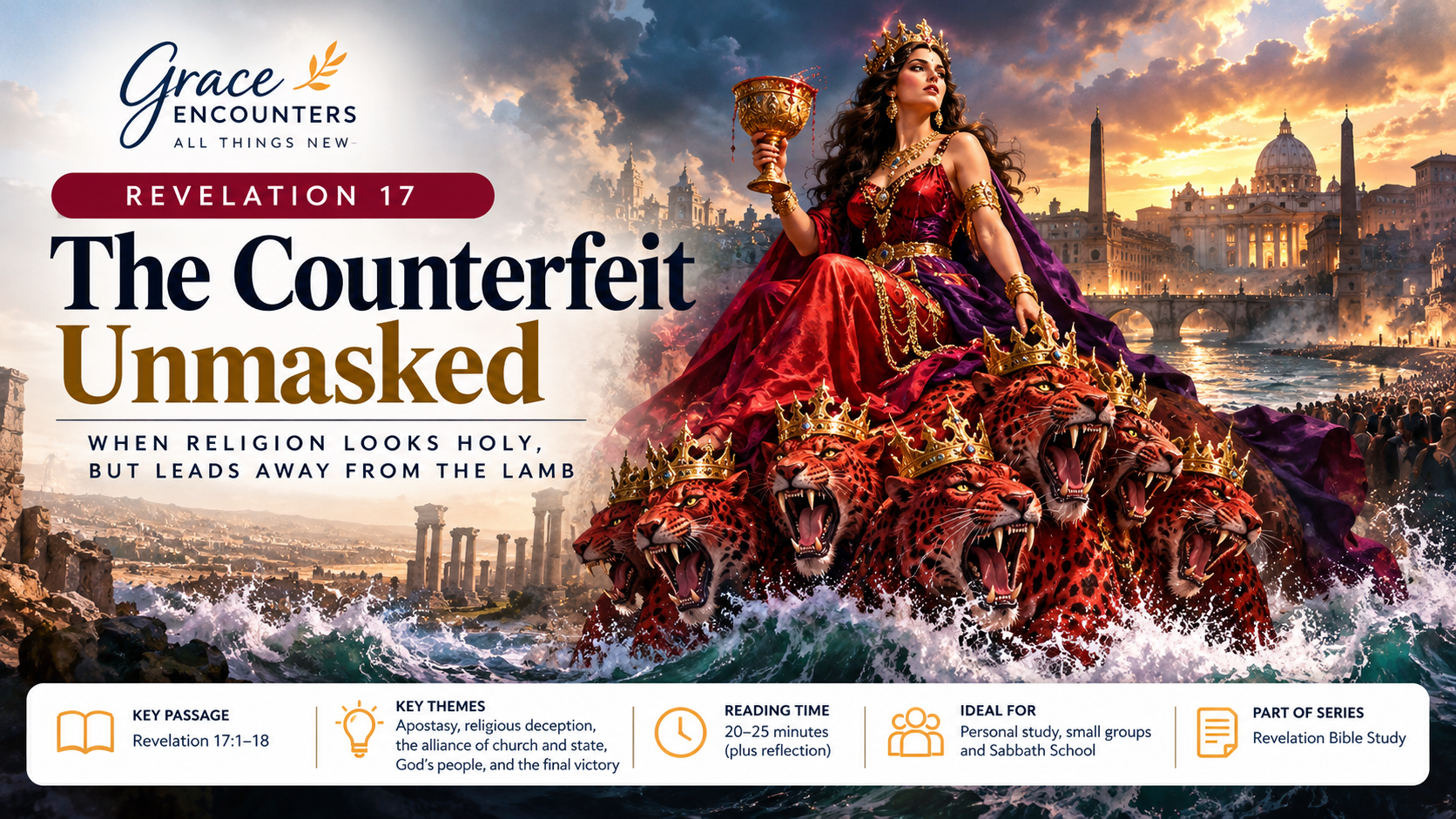
Grace Encounters | Bible Study Series: The Revelation of Jesus Christ
Subtitle: When religion looks holy, but leads away from the Lamb
Scripture: Revelation 17:1–18
Key verse: Revelation 17:14
Estimated reading time: 17–20 minutes
Introduction: Not everything that looks holy comes from God
One of the most dangerous characteristics of deception is that it seldom announces itself as deception.
A counterfeit succeeds because it resembles the genuine article. It may look convincing, carry familiar markings and appear trustworthy. Only careful examination reveals what it really is.
This is the unsettling picture John encounters in Revelation 17.
He sees a woman dressed in purple and scarlet, adorned with gold, precious stones and pearls. She carries a golden cup and exercises extraordinary influence over the nations.
Her appearance suggests splendour, wealth and religious authority.
Yet the angel reveals that she is Babylon, a symbol of spiritual unfaithfulness, deception and persecution.
The contrast is disturbing. What appears magnificent is spiritually corrupt. What presents itself as authoritative opposes God’s authority. What appears religious leads people away from genuine worship.
And this brings us to one of the central questions of Revelation:
How do we recognise the counterfeit when it looks so much like the genuine?
The answer is not found in endless speculation about Satan’s activities. It is found in becoming intimately acquainted with Jesus Christ and His Word.
1. The angel reveals Babylon’s true identity
Read Revelation 17:1–2.
The chapter begins with one of the seven angels who carried the bowls of God’s final judgements inviting John to witness the judgement of the great prostitute.
This deliberately connects Revelation 17 with Revelation 16.
In Revelation 16:19, Babylon is remembered before God. Now the angel explains why Babylon is being judged and reveals the character of the system behind the deception.
The woman is described as sitting upon many waters.
Fortunately, Revelation explains this symbol for us.
Revelation 17:15 identifies the waters as peoples, multitudes, nations and tongues.
Babylon’s influence is therefore extensive. She exercises influence over populations and nations rather than merely occupying a geographical location.
The connection with ancient Babylon
Ancient Babylon was closely associated with the Euphrates River.
Jeremiah 51:13 describes Babylon as dwelling upon many waters.
The Euphrates was central to Babylon’s prosperity and defence. Its waters were part of the city’s strength.
In Revelation 16:12, the symbolic Euphrates dries up.
Within the imagery of Revelation 17, the waters represent the peoples who support Babylon. Later, the political powers that once supported her turn against her.
This creates an important prophetic parallel:
Ancient Babylon lost its security when its defences were breached.
Prophetic Babylon ultimately loses the support upon which its power depends.
The system that once appeared invincible collapses.
The lesson: Human power, popularity and political support cannot guarantee the survival of a system that opposes God.
2. The kings of the earth and the wine of Babylon
Read Revelation 17:2.
John describes two groups involved with Babylon.
The kings of the earth participate in her spiritual unfaithfulness, while the inhabitants of the earth become intoxicated with her wine.
In Old Testament prophetic language, adultery and prostitution frequently symbolise covenant unfaithfulness and the abandonment of God for false worship and illicit alliances.
See Jeremiah 3:6–10, Ezekiel 16 and Hosea 2.
In Revelation 17, the imagery portrays the relationship between corrupted religion and worldly power.
Religious influence and political authority become intertwined.
This recalls Revelation 13, where religious deception and coercive power operate together.
But Babylon does not rely upon force alone.
She offers wine.
What does the wine represent?
Revelation 14:8 already introduced Babylon’s intoxicating influence over the nations.
The wine symbolises her corrupting teachings and spiritual influence.
The imagery is significant because intoxication affects judgement and discernment.
A person under its influence may sincerely believe that what they are doing is right.
That makes deception particularly dangerous.
People do not necessarily reject God knowingly. They may be persuaded that a counterfeit represents His will.
Deception can produce sincere conviction without producing truth.
This is why sincerity, although important, cannot replace the authority of Scripture.
3. The woman riding the scarlet beast
Read Revelation 17:3.
John is carried into the wilderness, where he sees a woman sitting upon a scarlet beast.
The beast has seven heads and ten horns and is covered with blasphemous names.
These characteristics connect the vision with Revelation 12 and 13.
Yet an important distinction must be maintained.
The woman and the beast are not identical.
The woman rides the beast.
In the historicist Seventh-day Adventist interpretation, the woman represents an apostate religious system, while the beast represents political power operating in support of that system.
The imagery suggests an alliance between religious influence and civil authority.
Religious power seeks the support of the state, while political power becomes an instrument through which religious objectives can be enforced.
This is consistent with the coercive worship described in Revelation 13.
However, the relationship is not permanent.
Revelation 17:16 reveals that the very powers associated with the beast eventually turn against the woman.
The alliance that appears to sustain Babylon becomes part of her destruction.
This is an important warning against confusing political influence with divine approval.
God’s truth does not become more truthful because governments support it.
Nor does His authority depend upon human institutions.
4. Purple, scarlet and gold: The counterfeit sanctuary
Read Revelation 17:4–5 alongside Exodus 26:1, 31 and Exodus 28:5–38.
This was one of the most striking connections in our study.
John describes the woman as wearing purple and scarlet, adorned with gold, precious stones and pearls.
These details recall the colours and materials associated with the Old Testament sanctuary and the garments of Israel’s high priest.
Consider the comparison:
| Sanctuary and high priest | Babylon in Revelation 17 |
|---|---|
| Gold, blue, purple and scarlet | Gold, purple and scarlet |
| Precious stones on the priestly breastplate | Precious stones and pearls |
| Sacred golden vessels | A golden cup |
| “Holiness to the LORD” on the high priest’s forehead | Babylon’s identity written on her forehead |
| Ministry established by God | Corrupted religious authority |
The similarities invite us to consider the possibility of deliberate counterfeit imagery.
The missing blue
Exodus 28:5 includes blue among the colours of the priestly garments.
Yet Revelation 17:4 does not mention blue in Babylon’s clothing.
This is especially interesting when we consider Numbers 15:38–40.
God instructed Israel to place a blue cord upon their garments as a reminder to remember and obey His commandments.
From an Adventist interpretive perspective, the absence of blue in Babylon’s description offers a possible symbolic contrast between outward religious splendour and faithfulness to God’s commandments.
We must be careful, however.
Revelation does not explicitly interpret the absence of blue.
We should therefore treat this as a suggestive biblical parallel rather than a conclusive prophetic identification.
The stronger point lies in the overall contrast between the woman’s appearance and her character.
The writing on the forehead
Exodus 28:36–38 describes the gold plate worn upon the high priest’s forehead.
It bore the inscription:
HOLINESS TO THE LORD.
In Revelation 17:5, Babylon also has a name written upon her forehead.
But her identity is associated with spiritual corruption and unfaithfulness.
The contrast becomes particularly meaningful when placed alongside Revelation 7, 13 and 14.
Throughout these chapters, the forehead is associated with identity and allegiance.
God’s servants are sealed in their foreheads.
The followers of the Lamb bear His Father’s name.
The beast’s followers receive its mark.
And Babylon bears her own identifying name.
The final conflict concerns more than outward religious profession.
It concerns whom we worship, whose authority we recognise and whose character we reflect.
The golden cup
The woman’s golden cup presents another striking contrast.
Externally, it is beautiful.
Internally, it contains abominations and impurity.
Its appearance conceals its contents.
This brings us back to Daniel 5.
At Belshazzar’s feast, the sacred vessels taken from God’s temple were used while Babylon’s rulers praised their false gods.
That night, judgement came upon Babylon.
Revelation does not explicitly identify the woman’s cup with Belshazzar’s vessels, but the shared imagery of Babylon, golden vessels, wine and judgement invites comparison.
The central lesson is unmistakable.
Something may possess the outward appearance of holiness while being spiritually corrupt within.
Jesus warned against the same danger when He spoke of false prophets who come in sheep’s clothing but are inwardly ravenous wolves (Matthew 7:15).
The test of genuine faith is not religious splendour.
It is faithfulness to God and His revealed Word.
5. Two women, two systems of worship
Revelation presents a deliberate contrast between the faithful woman of Revelation 12 and the unfaithful woman of Revelation 17.
The woman of Revelation 12 is clothed with the sun, with the moon beneath her feet and a crown of twelve stars.
She represents God’s covenant people, ultimately identified through their allegiance to Him.
The woman of Revelation 17 is clothed in earthly magnificence and associated with spiritual corruption.
One woman is persecuted.
The other persecutes.
One is sustained by God.
The other depends upon worldly power.
One remains faithful to God’s commandments and the testimony of Jesus.
The other intoxicates the nations and opposes God’s faithful people.
The contrast continues in Revelation 19.
There, the bride of the Lamb is clothed in fine linen, clean and bright.
Revelation 19:8 explains the symbolism in terms of the righteous acts of the saints.
Babylon’s clothing displays outward splendour.
The bride’s clothing reflects a life transformed through relationship with Christ.
This is not a lesson about poverty versus wealth or plain clothing versus beautiful clothing.
It is a contrast between outward religious appearance and genuine covenant faithfulness.
6. Drunk with the blood of the saints
Read Revelation 17:6.
John sees the woman drunk with the blood of the saints and the martyrs of Jesus.
This reveals the violent character concealed beneath her religious appearance.
The woman who intoxicates the nations with her wine is herself intoxicated with the blood of God’s people.
The symbolism connects with the persecution described in Revelation 12 and 13.
It also recalls the martyrs beneath the altar in Revelation 6:9–11, who cry out for justice.
Throughout Revelation, God has not forgotten the suffering of His faithful people.
Their blood has not escaped His notice.
In the historicist Adventist understanding, this imagery includes the persecution of dissenting believers by religious-political institutions throughout Christian history and points towards the final conflict over worship.
However, an essential distinction must be preserved.
Prophecy concerns systems, their teachings and their exercise of power. It does not give us permission to condemn individual believers.
Many sincere Christians worship God within religious traditions whose teachings Adventists believe depart from Scripture.
God knows their hearts.
Our calling is not to attack people but to present truth faithfully, compassionately and clearly.
The same Jesus who exposes Babylon also calls His people out of Babylon in Revelation 18:4.
That invitation reveals His desire to save, not merely to condemn.
7. The beast that was, is not, and will ascend
Read Revelation 17:7–8.
John is astonished by what he sees, and the angel begins explaining the mystery of the woman and the beast.
The beast is described as one that:
- Was.
- Is not.
- Will ascend out of the bottomless pit.
- Will ultimately go to destruction.
This unusual description deliberately contrasts with the way God is described in Revelation.
In Revelation 1:4 and 1:8, God is the One who is, who was and who is to come.
The beast’s description appears to imitate that language, but with a crucial difference.
God is eternal.
The beast’s power is interrupted, reappears and ultimately ends in destruction.
A counterfeit of divine authority
Throughout Revelation, Satan attempts to imitate God’s authority.
In Revelation 12, the dragon opposes God’s people.
In Revelation 13, the dragon gives authority to the beast.
In Revelation 17, the beast again becomes the instrument through which opposition to God operates.
The pattern suggests that Satan does not always act openly.
He works through earthly powers, institutions and systems.
The beast becomes an instrument of opposition to God’s government.
This also recalls Revelation 13:3, where one of the beast’s heads receives a seemingly fatal wound that is later healed.
Both passages describe a form of interrupted and renewed power that astonishes the world.
However, the passages do not use identical language, and we should be cautious about treating every detail as an exact equivalent.
The bottomless pit
The Greek term abyssos, translated as the bottomless pit or abyss, is associated in Revelation with confinement, destruction and demonic activity.
In Revelation 9, destructive powers emerge from the abyss.
In Revelation 20, Satan is confined in the abyss during the millennium.
In Revelation 17, the beast ascends from it.
The imagery communicates a renewed manifestation of hostile power, but the precise historical identification remains debated.
The important conclusion is explicit:
The beast goes to destruction.
Whatever power Satan appears to gain, its future is already determined.
God’s kingdom will endure.
Satan’s kingdom will not.
8. The seven heads and seven mountains
Read Revelation 17:9–11.
The angel explains that the seven heads are seven mountains and also seven kings.
This passage has produced considerable discussion among Bible scholars.
Some interpret the seven mountains as an allusion to Rome, famously associated with seven hills.
Others understand the mountains symbolically as kingdoms or successive centres of political authority.
In the Old Testament, mountains can represent kingdoms or political powers, as illustrated in Daniel 2:35, 44–45 and Jeremiah 51:25.
The reference to kings therefore strengthens the possibility that the heads represent successive ruling powers.
The historicist interpretation
Within historicist interpretation, the seven heads are commonly understood as successive manifestations of political opposition to God’s people.
Different Adventist interpreters have proposed different historical identifications.
Some begin with ancient Egypt or Babylon, while others focus more narrowly on the sequence of powers associated with Rome.
The Seventh-day Adventist Bible Commentary acknowledges the difficulty of identifying every head with certainty.
We should therefore avoid presenting one disputed list of seven kingdoms as though Scripture explicitly provides their names.
What the text does establish is that these powers belong to a sequence.
Five have fallen.
One is.
Another is yet to come.
The beast is also described as an eighth, yet belonging to the seven.
What is the eighth?
A careful reading reveals that the text does not describe an eighth head.
It describes the beast itself as an eighth king or ruling manifestation.
This distinction matters.
The eighth is connected with the seven, suggesting continuity with the preceding manifestations of opposition.
In the historicist understanding, this may be interpreted as a final resurgence or manifestation of the same anti-God power.
But again, the chapter does not provide a complete historical timetable.
We should not force contemporary events into the prophecy merely to complete a chart.
The angel’s final statement is more important than identifying every political development:
The beast is going to destruction.
Human kingdoms rise and fall.
God remains sovereign.
9. The ten horns: Political power united for a common purpose
Read Revelation 17:12–13.
The angel identifies the ten horns as ten kings who have not yet received a kingdom but will receive authority for a short period alongside the beast.
They are described as being of one mind and giving their power and authority to the beast.
The imagery recalls Daniel 7, where horns represent kings or kingdoms.
In Revelation 17, the ten kings participate in a temporary political alliance.
Their unity is significant.
They are not necessarily united because they share identical beliefs, cultures or national interests.
They become united in their support of the beast.
Religious and political power
The alliance illustrates how political authority can be directed towards a common religious or ideological objective.
In the Adventist prophetic understanding, this points towards a final confederation of earthly powers supporting opposition to God’s commandments and genuine worship.
This interpretation connects Revelation 17 with Revelation 13, where coercive measures are employed to enforce false worship.
But Revelation does not identify these ten kings by modern national names.
It would therefore be irresponsible to declare that a particular contemporary alliance or group of countries must represent the ten horns without sufficient biblical evidence.
The central prophetic issue is the transfer of authority to a system opposed to God.
And that leads directly to verse 14.
10. The turning point: They make war against the Lamb
Read Revelation 17:14.
This is the theological centre of the chapter.
The political powers described in the preceding verses ultimately make war against the Lamb.
And Revelation immediately tells us the outcome:
“And the Lamb shall overcome them: for he is Lord of lords, and King of kings.”
— Revelation 17:14, KJV
Notice who wins.
Not an earthly religious organisation.
Not a political movement.
Not a human leader.
The Lamb.
The same Jesus who was slain in Revelation 5 is now revealed as the victorious King.
The Lamb’s victory is one of the great recurring themes of Revelation.
Satan may exercise influence.
The beast may receive authority.
Babylon may deceive the nations.
Earthly rulers may unite.
But none of them can overcome Christ.
Called, chosen and faithful
Revelation 17:14 also describes those who are with the Lamb as called, chosen and faithful.
This brings the prophecy into our personal lives.
The question is not simply whether we can identify Babylon.
It is whether we belong to the Lamb.
Are we listening to His voice?
Are we following Him?
Are we allowing His Word to shape our convictions and choices?
Are we remaining faithful when obedience becomes costly?
Our earlier study of Daniel’s three friends provides a powerful illustration.
When they were commanded to bow before Nebuchadnezzar’s image, they refused.
They could have outwardly complied while privately maintaining their faith.
But their allegiance to God governed their actions.
Their faithfulness did not depend upon whether God would rescue them from the furnace.
They knew whom they served.
In the final conflict described by Revelation, genuine allegiance to Christ will likewise involve more than an outward religious identity.
Faithfulness is the fruit of a living relationship with the Lamb.
11. The waters withdraw: Babylon’s final collapse
Read Revelation 17:15–17.
The angel returns to the imagery introduced at the beginning of the chapter.
The waters upon which Babylon sits represent peoples, multitudes, nations and tongues.
Then comes a dramatic reversal.
The ten horns and the beast turn against the woman.
They hate her, strip her, consume her flesh and burn her with fire.
The very powers that supported Babylon become instruments of her destruction.
The Euphrates connection
This helps illuminate Revelation 16:12, where the Euphrates dries up.
Ancient Babylon depended upon the Euphrates.
Prophetic Babylon depends upon the support of earthly powers and peoples.
When that support is withdrawn, the system collapses.
The parallel is particularly meaningful when read alongside Jeremiah 50–51 and Daniel 5.
However, Revelation 17:15–16 is the strongest direct textual basis for understanding the withdrawal of support.
We should distinguish this explanation from additional historical details sometimes associated with the fall of ancient Babylon.
Why do the powers turn against Babylon?
The passage does not describe a peaceful separation.
It portrays a violent reversal.
Those who once supported Babylon become hostile towards her.
The alliance was built upon shared interests and deception rather than genuine faithfulness.
When the system fails, its unity disintegrates.
There is a profound lesson here.
Relationships built upon deception and the pursuit of power cannot provide lasting security.
Only God’s kingdom is permanent.
God’s sovereignty over the collapse
Revelation 17:17 introduces another important truth.
God remains sovereign even while rebellious powers act according to their own intentions.
This does not mean God approves of their evil or causes their wickedness.
Rather, their actions cannot prevent the fulfilment of His purposes.
We have encountered this principle elsewhere in Scripture.
God used Cyrus in the deliverance of His people, even though Cyrus was not an Israelite king (Isaiah 44:28–45:1).
God can accomplish His purposes despite the ambitions and actions of earthly rulers.
Babylon’s collapse therefore does not occur because Satan voluntarily relinquishes his power.
It occurs within the unfolding of God’s final judgement.
12. The great city that reigns over the kings of the earth
Read Revelation 17:18.
The angel concludes:
“And the woman which thou sawest is that great city, which reigneth over the kings of the earth.”
— Revelation 17:18, KJV
The woman is identified with a great city exercising influence over earthly rulers.
For John’s first-century readers, the description would naturally evoke imperial Rome.
Within the broader historicist Adventist interpretation, Babylon also represents the later development of an apostate religious system that unites spiritual claims with worldly power.
The interpretation must account for both the original historical setting and Revelation’s wider prophetic development.
The city is more than a collection of buildings.
It represents an organised centre of power, influence and opposition to God.
This prepares us for Revelation 18, where Babylon’s fall is announced in greater detail.
But before we move there, we need to consider the spiritual warning that runs throughout the chapter.
13. The greatest danger: A counterfeit gospel
Our study repeatedly returned to Paul’s warning in Galatians.
Read Galatians 1:6–9.
Paul warns the churches against accepting a different gospel, even if the messenger claims extraordinary authority.
His warning is remarkably relevant to Revelation 17.
The authority of a message cannot be established merely by the appearance, reputation or supernatural claims of the messenger.
Even an impressive religious presentation must be tested against the gospel of Jesus Christ.
Jesus gives a similar warning in Matthew 24:24.
False christs and false prophets will arise, displaying convincing signs and wonders.
The deception will be so persuasive that, if it were possible, even the elect would be deceived.
Satan’s deception is subtle
The woman in Revelation 17 does not initially appear as a grotesque monster.
She is magnificently dressed.
She carries a golden cup.
Her appearance echoes sacred imagery.
And that is precisely why the symbolism is so disturbing.
She represents a system that claims spiritual authority while leading people away from genuine allegiance to God.
The danger is not simply open opposition to Christianity.
It is a counterfeit that resembles Christianity closely enough to deceive.
Avoiding speculative interpretations
This also challenges the way we approach Bible prophecy.
Throughout history, people have attempted to identify prophetic symbols with the latest political crisis, medical development, technological innovation or world event.
For example, claims that a particular vaccination fulfils Revelation 6 cannot be established simply by associating a contemporary event with prophetic language.
A proposed interpretation must be supported by the biblical text and its context.
We should ask:
- What does the passage actually say?
- Does Scripture explain the symbol elsewhere?
- How does the imagery connect with the Old Testament?
- What did the prophecy communicate to its original audience?
- How does it fit the wider message of Revelation?
- Are we distinguishing biblical statements from historical interpretation and speculation?
This approach does not remove every interpretive difficulty.
But it gives us a responsible foundation.
We must allow Scripture to interpret Scripture rather than forcing Scripture to accommodate our assumptions.
14. The safest protection against deception
Our discussion eventually returned to something far more personal than prophetic charts or historical identifications.
How do we recognise a counterfeit?
We become intimately familiar with the genuine.
Jesus said:
“My sheep hear my voice, and I know them, and they follow me.”
— John 10:27, KJV
A sheep recognises the shepherd’s voice through familiarity.
In the same way, spiritual discernment grows through a continuing relationship with Christ, prayerful study of Scripture and responsiveness to the Holy Spirit.
This does not mean that sincere Christians cannot misunderstand Scripture.
Nor does it mean that spiritual maturity makes us incapable of error.
We must remain humble, teachable and willing to have our interpretations corrected by God’s Word.
But our confidence rests in Christ rather than in our ability to detect every possible deception.
Jude 24 reminds us that God is able to keep us from falling.
Our security is not found in knowing everything Satan might do.
It is found in knowing the Saviour who holds us.
15. Grace Encounter: You will seek Me and find Me
This was perhaps the most personal discovery of our Revelation 17 study.
The chapter began with Babylon’s counterfeit religious splendour.
It led us through deception, political power, persecution and judgement.
But it ended by drawing our attention back to Jesus.
The Lamb overcomes.
And those who are with Him are called, chosen and faithful.
This raises a deeply personal question.
Do I know the genuine well enough to recognise the counterfeit?
Not merely intellectually.
Not simply through familiarity with prophetic interpretation.
But through a living relationship with Jesus Christ.
Jeremiah 29:11–13 contains a beautiful promise.
God speaks of His purposes for His people, invites them to call upon Him and promises that they will find Him when they seek Him with all their hearts.
The original promise was given to Judah’s exiles in Babylon. Its historical context should not be overlooked.
Yet the principle of wholeheartedly seeking God is reaffirmed throughout Scripture.
Deuteronomy 4:29, Psalm 119:2, Matthew 7:7–8 and Hebrews 11:6 all encourage earnest seeking and trust in God.
And this became our prayer:
Lord, make me intimately familiar with You.
Not simply familiar with religious teachings.
Not merely knowledgeable about prophecy.
Not preoccupied with every possible deception.
But familiar with Jesus.
With His voice.
With His character.
With His Word.
With His love.
When the world becomes noisy, draw me back to Your Word.
When prophecy becomes confusing, draw me back to Jesus.
When error resembles truth, give me discernment.
When fear becomes louder than faith, remind me who holds my future.
And when I search Your Word, reveal Yourself to me.
Because the greatest protection against deception is not an encyclopaedic knowledge of counterfeits.
It is a heart that knows and follows the Lamb.
16. A prayer for discernment
Heavenly Father,
Thank You that You have not left us without guidance in a world filled with competing voices.
You have given us Your Word, revealed Your character through Jesus Christ and promised the guidance of Your Holy Spirit.
Lord, I ask You for discernment.
Teach me to recognise Your voice so clearly that I will also recognise the rhetoric of the enemy, however subtly it is disguised.
Protect me from deception, especially when error appears beautiful, convincing or religious.
Keep me from becoming so fascinated with prophecy that I lose sight of the One whom prophecy reveals.
Give me a humble and teachable spirit.
Correct me when my understanding is wrong.
Help me to test everything against Your Word.
Father, make me intimately familiar with You.
As I open Scripture each day, reveal more of Your character.
Teach me to love what You love.
Teach me to recognise what is contrary to Your truth.
And above everything else, keep my eyes fixed upon Jesus.
You have promised that those who seek You with their whole hearts will find You.
Today I take You at Your Word.
I want to seek You with my whole heart.
Not casually.
Not only when I need answers.
But because I want to know You.
And Lord, when I am weak, hold me.
When I am confused, guide me.
When I am distracted, draw me back.
When I am tempted to trust my own understanding, remind me to depend upon You.
My confidence is not in my ability to recognise every counterfeit.
My confidence is in You.
Keep me close to the Lamb.
In Jesus’ precious name,
Amen.
17. Further study: Let Scripture interpret Scripture
| Theme | Scripture references |
|---|---|
| Ancient Babylon and its waters | Jeremiah 50–51; Daniel 5 |
| Spiritual unfaithfulness | Jeremiah 3:6–10; Ezekiel 16; Hosea 2 |
| The sanctuary and high-priestly garments | Exodus 26:1, 31; 28:5–38 |
| Blue and the commandments | Numbers 15:38–40 |
| The faithful woman | Revelation 12:1–17 |
| The beast and counterfeit worship | Revelation 13:1–18 |
| Babylon’s wine | Revelation 14:8 |
| The drying of the Euphrates | Revelation 16:12 |
| The seven heads and horns | Daniel 7:1–28; Revelation 17:7–14 |
| The Lamb’s victory | Revelation 5:5–14; 17:14 |
| The final fall of Babylon | Revelation 18:1–24 |
| The bride of the Lamb | Revelation 19:7–8; 21:2 |
| Testing the gospel | Galatians 1:6–9 |
| Warnings about deception | Matthew 24:4–5, 24 |
| Recognising the Shepherd’s voice | John 10:1–30 |
| Seeking God wholeheartedly | Jeremiah 29:11–13 |
| God’s power to keep us | Jude 24–25 |
Key thought to remember
The safest protection against the counterfeit is an intimate relationship with the genuine.
Revelation 17 exposes Babylon’s spiritual deception, but it does not leave us staring at Babylon.
It directs us to the Lamb.
The beast’s authority will end.
Babylon’s splendour will disappear.
Earthly alliances will collapse.
But Jesus Christ will overcome.
And those who belong to Him will share in His victory.
The invitation is therefore not to live in fear of deception.
It is to seek Christ wholeheartedly, study His Word prayerfully and follow His voice faithfully.
Because the ultimate question of Revelation is not simply whether we can identify Babylon.
It is whether we truly know the Lamb.
Continue your journey through Revelation
Previous study: Revelation 16 — The Seven Last Plagues and the Drying of the Euphrates
Next study: Revelation 18 — Babylon Has Fallen: God’s Final Call to His People
Grace Encounters
graceencounters.org.za
Encounter God through His Word.
Editorial note: The study distinguishes the biblical text from historicist and Seventh-day Adventist interpretations, particularly concerning the seven heads, the eighth king and the symbolism of the missing blue. These distinctions are important for responsible publication.