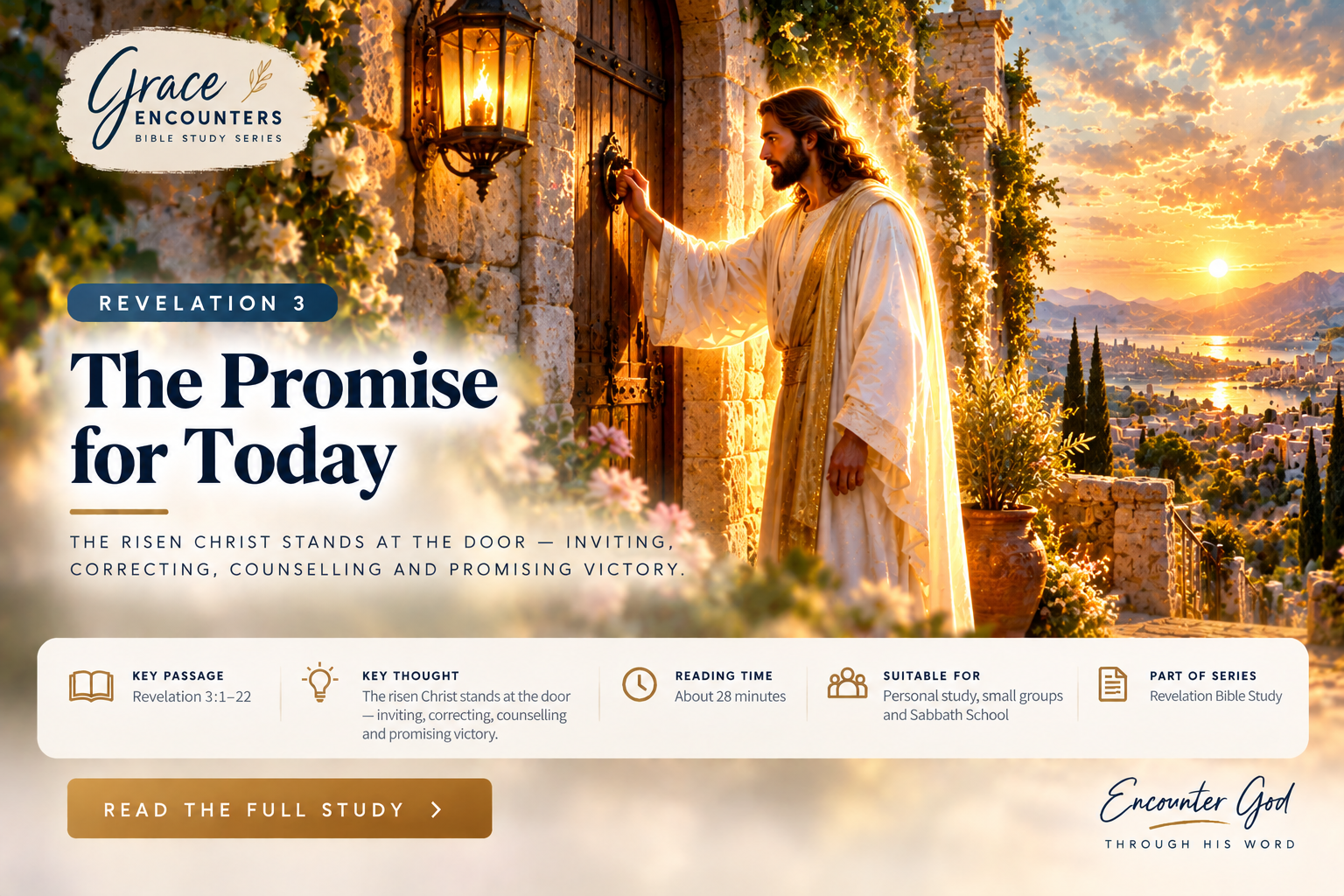
Key passage: Revelation 3
Revelation 3 completes Jesus’ messages to the seven churches.
Sardis has a reputation for being alive, but Jesus says it is dying.
Philadelphia has very little strength, but Jesus finds faithfulness there.
Laodicea believes it is rich and needs nothing, but Jesus says it is poor, blind and naked.
Three churches.
Three very different spiritual conditions.
Yet behind every diagnosis stands the same Saviour.
And perhaps the central message of Revelation 3 is much simpler than we sometimes make it:
Get with Jesus and stay with Jesus.
Because the Christian life was never meant to be lived independently of Him.
Before We Begin: How Should We Read These Churches?
The seven churches were real congregations in Asia Minor, and Jesus addressed real circumstances within them.
But their messages reach far beyond the first century.
Each church represents spiritual conditions that can exist in Christians and congregations in any generation. Within the historicist understanding of Revelation, the seven churches have also traditionally been understood as reflecting broad periods in the history of Christianity. This was not merely an Adventist interpretation. Many early Protestant interpreters also understood the seven churches as representing successive periods or conditions in Christian history, although their specific identifications and timelines varied. Adventists inherited this broader Protestant historicist framework and developed it further in connection with their understanding of Daniel and Revelation.
But we should be careful not to become so interested in identifying historical periods that we miss Jesus’ repeated words:
“He that hath an ear, let him hear what the Spirit saith unto the churches.”
That makes these messages personal.
The question is not only:
Which period of church history does this describe?
It is also:
Lord, is this describing me?
SARDIS
A Name That Says “Alive”
“I know thy works, that thou hast a name that thou livest, and art dead.”
— Revelation 3:1, KJV
Sardis presents us with a frightening possibility.
It is possible to have the reputation of spiritual life without actually possessing it.
People looking at Sardis apparently saw life.
Jesus saw something different.
This immediately confronts us with the difference between reputation and reality.
I may be known as a Christian.
I may belong to the right church.
I may understand Scripture.
I may participate in ministry.
I may know prophecy.
I may even have a reputation for being deeply spiritual.
But Jesus sees beyond everything other people see.
He sees the heart.
And His diagnosis of Sardis is:
“Thou hast a name that thou livest, and art dead.”
The One Who Has the Spirit
Jesus introduces Himself as:
“He that hath the seven Spirits of God, and the seven stars.”
Seven in Revelation repeatedly communicates completeness. The picture is therefore of the fullness of God’s Spirit.
That is significant because Sardis needs life.
And Jesus possesses exactly what Sardis lacks.
Even His introduction contains the remedy.
Jesus is not simply saying:
“You are dead.”
He is standing before a dying church as the One who can give life.
“Strengthen the Things Which Remain”
“Be watchful, and strengthen the things which remain, that are ready to die.”
— Revelation 3:2
Everything is not gone.
Something remains.
There is still something Jesus can revive.
Then He says:
“Remember therefore how thou hast received and heard, and hold fast, and repent.”
— Revelation 3:3
Remember.
Hold fast.
Repent.
Return.
This is not the language of a Saviour who has given up on His people.
It is the voice of Someone calling them home.
Sardis and the Reformation
Within the historicist Adventist understanding, Sardis broadly reflects the post-Reformation period. This general association was not invented by Adventists. It belongs to a wider Protestant historicist tradition in which the seven churches were understood as symbolising successive eras or conditions in Christian history. Early Protestant interpreters commonly connected Sardis with a later period of decline following the Reformation, though they did not all agree on the exact dates or historical details. Adventists adopted this historicist approach and placed Sardis broadly in the post-Reformation era.
The Reformation recovered magnificent truths.
The Bible returned to the hands of ordinary people.
Justification by faith was proclaimed.
The authority of Scripture challenged centuries of accumulated tradition.
Men and women risked their lives rather than surrender the truths they discovered in God’s Word.
But there is an irony here.
The Reformers themselves continued searching.
They followed the light they received.
Yet later generations could preserve the Reformers’ discoveries without possessing the Reformers’ willingness to continue following truth wherever Scripture led.
A movement can begin in revival and eventually become an institution.
A living experience can become a creed.
Yesterday’s discovery can become today’s boundary.
And so Jesus says:
Remember what you received. Hold fast. Keep going.
The Reformation principle cannot merely be:
“Our Reformers discovered truth.”
It must remain:
We continue allowing Scripture to reform us.
The Question of Overcoming
Then we reach a verse that can trouble sincere Christians:
“He that overcometh, the same shall be clothed in white raiment.”
— Revelation 3:5
It is easy to read “overcometh” and immediately think:
I must overcome every sin.
So we try harder.
And harder.
We watch ourselves.
We measure ourselves.
We fail.
We promise God we will do better.
Then we fail again.
And eventually the Christian life can become an exhausting attempt to make ourselves good enough to qualify as “overcomers”.
But notice what Jesus promises the overcomer:
white raiment.
Where does that garment come from?
Not from us.
Throughout Scripture, our hope is not the righteousness we manufacture.
Our covering is Christ’s righteousness.
That changes the question.
Overcoming cannot mean achieving spiritual independence successfully enough that eventually we no longer need Jesus.
That would contradict the gospel.
Jesus said:
“Without Me ye can do nothing.”
— John 15:5
The Christian life begins with dependence upon Christ and continues through dependence upon Christ.
The Disease Beneath the Symptoms
This brings us to something important.
We often think the Christian problem is primarily our individual sins.
Temper.
Pride.
Jealousy.
Selfishness.
Lust.
Materialism.
Gossip.
Unforgiveness.
And certainly Scripture calls sin by its name.
But those behaviours are also symptoms of something deeper.
The fundamental spiritual problem is attempting to live independently of Jesus.
When connection with Christ weakens, the symptoms begin appearing.
That is why simply attacking individual behaviours can become exhausting.
We keep trimming the fruit while ignoring the root.
Jesus gave us the picture Himself:
“Abide in Me, and I in you… for without Me ye can do nothing.”
— John 15:4–5
The branch does not struggle to manufacture grapes.
It remains connected to the vine.
Life flows through the connection.
And fruit follows.
This does not make obedience unimportant.
It explains where obedience comes from.
Get With Jesus and Stay With Jesus
That may be one of the simplest ways to describe the Christian life:
Get with Jesus and stay with Jesus.
Come to Him.
Know Him.
Talk to Him.
Listen to Him through Scripture.
Surrender to Him.
Walk with Him.
And when you fall?
Return to Him.
When you discover something ugly in yourself?
Bring it to Him.
When you realise you have wandered?
Come home.
The answer to failure is not running away from Jesus until we have repaired ourselves.
The answer is running to Jesus because we cannot repair ourselves.
“I Will Not Blot Out His Name”
Jesus continues:
“I will not blot out his name out of the book of life, but I will confess his name before My Father, and before His angels.”
— Revelation 3:5
Sometimes we focus entirely on the frightening possibility contained in this verse.
But listen to the promise.
Jesus says:
I know your name.
And then:
I will speak your name before My Father.
Christianity is profoundly personal.
Jesus does not merely save populations.
He knows people.
Names.
Stories.
Failures.
Tears.
Battles nobody else sees.
And He knows those who are His.
PHILADELPHIA
“You Have a Little Strength”
Then Jesus speaks to Philadelphia.
And this church is different.
“I know thy works: behold, I have set before thee an open door, and no man can shut it: for thou hast a little strength.”
— Revelation 3:8
Those words are beautiful:
“Thou hast a little strength.”
Not enormous strength.
Not heroic strength.
Not perfect faith.
A little strength.
And Jesus does not rebuke them for it.
He continues:
“and hast kept My word, and hast not denied My name.”
Philadelphia teaches us something important about faithfulness.
Sometimes faithfulness does not look powerful.
Sometimes faithfulness is simply saying:
Jesus, I hardly have strength left, but I am still holding onto You.
And Jesus says:
I know.
The Open Door
Jesus introduces Himself as:
“He that is holy, He that is true, He that hath the key of David, He that openeth, and no man shutteth; and shutteth, and no man openeth.”
— Revelation 3:7
The language echoes Isaiah 22:22 and communicates authority.
Jesus holds the key.
Jesus opens.
Jesus shuts.
And then He says:
“I have set before thee an open door.”
Within Adventist understanding, this language has particular significance in relation to Christ’s ministry in the heavenly sanctuary.
After the disappointment of 1844, early Advent believers returned to Scripture and gradually understood that Daniel 8:14 was not predicting the cleansing of the earth by Christ’s return. They understood it as pointing towards Christ’s continuing ministry in the heavenly sanctuary.
But we should never allow sanctuary terminology to become merely a prophetic diagram.
The sanctuary is about Jesus.
Our High Priest.
Our Advocate.
Our Mediator.
The One through whom we approach the Father.
The Door Was Opened at Calvary
There is an even larger biblical picture here.
When Jesus died:
“the veil of the temple was rent in twain from the top to the bottom.”
— Matthew 27:51
The barrier was torn.
And significantly, it was torn from the top downward.
God opened the way.
Hebrews tells us:
“Having therefore, brethren, boldness to enter into the holiest by the blood of Jesus… let us draw near.”
— Hebrews 10:19, 22
That changes the way we see the sanctuary.
The sanctuary is not a picture of God trying to keep sinners away.
It reveals what God has done through Christ to bring sinners near.
The door is open because of Jesus.
“I Will Keep Thee”
Then comes another promise:
“Because thou hast kept the word of My patience, I also will keep thee from the hour of temptation.”
— Revelation 3:10
Notice who does the keeping.
Jesus.
This matters enormously when Revelation begins describing the final crisis.
We can easily read prophecy and start wondering:
Will I be strong enough?
Will I survive?
Will I stand?
Will I have enough faith?
But Philadelphia redirects the question.
Our confidence is not:
I will become strong enough to keep myself.
Our confidence is:
Jesus is able to keep me.
Jude says:
“Now unto Him that is able to keep you from falling, and to present you faultless before the presence of His glory with exceeding joy.”
— Jude 24
That is where our security lies.
“Hold Fast”
“Behold, I come quickly: hold that fast which thou hast.”
— Revelation 3:11
Philadelphia does not need to become impressive.
Jesus simply says:
Hold on.
And perhaps there are seasons when that is exactly what faith looks like.
Not great emotional victories.
Not extraordinary spiritual experiences.
Just:
I am still here, Jesus.
And He says:
I know.
LAODICEA
The Church That Does Not Know
Then we reach the final church.
Laodicea.
And the most frightening thing about Laodicea is not merely its condition.
It is that Laodicea does not know its condition.
Jesus says:
“Because thou sayest, I am rich, and increased with goods, and have need of nothing.”
But Jesus sees something completely different:
“and knowest not that thou art wretched, and miserable, and poor, and blind, and naked.”
— Revelation 3:17
Two diagnoses.
Laodicea’s diagnosis:
I need nothing.
Jesus’ diagnosis:
You need everything.
Blessed Are the Poor in Spirit
Compare Laodicea with Jesus’ first Beatitude:
“Blessed are the poor in spirit: for theirs is the kingdom of heaven.”
— Matthew 5:3
Why are the poor in spirit blessed?
Because they recognise their need.
They come empty-handed.
They know they need grace.
Laodicea’s problem is exactly the opposite.
Laodicea is desperately poor but feels rich.
Blind but thinks it sees.
Naked but believes itself clothed.
The danger is not having nothing.
The danger is having nothing and believing you have everything.
The Lost Coin
Jesus’ parables in Luke 15 give us a striking picture.
There is a lost sheep.
A lost coin.
A lost son.
The sheep is lost and helpless.
The prodigal eventually wakes up and says:
“I perish with hunger!”
He realises what has happened.
He knows he needs to go home.
But the coin?
The coin does not know it is lost.
It lies inside the house.
It has value.
It belongs to the owner.
But it is lost and has absolutely no awareness of its condition.
That is a powerful picture of Laodicea.
Laodicea is lost in the house.
Religious.
Respectable.
Possessing spiritual treasure.
But unaware of its own need.
Could This Be Us?
This is where Revelation 3 becomes particularly uncomfortable for Seventh-day Adventists.
We possess extraordinary biblical knowledge.
We understand the Sabbath.
The sanctuary.
The state of the dead.
The Second Coming.
Daniel.
Revelation.
The three angels’ messages.
The great controversy.
The health message.
We possess the writings of Ellen White.
We have an extraordinary prophetic heritage.
These are precious gifts.
But there is a danger.
We can begin defining spiritual wealth by what we know.
And without ever saying the words, our hearts can begin saying:
“I am rich, and increased with goods, and have need of nothing.”
We can know exactly what the 2,300 days mean and still neglect Jesus.
We can explain the beasts of Daniel and Revelation while barely speaking to Him.
We can defend the Sabbath without resting in Christ.
We can understand the sanctuary while failing to enter God’s presence.
We can possess truth intellectually while losing intimacy with the One who is Truth.
The problem is not possessing doctrine.
Truth matters enormously.
The problem begins when possession of truth becomes a substitute for possession by Christ.
Jesus Outside His Own Church
And then comes perhaps the most heartbreaking image in Revelation 3:
“Behold, I stand at the door, and knock.”
— Revelation 3:20
Who is Jesus speaking to?
His church.
And where is Jesus?
Outside.
Think about that.
The church can continue operating.
Services can happen.
Sermons can be preached.
Prophecy can be explained.
Committees can meet.
Bible studies can be conducted.
Songs can be sung.
And Jesus can still be outside the door.
That is Laodicea.
Religion functioning without intimacy with Christ.
But He Has Not Left
Yet Revelation 3:20 is not ultimately a picture of abandonment.
Because Jesus is still there.
He is knocking.
He has not said:
“You rejected Me, so I am finished with you.”
He calls.
He knocks.
He waits.
And then He says:
“If any man hear My voice, and open the door, I will come in to him.”
Notice the intensely personal language:
“If any man…”
Even when an entire church becomes Laodicean, Jesus still speaks to the individual heart.
If you hear Me.
If you open.
I will come in.
“I Will Sup With Him”
And what does Jesus want when He enters?
“I will come in to him, and will sup with him, and he with Me.”
A meal.
Fellowship.
Relationship.
Presence.
Jesus does not merely want theological agreement.
He wants communion.
He wants us.
That has been His desire throughout Scripture.
From Eden to the sanctuary.
From Bethlehem to Calvary.
From the torn veil to the heavenly sanctuary.
And eventually:
“Behold, the tabernacle of God is with men, and He will dwell with them.”
— Revelation 21:3
God has always been trying to bring His children home to Himself.
“As Many as I Love”
Before Jesus knocks, He explains why His words have been so severe:
“As many as I love, I rebuke and chasten.”
— Revelation 3:19
That changes everything.
Why does Jesus expose Laodicea?
Because He loves Laodicea.
When God shows us something in ourselves that hurts to see, He is not humiliating us.
He is bringing something into the light because He wants to heal it.
And our response does not need to be:
“I must fix this before God will accept me.”
Our response can simply be:
“Lord, I see it now. I give it to You.”
That is surrender.
Gold, White Raiment and Eye Salve
Jesus says:
“I counsel thee to buy of Me gold tried in the fire… and white raiment… and anoint thine eyes with eyesalve, that thou mayest see.”
— Revelation 3:18
Notice those two words:
“of Me.”
Everything Laodicea lacks is available in Christ.
Gold: faith working through love.
White raiment: Christ’s righteousness.
Eye salve: spiritual discernment through the Holy Spirit.
Laodicea does not need greater self-sufficiency.
Laodicea needs Jesus.
And Then Comes the Throne
The chapter ends with an astonishing promise:
“To him that overcometh will I grant to sit with Me in My throne.”
— Revelation 3:21
Think about the journey.
Jesus begins by telling Laodicea:
You are poor.
Blind.
Naked.
Lukewarm.
You do not even realise your condition.
And then He says:
Open the door.
And where does He intend to take the person who opens?
To His throne.
That is grace.
The strongest rebuke ends with extraordinary intimacy.
From Sardis to Philadelphia to Laodicea
Now look at these three churches together.
Sardis
“I have a name that I am alive.”
Jesus says:
Wake up.
Philadelphia
“I have little strength.”
Jesus says:
Hold on. I will keep you.
Laodicea
“I need nothing.”
Jesus says:
You need Me. Open the door.
And suddenly Revelation 3 becomes very personal.
Perhaps the safest place spiritually is not feeling strong.
Perhaps it is recognising our need.
Because the person who knows they have “little strength” holds tightly to Jesus.
The person who believes they need nothing may stop reaching for Him.
The Real Question
So perhaps Revelation 3 does not finally ask:
How strong are you?
It asks:
Who are you depending upon?
Not:
How much doctrine do you know?
But:
Do those truths lead you to Jesus?
Not:
Have you overcome everything?
But:
Are you abiding in the One who overcame?
Not:
Can you survive what Revelation says is coming?
But:
Do you trust the One who says, “I will keep you”?
Get With Jesus and Stay With Jesus
After all the symbols, history, prophecy and theology, perhaps the lesson really is this simple:
Get with Jesus and stay with Jesus.
When you are strong, stay with Jesus.
When you have little strength, stay with Jesus.
When you fall, go back to Jesus.
When He exposes something painful in you, surrender it to Jesus.
When you do not understand prophecy, stay with Jesus.
When you understand prophecy exceptionally well, stay with Jesus.
When the world becomes frightening, stay with Jesus.
Because the Christian life was never about becoming strong enough to live without Him.
It has always been about learning that we cannot live without Him.
Reflection
There is one prayer Revelation 3 invites us to pray:
“Jesus, show me what You see.”
That is a frightening prayer.
Because He may show us things we have not recognised.
But the One examining us is not an enemy searching for reasons to reject us.
He is the One standing at the door.
The One carrying the white garment.
The One offering the eye salve.
The One possessing the gold.
The One promising:
“I will keep you.”
And the One who ultimately says:
Come and sit with Me on My throne.
So we need not fear what Jesus reveals.
Whatever He exposes, we can surrender back to Him.
Prayer
Lord Jesus,
You are the Faithful and True Witness.
You see what nobody else sees.
You see beyond my reputation, my knowledge, my church membership and even the things I believe about myself.
Please show me what You see.
If there are places in my life that have become like Sardis, wake me up.
If I have only a little strength, teach me that little strength is enough when I place it in Your hands.
Help me hold onto You.
And when I am tempted to believe that I am spiritually rich because of everything I know, remind me that without You I have nothing.
Lord, I do not want to know about You while leaving You outside the door.
I want to know You.
Give me the gold only You can give.
Cover me with Your righteousness.
Anoint my eyes so that I may see.
And when You show me something in myself that needs to change, teach me not to hide from You or try to repair myself first.
Help me surrender it to You.
Thank You that when I have little strength, You are able to keep me.
Thank You that when I wander, You still knock.
Thank You that the door into Your presence stands open because of Jesus.
Keep me close to You.
Teach me to abide in You.
Get me to Jesus.
Keep me with Jesus.
And finish in me the work that only You can do.
Until the day when faith becomes sight and we finally hear:
“Behold, the tabernacle of God is with men, and He will dwell with them.”
In Jesus’ name,
Amen.
Final Thought
Sardis warns us that reputation is not relationship.
Philadelphia teaches us that little strength is enough when we remain faithful to Jesus.
Laodicea warns us that religious wealth can hide spiritual poverty.
And Jesus stands behind every message saying:
Come to Me.
Perhaps that is the message we should carry with us from Revelation 3:
We do not overcome by finally becoming independent of Jesus.
We overcome by remaining completely dependent upon Him.
Get with Jesus.
Stay with Jesus.
And trust Him to finish what He started.
“He that hath an ear, let him hear what the Spirit saith unto the churches.”
— Revelation 3:22
Grace Encounters | Bible Study Series
Revelation 1: The Glorified Christ and His Revelation
Continue to Revelation 2: Christ Among His Churches
Scriptures for Further Study
Take time to explore these passages alongside this study. Compare Scripture with Scripture, follow the connections, and allow the Bible to illuminate its own message.
Isaiah 22:20–22
Isaiah 55:1–3
Isaiah 61:10
Zechariah 3:1–5
Matthew 6:19–21
Matthew 22:1–14
Matthew 25:1–13
Luke 12:35–40
John 10:7–9
John 14:1–3
John 15:1–11
2 Corinthians 3:18
2 Corinthians 5:17–21
Hebrews 12:5–11
James 1:2–4
1 Peter 1:6–7
Revelation 1:9–20
Revelation 4:1–11
Revelation 7:9–17
Revelation 14:12
Revelation 19:6–9
Revelation 21:1–7