GRACE ENCOUNTERS | REVELATION BIBLE STUDY SERIES
Key Passage: Revelation 8:1–13 (KJV)
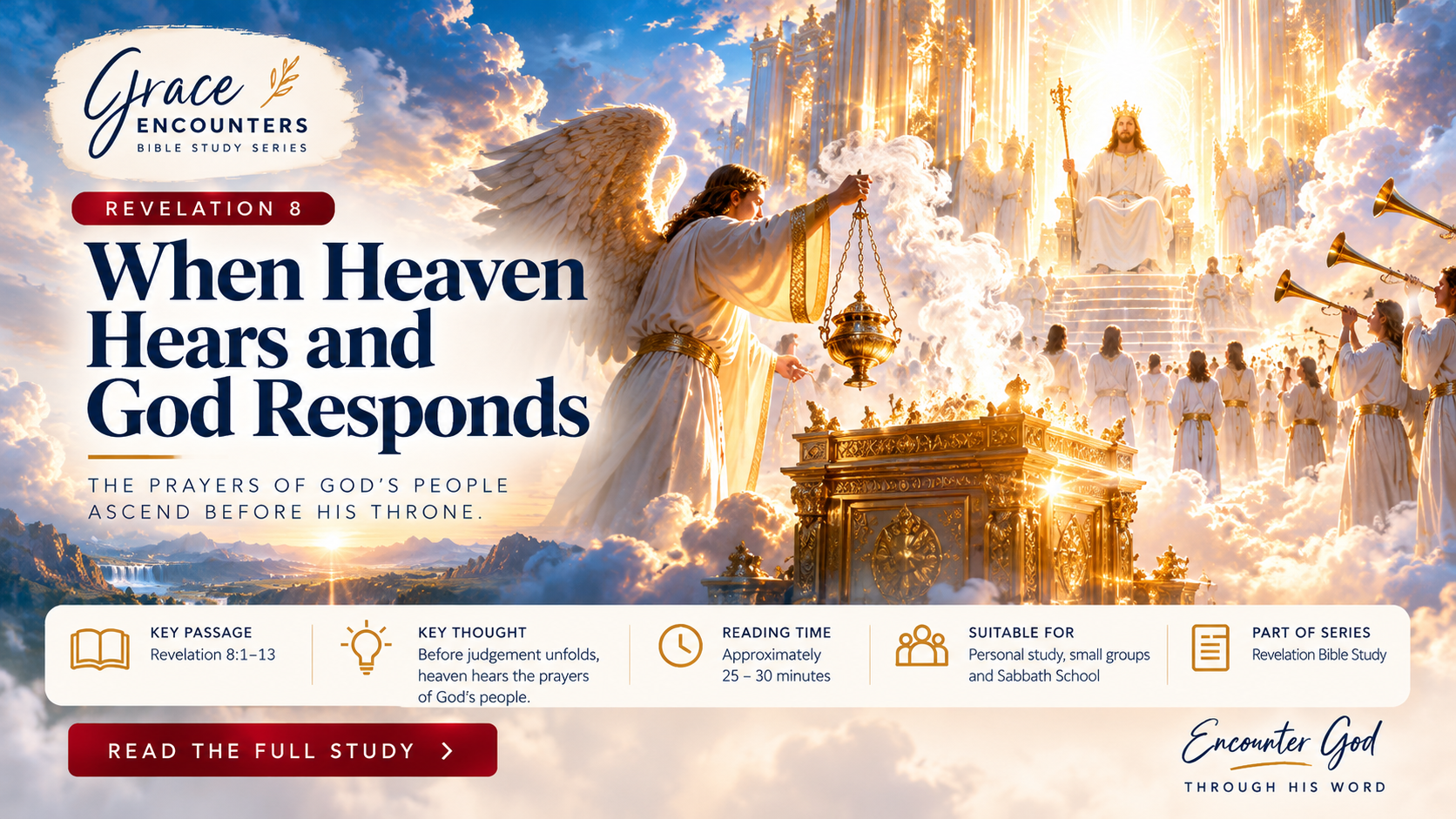
Key Thought: Before the trumpets sound, the prayers of God’s people ascend before His throne. Through the sanctuary and the trumpet warnings, we discover a God who hears, who restrains evil, who allows humanity to experience the consequences of rebellion, and who continues to call His children back to Himself.
Reading Time: Approximately 25–30 minutes
Introduction – Before the Trumpets Sound
In Revelation 7, we stood among the great multitude before God’s throne. We saw the redeemed clothed in white robes, holding palm branches, and heard the wonderful promise that God Himself would wipe away every tear.
The Lamb who was slain had become their Shepherd.
Now, as Revelation 8 begins, something unexpected happens.
Heaven falls silent.
The seventh seal is opened, and there is silence for approximately half an hour.
Then John sees seven angels standing before God, each receiving a trumpet.
We might expect the judgements to begin immediately.
But they do not.
Instead, John takes us into the heavenly sanctuary, where incense rises before God’s throne together with the prayers of His people.
This is where we must begin.
Throughout our studies of Revelation, we have repeatedly returned to one essential principle: God’s judgements must always be understood in the light of His character.
He is love. He is just. He is merciful. He does not delight in destruction, and He does not abandon His children.
The sanctuary reveals the God who has provided salvation through Jesus Christ. The trumpets reveal the consequences of rebellion and the warnings God sends throughout history.
Together, they tell us something remarkable.
Before judgement unfolds, heaven receives the prayers of God’s people.
Before destruction is described, we are reminded of our High Priest.
And before we attempt to identify the historical fulfilment of the trumpets, we must remember that Revelation is first and foremost the revelation of Jesus Christ.
1. The Seventh Seal – Silence in Heaven (Revelation 8:1)
“And when he had opened the seventh seal, there was silence in heaven about the space of half an hour.”
The opening of the seventh seal completes the sequence begun in Revelation 6.
The first six seals revealed the unfolding experiences of God’s people, including persecution, suffering, cosmic signs and the approach of the great day of God’s wrath.
Revelation 7 interrupted that sequence to answer an important question:
Who shall be able to stand?
We discovered that those who stand are not people who have earned their place through their own righteousness. They are those who have washed their robes in the blood of the Lamb.
Now the seventh seal opens.
And heaven becomes silent.
What does the silence mean?
Within traditional Seventh-day Adventist historicism, this silence has often been associated with the Second Coming of Christ.
According to this interpretation, Christ and the heavenly angels leave heaven to gather the redeemed, and heaven becomes silent in anticipation of their homecoming.
Some interpreters apply the day-year principle to the symbolic half-hour, suggesting approximately seven literal days.
However, Scripture does not explicitly identify the silence with the Second Coming, nor does it require this calculation.
Other interpreters understand the silence as a solemn pause before divine judgement, recalling Habakkuk 2:20:
“But the LORD is in His holy temple: let all the earth keep silence before Him.”
Both interpretations recognise the solemn significance of the moment.
What we can say with confidence is that the seventh seal marks an important transition.
The Lamb remains in control of history.
The suffering of His people has not been forgotten.
And God’s purposes are moving towards their final fulfilment.
2. The Seven Trumpets – Another Perspective on History (Revelation 8:2)
“And I saw the seven angels which stood before God; and to them were given seven trumpets.”
In Scripture, trumpets were used to announce important events, gather God’s people, prepare for battle and warn of approaching danger.
Numbers 10 describes their use among the Israelites.
Joel 2:1 declares:
“Blow ye the trumpet in Zion, and sound an alarm in my holy mountain…”
The trumpet is therefore not merely an instrument announcing destruction.
It is also an instrument of warning.
The seals and the trumpets
During our study, we recognised that Revelation does not always present events in one uninterrupted chronological sequence.
Instead, John frequently revisits the same broad historical period from different perspectives.
This is known as recapitulation.
The seven seals particularly reveal the experiences of God’s people as the gospel moves through history.
The seven trumpets emphasise divine warnings and judgements upon powers that oppose God and His people.
The sequences overlap, but their emphasis differs.
The seals reveal the suffering and perseverance of the faithful.
The trumpets reveal the consequences of rebellion and God’s interventions in human history.
Why do the trumpets matter?
One of our most important conclusions was that the trumpets should not be understood simply as seven acts of divine anger.
Throughout Scripture, God’s warnings serve a redemptive purpose.
He calls people to recognise their condition and return to Him.
Ezekiel 33:11 declares:
“As I live, saith the Lord GOD, I have no pleasure in the death of the wicked; but that the wicked turn from his way and live…”
This does not remove the seriousness of judgement.
Rather, it reveals the heart of the God who warns.
God’s purpose is not merely to expose rebellion, but to call people away from the destruction that rebellion brings.
3. The Golden Altar – Before Judgement, There Is Prayer (Revelation 8:3–4)
“And another angel came and stood at the altar, having a golden censer; and there was given unto him much incense, that he should offer it with the prayers of all saints upon the golden altar which was before the throne.”
Before the trumpets sound, John sees the golden altar of incense.
To understand the significance of this scene, we returned to the earthly sanctuary.
The sanctuary and the plan of salvation
God instructed Moses:
“And let them make me a sanctuary; that I may dwell among them.”
— Exodus 25:8
The sanctuary consisted of three principal areas.
The courtyard contained the altar of burnt offering, where sacrifices were presented.
The Holy Place contained the table of showbread, the lampstand and the golden altar of incense.
The Most Holy Place contained the ark of the covenant and the mercy seat.
These services pointed forward to Christ.
The sacrifices represented His atoning death.
The priestly ministry pointed towards His mediation.
The annual Day of Atonement foreshadowed the final removal of sin.
The sanctuary was therefore a revelation of the plan of salvation.
It showed how a holy God could restore His relationship with sinful humanity through the sacrifice and ministry of Jesus Christ.
The altar of incense
Exodus 30:1–10 describes the golden altar.
It stood before the veil separating the Holy Place from the Most Holy Place.
The priest offered incense there every morning and evening.
The incense represented prayer ascending before God.
David understood this symbolism when he wrote:
“Let my prayer be set forth before thee as incense; and the lifting up of my hands as the evening sacrifice.”
— Psalm 141:2
We also examined Luke 1:9–10.
While Zechariah entered the temple to burn incense, the people gathered outside were praying.
The priest offered incense.
The people prayed.
And now, in Revelation 8, John sees the heavenly counterpart.
The prayers of God’s people ascend before God’s throne.
The significance of the sequence
The seven angels have already received their trumpets.
Yet they do not sound them immediately.
First, John sees the prayers of the saints presented before God.
This is deeply significant.
Before the judgements begin, we are reminded that heaven hears.
The prayers of God’s people have not been forgotten.
4. Perpetual Incense – Learning to Live in Communion With God
During our sanctuary study, we stopped at a phrase in Exodus 30 that became particularly meaningful.
“And when Aaron lighteth the lamps at even, he shall burn incense upon it, a perpetual incense before the LORD throughout your generations.”
— Exodus 30:8
A perpetual incense before the Lord.
The priest offered incense morning and evening.
The ministry was continually maintained before God.
It was not an occasional ceremony performed only when circumstances became difficult.
It formed part of the daily rhythm of Israel’s worship.
Prayer as a continuing relationship
Paul writes:
“Pray without ceasing.”
— 1 Thessalonians 5:17
This does not mean that we must spend every waking moment speaking words of prayer.
It means that prayer becomes a continuing attitude of communion with God.
We deliberately set aside time for worship, but our relationship with Him does not end when we rise from our knees.
We can speak to Him while working, travelling, preparing meals or attending to ordinary responsibilities.
We can thank Him when something brings us joy.
We can turn towards Him when we are anxious.
We can ask for wisdom when facing a difficult decision.
And we can acknowledge our mistakes without waiting for a formal occasion.
Prayer becomes part of how we live.
Opening the heart to God
Ellen White writes in Steps to Christ, chapter 11:
“Prayer is the opening of the heart to God as to a friend.”
That description changes how we approach prayer.
We are not trying to inform God of something He does not already know.
We are opening our hearts to Him.
Prayer is not a performance.
It is communion.
And communion grows through relationship.
When songs become prayers
Not everyone finds spoken prayer easy.
Sometimes words fail us.
Sometimes our thoughts wander.
Sometimes it is easier to express what is in our hearts through music.
The Psalms remind us that songs can become prayers.
They contain praise, sorrow, confession, thanksgiving, longing and trust.
A song sincerely offered to God is no less meaningful because it is sung rather than spoken.
What matters is the heart that turns towards Him.
God is not asking us to become accomplished speakers. He is inviting us to know Him.
5. Christ, Our Ever-Living High Priest (Revelation 8:4)
“And the smoke of the incense, which came with the prayers of the saints, ascended up before God out of the angel’s hand.”
The incense rises with the prayers of God’s people.
But the effectiveness of those prayers does not depend upon human merit.
Hebrews 7:25 declares:
“Wherefore he is able also to save them to the uttermost that come unto God by him, seeing he ever liveth to make intercession for them.”
Here the earthly sanctuary’s continual ministry finds its fulfilment in Christ.
The earthly priests had to return to the altar each morning and evening.
They grew old and died.
Their ministry had to be continued by others.
But Jesus lives forever.
His priesthood is permanent.
He continues to intercede for those who come to God through Him.
When we do not know how to pray
Romans 8:26 reminds us that the Holy Spirit helps us in our weakness.
There are times when we do not know what to pray.
There are times when all we can say is, “Lord, help me.”
And there are times when we can only weep.
Yet our access to God does not depend upon our ability to express ourselves perfectly.
It rests upon Christ.
This is why Hebrews 4:16 invites us to approach the throne of grace with confidence.
We come because Jesus has made the way.
While we are learning to pray, Christ is already interceding for us.
6. The Prayers of the Saints – God Has Not Forgotten
There is a connection between the sanctuary scene and the fifth seal.
In Revelation 6:10, the martyrs cry:
“How long, O Lord, holy and true, dost thou not judge and avenge our blood…?”
They are told to wait.
Now, in Revelation 8, John sees the prayers of the saints ascending before God.
The passage does not say that these are exclusively the prayers of the martyrs, but the thematic connection is important.
God hears the cries of those who suffer.
He sees injustice.
He has not forgotten His people.
This does not mean that every prayer receives an immediate answer.
Nor does it mean that suffering ends as soon as we pray.
But it assures us that heaven is not indifferent.
God’s apparent silence must never be mistaken for His absence.
7. Fire From the Altar – Mercy and Judgement (Revelation 8:5–6)
“And the angel took the censer, and filled it with fire of the altar, and cast it into the earth: and there were voices, and thunderings, and lightnings, and an earthquake.”
The scene changes.
The censer associated with incense and prayer is filled with fire from the altar.
The fire is cast upon the earth.
Thunder, lightning and an earthquake follow.
These manifestations recall God’s presence at Mount Sinai (Exodus 19:16–19).
They are associated with divine authority and judgement.
The God who judges is also the God who saves
The sanctuary reminds us that God’s mercy and justice are not opposing characteristics.
He does not ignore evil.
He hears the cries of those who suffer.
He holds humanity accountable.
Yet His judgements must be understood within the larger story of redemption.
The trumpets unfold during the period of Christ’s heavenly ministry, according to the historicist understanding.
They are not identical to the seven last plagues, which occur after the close of probation.
The trumpets warn while mercy remains available.
And this brings us to an important principle that became central to our study.
8. Understanding God’s Judgements – When He Withdraws His Restraint
One of the most important questions we asked was whether every judgement described in Scripture means that God directly causes the destruction.
We discovered that Scripture presents more than one way in which judgement operates.
Sometimes God intervenes directly.
At other times, He permits people or nations to experience the consequences of their decisions.
God sometimes allows the consequences of rebellion
Romans 1 repeatedly describes God giving people over to the choices they persistently make.
In Isaiah 5:1–7, God describes a vineyard that has produced wild grapes despite His careful cultivation.
He then declares that He will remove its protective hedge.
The vineyard experiences the consequences of losing that protection.
We also considered Job.
Satan was permitted to afflict Job, but only within boundaries established by God.
God’s permission was not the same as Satan’s intention.
And it was not evidence that Job had been abandoned.
The connection with Job
Job 1:10–12 reveals that Satan recognised the protection surrounding Job.
He accused God of placing a hedge around Job, his household and everything he possessed.
Satan argued that Job served God only because God had blessed him.
God permitted Satan to test Job, but established limits.
In Job 2:6, God again restricted Satan’s actions.
This is a remarkable insight into the great controversy.
Satan was the accuser.
Satan desired Job’s destruction.
But Satan did not possess unlimited authority.
God established the boundaries.
This helps us understand the trumpet judgements.
The fact that God permits an event does not mean that He approves of the motives or actions of those who cause it.
Nor does it mean that the suffering of His people indicates that He has abandoned them.
Job suffered terribly, yet he remained precious to God.
God’s permission is not the same as His approval of evil.
Why would God allow consequences?
We considered the example of someone struggling with addiction.
If a person is continually protected from every consequence of destructive behaviour, that protection may prevent them from recognising the seriousness of their condition.
Sometimes allowing consequences can awaken the need for change.
The father in the parable of the prodigal son did not prevent his son from leaving.
He allowed him to make his choice.
But when the son returned, the father received him with compassion.
This does not mean that every hardship is a judgement or that suffering proves personal wrongdoing.
Job’s experience teaches us precisely the opposite.
Rather, it reminds us that God may sometimes allow the consequences of rebellion to reveal what sin truly produces.
Jesus wept over Jerusalem
Luke 19:41–44 gives us a particularly important picture of God’s character.
Jesus looked upon Jerusalem and wept.
He knew the destruction that would come.
Yet He did not rejoice in it.
He grieved because the city had failed to recognise the things that belonged to its peace.
The God who warns of judgement is the same God who weeps over those who reject His mercy.
This understanding became an important foundation for our interpretation of the trumpets.
We should not imagine God as eagerly bringing destruction upon humanity.
Instead, we must ask how His judgements reveal both the seriousness of rebellion and His continued desire to save.
9. The First Trumpet – Hail, Fire and Blood (Revelation 8:7)
“The first angel sounded, and there followed hail and fire mingled with blood, and they were cast upon the earth: and the third part of trees was burnt up, and all green grass was burnt up.”
The first trumpet introduces imagery of hail, fire, blood and destroyed vegetation.
These symbols recall the seventh plague upon Egypt in Exodus 9:22–26.
During that plague, hail and fire struck the land, destroying crops and trees.
The similarity is significant.
John is drawing upon the language of divine judgement already established in Scripture.
The traditional historicist interpretation
Uriah Smith and other historicist interpreters associated the first trumpet with the invasions of the Western Roman Empire by the Visigoths under Alaric.
During the late fourth and early fifth centuries, the Western Empire experienced growing military instability.
Alaric’s forces invaded Italy, and Rome was sacked in AD 410.
The destruction caused by warfare was understood as the fulfilment of the hail, fire and blood described in Revelation 8:7.
The burning vegetation symbolised the devastation inflicted upon the empire.
Another interpretation – The destruction of Jerusalem
Other Adventist interpreters have associated the first trumpet with the destruction of Jerusalem in AD 70.
This interpretation draws upon Jesus’ warnings in Matthew 24 and Luke 19, together with the covenant judgement language of the Old Testament.
Jesus wept over Jerusalem because the city had failed to recognise the things that belonged to its peace.
Its destruction was not something in which He delighted.
Our understanding
We recognised that the historical identification of the first trumpet remains disputed.
However, the traditional Western Roman interpretation provides a coherent historical sequence when considered alongside the second and fourth trumpets.
More importantly, we recognised that the judgement imagery must be understood through God’s character.
Rome had become a persecuting power.
Yet the destruction of the empire did not necessarily require God to directly produce every act of violence.
He could permit invading forces to act while withdrawing the protection and restraint that had previously limited their success.
This does not mean that the invaders themselves were righteous.
It means that God can work through the consequences of human decisions without approving the evil motives of those involved.
The destruction was serious, but it was limited.
Only a third is described as being affected.
Even in judgement, the language of the trumpets reminds us of restraint.
10. The Second Trumpet – The Burning Mountain (Revelation 8:8–9)
“And the second angel sounded, and as it were a great mountain burning with fire was cast into the sea: and the third part of the sea became blood.”
John sees something resembling a great burning mountain cast into the sea.
A third of the sea becomes blood.
A third of its living creatures die.
And a third of the ships are destroyed.
Understanding the symbolism
In biblical prophecy, mountains can symbolise kingdoms and powerful nations.
Jeremiah 51:25 describes Babylon as a destroying mountain that God will bring down.
The sea may represent peoples and nations, while the destruction of ships can point towards maritime warfare and economic disruption.
The imagery also recalls the first plague upon Egypt, when the waters were turned to blood (Exodus 7:20–21).
The Vandals and the Western Roman Empire
The traditional historicist interpretation associates the second trumpet with the Vandals under Gaiseric, also known as Genseric.
The Vandals moved through Gaul and Spain before establishing themselves in North Africa.
They captured Carthage in AD 439.
From there, Gaiseric developed a formidable naval power in the Mediterranean.
The Vandals sacked Rome in AD 455, and their naval campaigns severely weakened Western Roman power.
Roman attempts to defeat them at sea suffered major setbacks, including the disastrous expedition of AD 468.
This history gives particular significance to John’s reference to the sea and ships.
The second trumpet has therefore traditionally been understood as another stage in the weakening of Western Rome.
Why we must test prophetic interpretations
During this part of our study, we agreed that we should never accept a historical interpretation merely because it appears in an established commentary.
We must test it.
Does the proposed interpretation fit the biblical symbols?
Does it fit the historical chronology?
Does it agree with the broader prophetic sequence?
And does it remain consistent with the testimony of Scripture concerning God’s character?
Historicism is not unique to Seventh-day Adventism. Earlier Protestant interpreters also understood biblical prophecy as unfolding through history.
Their conclusions deserve examination, but no commentator replaces Scripture.
History may help us recognise the fulfilment of prophecy, but Scripture must remain the foundation of our interpretation.
Our prayer for understanding
This study prompted a prayer that became important to our approach to Revelation.
We asked God to open our minds to the deeper truths of His Word.
We did not want to read prophecy superficially or force our own preferred interpretation upon Scripture.
We wanted the Holy Spirit to guide our understanding.
And above all, we wanted our study to strengthen our confidence in the God we serve.
Not a distant, indifferent God.
But a living God who loves His children and continues to work for their salvation.
That is the purpose of studying prophecy.
Not merely to identify events, but to know the God who reveals them.
11. The Third Trumpet – Wormwood and the Corruption of Truth (Revelation 8:10–11)
“And the third angel sounded, and there fell a great star from heaven, burning as it were a lamp, and it fell upon the third part of the rivers, and upon the fountains of waters.”
The star is called Wormwood.
It falls upon the rivers and fountains of waters, turning them bitter.
Many people die because of the waters.
This trumpet led us into one of our most searching discussions.
The traditional interpretation – Attila and the Huns
Uriah Smith and other historicist interpreters associated the third trumpet with Attila and the Huns.
Attila’s campaigns devastated parts of the Roman Empire during the fifth century.
The falling star has been understood as a destructive power appearing suddenly, while the bitter waters represent the suffering and devastation caused by invasion.
However, we questioned whether this interpretation sufficiently explained the particular symbols John uses.
Why a star?
Why is it described as burning like a lamp?
Why does it fall upon rivers and fountains rather than simply upon cities or armies?
And why are the waters made bitter?
These questions led us back to Scripture.
The biblical meaning of the symbols
The falling star
Stars can represent angels or spiritual agents in prophetic symbolism.
Revelation 1:20 uses stars to represent the angels of the seven churches.
A falling star may therefore suggest a spiritual fall, although the symbol does not carry exactly the same meaning in every biblical passage.
The burning lamp
A lamp is associated with light.
Psalm 119:105 declares:
“Thy word is a lamp unto my feet, and a light unto my path.”
The star’s appearance as a burning lamp invites consideration of something that once appeared to provide light.
The rivers and fountains
Water is repeatedly associated with life and spiritual refreshment.
Jesus offered the Samaritan woman living water in John 4:13–14.
In Revelation 7:17, the Lamb leads the redeemed to living fountains of waters.
Wormwood
Wormwood represents bitterness and is associated with divine judgement and unfaithfulness.
Jeremiah 23:15 connects wormwood and poisoned water with corrupt prophets.
This Old Testament background became particularly significant.
Our preferred interpretation – Spiritual apostasy
After comparing the historical interpretations with the biblical symbols, we found the interpretation involving religious apostasy more persuasive.
The falling star can be understood as a spiritual power departing from its proper position.
The light that should illuminate becomes associated with corruption.
And the waters that should give life become bitter.
Applied historically, this interpretation points towards the growing corruption of professed Christianity as human traditions and ecclesiastical authority increasingly obscured biblical teaching.
Instead of directing people towards Christ as their only Mediator, religious systems developed practices that placed human authorities between the believer and God.
Instead of relying upon Scripture as the final authority, traditions acquired increasing doctrinal importance.
The result was spiritual confusion.
Testing religious teaching against Scripture
During our study, we considered several teachings that developed within medieval Christianity.
These included priestly absolution, purgatory and prayers intended to assist the dead.
We compared these teachings with the biblical presentation of Christ’s priesthood and the state of the dead.
Hebrews 7:25 identifies Christ as our continuing Intercessor.
Ecclesiastes 9:5 teaches that the dead know nothing.
Psalm 6:5 asks:
“For in death there is no remembrance of thee: in the grave who shall give thee thanks?”
Within our understanding of Scripture, these passages challenge the idea that the dead remain consciously involved in earthly religious affairs or that human priesthood can replace Christ’s unique mediatorial work.
Our concern is not to condemn individual believers.
God has sincere followers in many religious communities.
The question is whether religious teachings faithfully represent the gospel.
When living water becomes bitter
This was the central spiritual insight of our third-trumpet study.
Water should sustain life.
But in the vision, the water becomes bitter and causes death.
If the water represents spiritual truth, the image is deeply troubling.
It describes the tragedy of people seeking spiritual life from sources that have become corrupted.
And it reminds us why we must continually return to Scripture.
When human authority obscures Christ and His Word, what should give spiritual life can become a source of spiritual darkness.
This remains our preferred symbolic reading of the third trumpet. It is an interpretation rather than an explicit identification supplied by the text, and its precise historical application remains debated.
12. The Fourth Trumpet – The Darkening of Imperial Power (Revelation 8:12)
“And the fourth angel sounded, and the third part of the sun was smitten, and the third part of the moon, and the third part of the stars…”
The fourth trumpet brings darkness.
A third of the sun, moon and stars loses its light.
This imagery recalls Old Testament prophecies concerning the downfall of kingdoms.
Isaiah 13:10 describes the darkening of heavenly bodies in connection with judgement upon Babylon.
Ezekiel 32:7–8 uses similar imagery concerning Egypt.
The heavenly lights can therefore represent the authority, stability and glory of earthly powers.
The collapse of the Western Roman Empire
In our study, we examined the traditional historicist interpretation that associates the fourth trumpet with the final collapse of Western Roman imperial government.
The Western Empire had already suffered repeated invasions.
Its military power had weakened.
Its political institutions were increasingly unstable.
In AD 476, Odoacer deposed Romulus Augustulus, conventionally marking the end of the Western Roman Empire.
This date is significant, although the decline of Western Roman authority was a gradual historical process rather than a single event.
The fourth trumpet has traditionally been interpreted as the extinguishing of the political lights of Western Rome.
The imperial authority that once appeared powerful and enduring was brought to an end.
Why only one third?
We considered the significance of the repeated fraction.
The Western Roman Empire collapsed, but the Eastern Roman Empire continued, centred in Constantinople.
This provides a possible historical illustration of the limited scope suggested by the one-third imagery.
However, Scripture does not explicitly define the third as the Western Empire, so this connection remains part of the historicist interpretation rather than a stated biblical identification.
Connecting the prophetic timeline
Our discussion then moved to the broader prophetic sequence.
The fall of Western Rome created historical conditions in which medieval ecclesiastical authority could develop.
Within traditional Adventist historicism, several dates become important.
| Date | Historical or prophetic significance |
|---|---|
| AD 410 | Alaric and the Visigoths sack Rome |
| AD 439 | Vandals capture Carthage |
| AD 455 | Vandals sack Rome |
| AD 476 | Conventional date for the fall of the Western Roman Empire |
| AD 538 | Traditional Adventist starting point for the 1,260-year period of papal supremacy |
| AD 1798 | Traditional Adventist identification of the deadly wound of Revelation 13 |
| AD 1844 | Conclusion of the 2,300-year prophecy, reckoned from 457 BC in Adventist interpretation |
We were careful to distinguish these events.
The fall of Western Rome in AD 476 is not the deadly wound of Revelation 13.
The traditional Adventist interpretation associates that wound with events in AD 1798.
Likewise, the 2,300-year prophecy of Daniel 8 follows a separate prophetic calculation.
These periods should not be confused simply because they overlap historically.
The importance of the larger picture
This discussion reinforced a principle that has guided our Revelation studies.
Prophecy should not be interpreted as a collection of disconnected events.
The symbols, historical developments and prophetic time periods must be considered together.
But we must also resist the temptation to force every historical event into a prophetic symbol.
The goal is not to make history fit our preferred conclusions.
It is to allow Scripture to guide our understanding of history.
God’s Word must interpret our understanding of events, rather than our preferred understanding of events determining the meaning of God’s Word.
13. The Threefold Warning – Three Woes Remain (Revelation 8:13)
“And I beheld, and heard an angel flying through the midst of heaven, saying with a loud voice, Woe, woe, woe, to the inhabiters of the earth…”
The first four trumpets have sounded.
Now John hears a solemn announcement.
Three woes remain.
The KJV describes the messenger as an angel, while many modern translations follow Greek manuscript evidence that reads eagle.
The message is unmistakable.
The remaining trumpets will bring increasingly serious warnings.
The transition from four trumpets to three woes
The first four trumpets form a recognisable group.
Their imagery involves the earth, sea, rivers and heavenly lights.
The final three trumpets are introduced as woes.
The fifth and sixth trumpets appear in Revelation 9.
The seventh trumpet is announced in Revelation 11:15–19.
This distinction is important for the structure of our Bible studies.
Revelation 8 contains the first four trumpets, not all seven.
Our study of the remaining trumpets belongs to the following chapters.
A warning is still an invitation
The threefold announcement is solemn, but it also gives warning before the events unfold.
God does not leave humanity without a call to repentance.
The message of the trumpets becomes even clearer in Revelation 9:20–21, where John describes those who survive the judgements but still refuse to repent.
The tragedy is not merely that judgement has occurred.
It is that people continue to resist the very mercy that could save them.
This takes us back to God’s appeal in Ezekiel 33:11.
He takes no pleasure in the death of the wicked.
He calls them to turn and live.
14. Why Does Revelation Keep Saying One Third?
One expression appears repeatedly throughout the first four trumpets.
A third of the trees.
A third of the sea.
A third of the sea creatures and ships.
A third of the rivers.
A third of the heavenly lights.
The repetition is deliberate.
Partial judgement and divine restraint
The repeated fraction suggests limitation.
The judgements are serious, but they are not presented as the complete destruction of everything affected.
This is one of the important differences between the trumpets and the seven last plagues.
The trumpet judgements occur within the unfolding history of a world where the gospel is still being proclaimed.
The final plagues occur after the close of probation.
Mercy remains available
Throughout Scripture, God warns before final judgement.
He warned the antediluvian world through Noah.
He warned Israel through the prophets.
Jesus warned Jerusalem.
And Revelation presents repeated appeals before the final crisis.
The partial nature of the trumpet judgements is consistent with this pattern.
God’s warnings reveal the seriousness of sin while reminding us that the opportunity to repent has not yet come to its final end.
We should not assume that the fraction must always represent an exact mathematical proportion of a historical territory or population.
Within Revelation’s symbolic language, its repeated use communicates the limited scope of the judgements.
15. The Sanctuary, the Trumpets and the Great Controversy
As we bring Revelation 8 together, we discover that the sanctuary scene and the trumpets are not separate subjects.
They belong to the same story.
The sanctuary reveals Christ’s continuing ministry for humanity.
The trumpets reveal the seriousness of rebellion and the consequences that unfold throughout history.
And both must be understood within the great controversy between Christ and Satan.
God’s character is at the centre
One of the questions we repeatedly asked was whether God’s judgements contradict His love.
But Scripture presents a God whose love and justice are inseparable.
He cannot be indifferent to suffering.
He cannot approve of evil.
Yet He continually seeks to restore those who have turned away from Him.
The story of the prodigal son reminds us that God allows human beings to make real choices.
The story of Job reminds us that suffering does not necessarily indicate God’s displeasure.
And Jesus weeping over Jerusalem reminds us that divine judgement is not something in which God takes pleasure.
These truths help us understand the trumpets without reducing God to either a harsh destroyer or a passive observer.
The prayers of the saints
Perhaps the most beautiful connection is between the fifth seal and the golden altar.
In Revelation 6, the martyrs cry, “How long?”
In Revelation 8, the prayers of God’s people ascend before God.
The message is one of assurance.
God hears.
He remembers.
And His purposes will be fulfilled.
The sanctuary reminds us that Christ continues to minister for His people even while history unfolds.
We are not abandoned to the events described in prophecy.
While judgement unfolds on earth, Christ continues His ministry of intercession in heaven.
And this brings us back to the perpetual incense.
Our lives are not meant to be lived independently of God, with occasional moments of prayer added when we need help.
We are invited into continuing communion with Him.
Grace Encounter – Lord, Give Me a Posture of Prayer
There is one phrase from this study that has stayed with me.
“A perpetual incense before the LORD.” (Exodus 30:8)
We began by studying the sanctuary and the seven trumpets. We explored historical events, the fall of empires, religious apostasy and the solemn warnings of judgement.
But somewhere in the middle of all those prophetic symbols, God brought my attention back to something very personal.
Prayer.
I have always struggled with prayer.
Not because I do not want to speak to God, but because I sometimes find it difficult to know how.
I can study His Word for hours. I can recognise connections between passages and become deeply moved by what I discover.
And I can sing.
Often, when I sing, I think of my songs as my prayers.
Music has always given me a way to express things that I struggle to put into ordinary words.
But as we studied the perpetual incense, I began to realise that perhaps I have been thinking about prayer too narrowly.
Prayer does not have to be confined to a particular place, a particular time or a particular form.
It is not something I must perform correctly before God will listen.
Ellen White describes prayer as opening the heart to God as to a friend.
And that is what I want.
I want to speak to God as naturally as I speak to my children or my parents.
I want Him to be part of the ordinary conversations of my day.
When something makes me happy, I want to share it with Him.
When something troubles me, I want to turn towards Him.
When I see something beautiful, I want my heart to respond with gratitude.
When I am uncertain, I want to ask Him for wisdom.
And when I have nothing to say, I want to be comfortable simply being in His presence.
I do not want prayer to be something I remember to do only when I have reached the end of my own understanding.
I want to learn to live with Him.
That is what the perpetual incense has come to represent for me.
A heart continually open towards God.
And there is another thought that makes this even more precious.
While I am learning to pray, Jesus is already interceding for me.
Hebrews 7:25 tells us that He ever lives to make intercession.
My prayers do not depend upon my ability to find the right words.
They rest upon His grace.
What a beautiful assurance.
The God who governs the universe, who sees the rise and fall of kingdoms, who hears the cries of His suffering people and who will one day bring evil to an end, is the same God who invites me to speak to Him as a friend.
And perhaps that is the greatest lesson I want to carry from Revelation 8.
I do not simply want to understand what God is doing in history. I want to know the God who is doing it.
I want my study of prophecy to draw me closer to Him.
I want His Word to shape my understanding of His character.
And I want my life to become a continuing conversation with the One who loves me.
Not merely morning and evening.
But throughout the day.
A perpetual incense before the Lord.
Closing Prayer – Teach Me to Live in Your Presence
Heavenly Father,
Thank You for the privilege of opening Your Word and discovering more of who You are.
Lord, as we study these solemn prophecies, please protect us from reading Your Word superficially or imposing our own interpretations upon it.
Open our minds to the deeper truths You have revealed.
Give us discernment to distinguish between what Scripture clearly teaches and what we are still learning to understand.
Let Your Holy Spirit guide us into truth.
And above all, let everything we discover strengthen our confidence in Your character.
I do not want to know You merely as the God who rules over history.
I want to know You as my Father, my Redeemer and my Friend.
Lord, teach me to pray.
You know how often I struggle to find the right words.
You know how easily I become distracted and how often I wait for a formal moment before speaking to You.
Please give me a posture of prayer.
Teach me to include You in the ordinary moments of my life.
When I am happy, let me share my joy with You.
When I am afraid, let me turn towards You.
When I am uncertain, remind me to seek Your wisdom.
When I am disappointed, teach me to bring my heart honestly before You.
And when I cannot find the words, receive the songs and quiet longings of my heart.
Lord Jesus, thank You for being my High Priest.
Thank You that You ever live to make intercession for me.
Thank You that my prayers are made acceptable through Your righteousness and not through my own worthiness.
As we continue studying Revelation, help us to see Your love even in the solemn warnings of judgement.
May we never become so absorbed in identifying prophetic events that we lose sight of the Lamb.
Let our understanding of Your Word lead us into deeper trust, greater obedience and a more intimate relationship with You.
And may our lives reveal to others that we serve a living God.
A God who hears.
A God who cares.
A God who loves.
A God who continues to call His children home.
Keep our hearts open to You.
Let the incense of our prayers rise continually before Your throne.
In Jesus’ precious name,
Amen.
Scriptures for Further Study
The Sanctuary and Prayer
- Exodus 25:8
- Exodus 30:1–10
- Psalm 141:1–2
- Luke 1:8–10
- Hebrews 4:14–16
- Hebrews 7:23–28
- Hebrews 8:1–5
- Romans 8:26–27
- 1 Thessalonians 5:16–18
The Trumpets and Judgement
- Exodus 7:14–25
- Exodus 9:22–26
- Job 1:6–12; 2:1–6
- Isaiah 5:1–7
- Isaiah 13:9–13
- Jeremiah 23:13–15
- Jeremiah 51:25
- Ezekiel 32:7–8
- Ezekiel 33:11
- Luke 15:11–32
- Luke 19:41–44
- Romans 1:18–32
- Revelation 6:9–11
- Revelation 7:1–3
- Revelation 9:20–21
Further Reading
- Ellen G. White, Steps to Christ, Chapter 11, “The Privilege of Prayer”.
- Ellen G. White, The Great Controversy, on the development of medieval Christianity and the Reformation.
- Uriah Smith, Daniel and the Revelation, for the traditional historicist interpretation of the trumpets.
- Ranko Stefanović, Revelation of Jesus Christ, for alternative Adventist interpretations of the trumpet sequence.
- Seventh-day Adventist Biblical Research Institute, studies on the interpretation of the seven trumpets.
Continue Your Study
Next: Revelation 9 – The Fifth and Sixth Trumpets
In Revelation 9, the fifth and sixth trumpets introduce the first two woes. The imagery becomes more intense, but the central question remains: Will humanity respond to God’s warnings with repentance?
Encounter God Through His Word.
Grace Encounters | graceencounters.org.za
WordPress Publishing Details
Title: Revelation 8 – When Heaven Hears and God Responds
Excerpt: Before the trumpets sound, John sees the prayers of God’s people ascending before His throne. Explore the sanctuary, perpetual incense, the first four trumpets and the mercy revealed in God’s judgements.
Slug: revelation-8-when-heaven-hears-and-god-responds
Category: Bible Study
Featured Image Key Thought: Before judgement unfolds, heaven hears the prayers of God’s people.
Image Alt Text: A golden altar of incense in the heavenly sanctuary, with smoke rising towards a radiant throne and seven angels holding trumpets in the background.
Image Caption: Before the trumpets sound, the prayers of God’s people rise before His throne.
Image Description: A reverent depiction of the heavenly sanctuary, featuring the golden altar of incense, rising smoke and seven angels holding trumpets. The scene emphasises Christ’s intercession and God’s attentiveness to prayer rather than destruction.