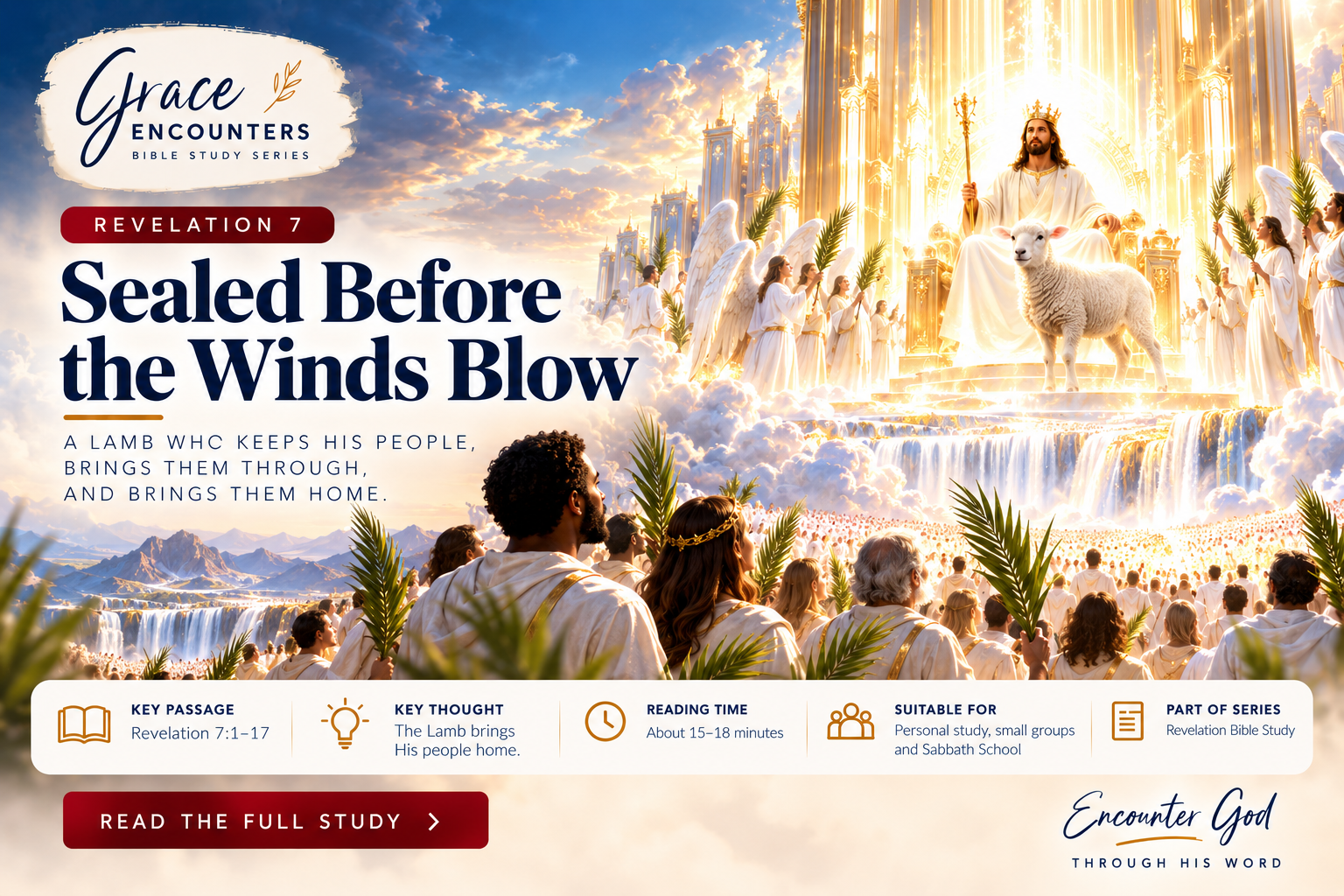
Grace Encounters | Bible Study Series
Key Thought:
Before the winds are released, God seals His people. When the storm is over, John sees them standing before the throne. Revelation 7 is not ultimately about whether God’s people will be strong enough to survive the final crisis. It is about the Lamb who is able to keep His people, bring them through, and bring them home.
Reading Time: Approximately 15–18 minutes
Who Shall Be Able to Stand?
Revelation 7 does not begin a completely new story. It answers the question with which Revelation 6 ended:
“For the great day of his wrath is come; and who shall be able to stand?”
— Revelation 6:17
The sixth seal left humanity confronted by the coming of Christ. Kings, rulers, rich and poor alike recognised that earthly power could no longer protect them.
Then, before the seventh seal is opened, Revelation pauses.
John is shown something God wants us to understand before the story continues.
There will be people who stand.
Revelation 7 shows us who they are, how they are prepared, and ultimately why they are able to stand.
Revelation 7:1–3 — The Winds Are Held Back
John sees four angels standing at the four corners of the earth, holding back the four winds so that they cannot blow upon the earth.
Throughout Scripture, winds can represent destructive forces, conflict and judgement.
Daniel saw “the four winds of the heaven” striving upon the great sea before the kingdoms represented by four beasts arose (Daniel 7:2–3). Jeremiah also used wind as imagery for judgement and destruction (Jeremiah 49:36).
But in Revelation 7 the winds are not yet allowed to blow.
Something must happen first.
Another angel ascends from the east carrying “the seal of the living God” and cries:
“Hurt not the earth, neither the sea, nor the trees, till we have sealed the servants of our God in their foreheads.”
— Revelation 7:3
Before God permits the final crisis to unfold, He prepares His people.
This tells us something important about God.
Judgement is not reckless.
God does not lose control of history.
The winds remain restrained until His work in His people has been accomplished.
The Seal of the Living God
The idea of God’s seal does not suddenly appear in Revelation.
In Ezekiel 9, before judgement fell upon Jerusalem, a mark was placed upon the foreheads of those who grieved over the abominations being committed in the city.
The New Testament also uses sealing language.
Paul writes:
“In whom also after that ye believed, ye were sealed with that holy Spirit of promise.”
— Ephesians 1:13
And:
“Grieve not the holy Spirit of God, whereby ye are sealed unto the day of redemption.”
— Ephesians 4:30
A seal communicates ownership, authenticity and belonging.
Revelation later presents a direct contrast between those who belong to God and those who receive the mark of the beast.
The forehead is particularly significant. Biblically, it represents the mind, conviction and allegiance.
The final conflict therefore concerns much more than an outward mark.
The deeper questions are:
Who has my allegiance?
Whom do I trust?
Whom do I worship?
To whom do I belong?
The sealing is not God placing an arbitrary label upon people. It represents people becoming settled in their allegiance to Him.
They know the Lamb.
They trust the Lamb.
And when the winds finally blow, they do not compromise their allegiance to Him. But their confidence is not in the strength of their own grip upon Christ. It is in the strength of Christ’s grip upon them.
The God who seals His people is the God who keeps His people.
Their faithfulness is real, but it is the fruit of His faithfulness. They stand because they have learned to depend completely upon the One who is “able to keep you from falling” (Jude 24).
The question is not ultimately, “Will I be strong enough to hold on to Jesus?”
It is:
“Will I trust Jesus enough to let Him hold on to me?”
Revelation 7:4–8 — The 144,000
John hears:
“And I heard the number of them which were sealed: and there were sealed an hundred and forty and four thousand…”
— Revelation 7:4
The number is organised according to twelve tribes of Israel, twelve thousand from each tribe.
But this is an unusual tribal list.
The order differs from Old Testament lists. Dan is absent. Ephraim is not named, although Joseph is included. Levi, which often had a distinctive position because of its priestly role, appears among the tribes.
These features are among the reasons many interpreters understand the list symbolically rather than as a literal genealogical census of ethnic Israel.
The number itself is highly structured:
12 × 12 × 1,000 = 144,000
Twelve repeatedly represents God’s covenant people in Scripture: twelve tribes of Israel and twelve apostles of the Lamb.
Revelation itself later joins these images together in the New Jerusalem, which has the names of the twelve tribes on its gates and the names of the twelve apostles in its foundations (Revelation 21:12–14).
Christ’s redeemed people are gathered from across humanity.
This becomes especially significant when we reach verse 9.
Revelation 7:9 — “A Great Multitude, Which No Man Could Number”
John now says:
“After this I beheld, and, lo, a great multitude, which no man could number, of all nations, and kindreds, and people, and tongues…”
Notice the movement.
John HEARS the number 144,000.
Then:
John SEES an innumerable multitude.
We have already encountered this literary pattern in Revelation.
In Revelation 5 John heard:
“the Lion of the tribe of Juda.”
But when he looked, he saw:
“a Lamb as it had been slain.”
There are not two different Christs. John hears one description and then sees the reality from another perspective.
This provides strong support for understanding the 144,000 and the great multitude in a similar way.
John hears God’s people described symbolically as numbered Israel, sealed and prepared for the conflict.
Then he sees them as an innumerable multitude drawn from every nation, people and language, standing victorious before God.
The 144,000 show us God’s people prepared for the conflict.
The great multitude shows us God’s people having come through it.
And now Revelation 6:17 finally receives its answer.
“Who shall be able to stand?”
John sees:
“…a great multitude…standing before the throne, and before the Lamb.”
Here they are.
They are standing.
White Robes and Palm Branches
The multitude is:
“…clothed with white robes, and palms in their hands.”
— Revelation 7:9
White garments have already appeared in Revelation as symbols of purity, righteousness and victory.
The palm branches also communicate celebration and triumph.
These are not defeated refugees barely escaping catastrophe.
They are victorious.
Before Revelation tells us more about the conflict ahead, God allows John to see the destination.
They make it through.
They are standing.
They are clothed.
They are safe.
They are worshipping.
They are home.
This changes the way we read the frightening passages of Revelation.
God does not reveal the coming crisis merely to frighten His people.
Before showing us more of the storm, He shows us where His children will be when it is over.
Revelation 7:10 — They Know Why They Are There
The great multitude cries:
“Salvation to our God which sitteth upon the throne, and unto the Lamb.”
Notice what they do not sing about.
They do not celebrate their own strength.
They do not congratulate themselves for understanding prophecy.
They do not proclaim how successfully they endured the tribulation.
Their song is about God.
Their song is about the Lamb.
They know exactly why they are standing there.
Salvation belongs to Him.
This protects the doctrine of the sealing from becoming a doctrine of spiritual self-sufficiency.
The sealed are not people who eventually become so spiritually accomplished that they no longer need Christ.
Quite the opposite.
They have become so settled in Christ that they refuse to leave Him.
Their obedience grows from relationship.
Their endurance grows from trust.
Their victory belongs to the Lamb.
Revelation 7:11–12 — Heaven Answers
The angels, the elders and the four living creatures fall before God’s throne and worship:
“Amen: Blessing, and glory, and wisdom, and thanksgiving, and honour, and power, and might, be unto our God for ever and ever. Amen.”
Human redemption produces worship throughout heaven.
The Great Controversy has never concerned humanity alone.
God’s character has been accused.
His government has been challenged.
His motives have been questioned.
Now heaven witnesses the redeemed standing before Him.
And heaven answers:
Amen.
Revelation 7:13–14 — “Whence Came They?”
One of the elders asks John:
“What are these which are arrayed in white robes? and whence came they?”
John answers:
“Sir, thou knowest.”
Then the elder explains:
“These are they which came out of great tribulation…”
The chapter has now come full circle.
At the beginning of Revelation 7, the winds are being restrained while God’s servants are sealed.
Now John sees people who have come through the tribulation.
This is particularly significant in the historicist and Seventh-day Adventist understanding of Revelation, which connects this passage with the final crisis described in Daniel 12:1:
“And there shall be a time of trouble, such as never was since there was a nation…”
Ellen G. White similarly connects Revelation 7 with God’s people passing through the final time of trouble.
However, the emphasis of the passage is not the greatness of the tribulation.
It is the greatness of the Deliverer.
Suffering is not glorified.
The Lamb is.
“They Have Washed Their Robes”
The elder continues:
“…and have washed their robes, and made them white in the blood of the Lamb.”
— Revelation 7:14
It is one of Revelation’s most beautiful paradoxes.
Blood normally stains white clothing.
The blood of Christ makes stained people clean.
The multitude does not stand before God because human beings finally achieved sufficient righteousness.
They stand there because of Jesus.
They endured.
They obeyed.
They remained faithful.
But their robes tell us where their righteousness came from.
The Lamb.
This is righteousness by faith at the heart of Revelation.
The final generation is not God’s monument to human achievement.
It is God’s testimony to what His grace can accomplish in human lives that remain surrendered to Christ.
Revelation 7:15 — God Dwells With Them
“Therefore are they before the throne of God, and serve him day and night in his temple…”
Then comes an extraordinary promise:
“…he that sitteth on the throne shall dwell among them.”
This is where deliverance becomes homecoming.
The purpose of salvation was never simply to rescue human beings from punishment.
God wants His children with Him.
The story that began in Eden with separation is moving towards restoration.
Sin separated.
Christ reconciled.
The Lamb brings His people home.
Revelation 7:16 — The Suffering Ends
“They shall hunger no more, neither thirst any more; neither shall the sun light on them, nor any heat.”
Everything that harmed them ends.
Hunger ends.
Thirst ends.
Persecution ends.
Fear ends.
Pain ends.
The things that wounded God’s children do not follow them into eternity.
The Great Controversy describes the redeemed after their suffering with the beautiful assurance that the days of pain and weeping are forever ended.
God has not forgotten what His children endured.
He brings them through it.
Revelation 7:17 — The Lamb Becomes the Shepherd
“For the Lamb which is in the midst of the throne shall feed them, and shall lead them unto living fountains of waters…”
Here Revelation gives us a remarkable reversal.
The Lamb becomes the Shepherd.
The One who gave His life for the sheep now leads them.
The One whose blood washed their robes takes responsibility for them forever.
Psalm 23 has reached its ultimate fulfilment:
“The LORD is my shepherd…”
The Shepherd has brought His sheep home.
“God Shall Wipe Away All Tears”
Then comes one of the tenderest promises in Scripture:
“…and God shall wipe away all tears from their eyes.”
— Revelation 7:17
Psalm 56:8 gives us another beautiful picture:
“Put thou my tears into thy bottle: are they not in thy book?”
The God who knew every tear is the God who will finally wipe them away.
Not one was unseen.
Not one moment of grief escaped His notice.
There may be tears of overwhelming gratitude when the redeemed finally realise:
I am here.
There will be reunions beyond anything we can presently imagine.
There will also be things we do not yet understand.
Paul says:
“For now we see through a glass, darkly; but then face to face: now I know in part…”
— 1 Corinthians 13:12
Today we see fragments.
We do not know every person’s heart.
We do not understand every tragedy.
We cannot see all the opportunities God has given another person.
We often cannot understand why God permitted particular things in our own lives.
But eternity will not be built upon unanswered doubts about God’s character.
Judgement and Understanding
Revelation 20 later tells us that during the millennium:
“…judgment was given unto them.”
— Revelation 20:4
Paul similarly writes:
“Do ye not know that the saints shall judge the world?”
— 1 Corinthians 6:2
God does not need the books opened because He lacks information.
He already knows.
We need to understand.
Imagine Stephen entering the kingdom and discovering Paul there.
The last time Stephen saw Saul, Saul was standing with those who killed him.
Stephen knew that chapter of Saul’s life.
Jesus knew the rest.
And there may also be people we expected to see who are absent.
God does not ask His children to spend eternity wondering whether He was fair, whether He tried hard enough, or whether someone might have been saved if only God had done something more.
The biblical picture of judgement is transparent.
The redeemed are permitted to understand.
Eventually the universe reaches the conclusion proclaimed in Revelation:
“Just and true are thy ways…”
— Revelation 15:3
God’s judgement does not inform God.
It reveals His justice to His creatures.
We discover that He knew the whole story when we knew only fragments.
We see every opportunity grace provided.
We understand enough to know that God was both just and merciful.
And eventually every cause of sorrow is gone.
God wipes away the tears.
Not because love has been erased.
Not because our memories have been removed.
But because the Great Controversy has been completely resolved.
We will know:
God was just.
God was merciful.
God never stopped pursuing His children.
Love did everything Love could do.
The Grace Encounter
The Lamb Brings Me Home
Where do I encounter the heart of God in Revelation 7?
Revelation 7 begins with God’s people facing a coming storm.
It ends with God wiping their faces.
Between those two moments are sealing, conflict, tribulation, endurance and suffering.
But the central Person never changes.
Jesus.
His blood makes the robes white.
His righteousness covers His people.
His grace keeps them.
His victory enables them to stand.
His presence makes heaven home.
And finally, the Lamb becomes their Shepherd and leads them to living water.
One day every person in that great multitude will have a story.
A story of wandering.
A story of pain.
A story of questions.
A story of grace.
A story about a God who came looking.
And perhaps one of the overwhelming thoughts when we finally stand there will simply be:
I am here.
Not because I was strong enough.
Not because I understood everything.
Not because I managed to make myself worthy.
I am here because of the Lamb.
He found me.
He washed me.
He marked me as His own.
He carried me through.
He shepherded me home.
The God who saw every tear I cried will bend down and wipe away the last one.
I am home because He never stopped coming for me.
Prayer
Father,
When I look at the great multitude standing before Your throne, I long to be there.
Thank You that my hope does not rest in my ability to make myself worthy. My hope rests in Jesus, the Lamb who was slain for me.
Seal me as Yours.
Settle my heart so deeply into Christ that when the winds blow, I will not let go of Him. Teach me to trust You when I understand and when I do not.
Wash my robe in the blood of the Lamb. Remove everything in me that resists Your love. Let obedience grow from knowing You, rather than from fear.
Lord, You know every tear I have cried.
You know the people I love and the people I long to see standing in that multitude. Please keep working in their hearts. Help me to represent Jesus faithfully to them. Give me wisdom to speak when I should speak, to be quiet when I should be quiet, and above everything else, to love them as You love them.
There are things I cannot understand now.
When I see through a glass darkly, help me to trust the God who already sees the whole picture.
And when that day finally comes, when the battle is finished and Your children stand before Your throne, let my song be theirs:
“Salvation to our God which sitteth upon the throne, and unto the Lamb.”
Thank You for coming after me when I was lost.
Thank You for continuing to come when I wandered.
Thank You for never giving up.
Keep me close until faith becomes sight.
And one day, lead me to those living fountains of water, wipe away the final tear, and bring me home.
In Jesus’ name,
Amen.
Further Text Studies
Take time to explore these passages alongside this study. Compare Scripture with Scripture, follow the connections, and allow the Bible to illuminate its own message.
The Sealing and God’s People
Ezekiel 9:1–6
Ephesians 1:13–14
Ephesians 4:30
2 Corinthians 1:21–22
Revelation 3:12
Revelation 14:1–5
The Winds and the Coming Crisis
Daniel 7:2–3
Jeremiah 49:35–37
Daniel 12:1
Matthew 24:21–22
Revelation 6:12–17
Revelation 13:11–18
The Lamb, the Shepherd and the Great Multitude
Psalm 23
Isaiah 25:8–9
John 10:11–16
Revelation 5:5–10
Revelation 14:1–5
Revelation 21:1–4
Tears, Judgement and Understanding
Psalm 56:8
1 Corinthians 6:2–3
1 Corinthians 13:12
1 Corinthians 15:51–54
1 John 3:2
Revelation 15:2–4
Revelation 20:4–6
Revelation 21:4
Grace Encounters | Bible Study Series
Revelation 7: Sealed Before the Winds Blow
The Lamb brings me home.
Continue to Revelation 8: The Seventh Seal and the Trumpets