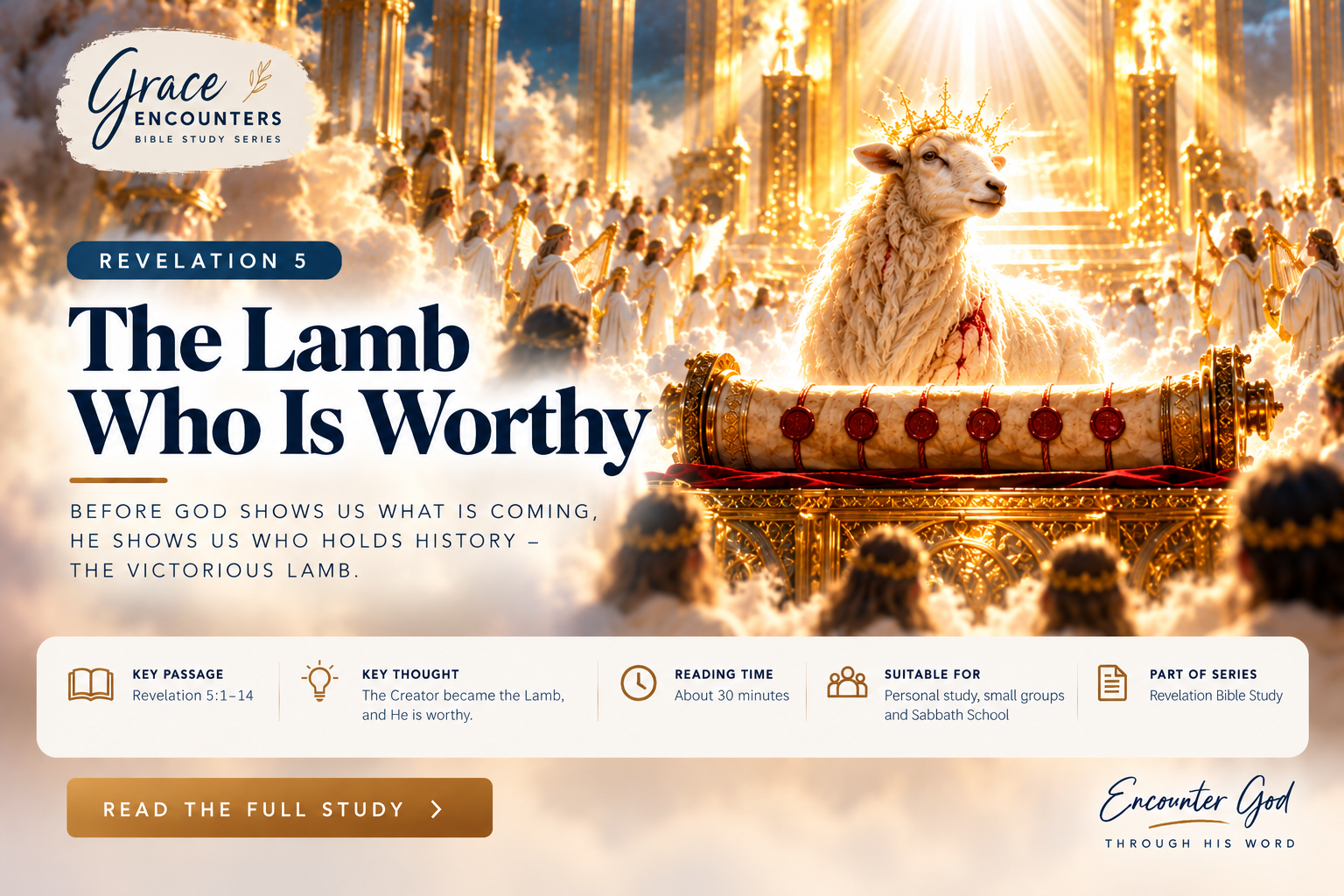
“Worthy is the Lamb who was slain
To receive power and riches and wisdom,
And strength and honour and glory and blessing!”
— Revelation 5:12
Revelation 4 brought John through the open door into the throne room of heaven.
He saw the throne. He saw the One seated upon it. He saw the living creatures and the twenty-four elders worshipping God:
“You are worthy, O Lord,
To receive glory and honour and power;
For You created all things,
And by Your will they exist and were created.”
— Revelation 4:11
Revelation 5 continues in the same throne room.
But John’s attention is now drawn to something in the right hand of the One sitting upon the throne:
a scroll.
It is completely written.
It is sealed with seven seals.
And then a question rings throughout creation:
Who is worthy to open it?
John weeps because no one can be found.
Until heaven tells him to look again.
There is One.
The Lion of Judah has conquered.
But when John looks for the Lion, he sees something astonishing.
He sees a Lamb who has been slain.
Revelation 5 takes us into the very heart of the gospel. It shows us the Father upon the throne, the Spirit sent into all the earth, and the Son standing as the victorious Lamb.
Before God begins showing John what will happen as the seals are opened, He shows him Who holds history.
Revelation 5:1 | The Scroll in the Father’s Hand
“And I saw in the right hand of Him who sat on the throne a scroll written inside and on the back, sealed with seven seals.”
The first thing we should notice is where the scroll begins.
It is in the right hand of the One sitting upon the throne.
It has not fallen into Satan’s hands.
Human governments do not possess it.
History is not controlled by chance.
The scroll remains under God’s authority.
Written on Both Sides
John specifically tells us that the scroll is written:
“inside and on the back.”
This recalls Ezekiel’s vision:
“Then He spread it before me; and there was writing on the inside and on the outside.”
— Ezekiel 2:10
Whatever the precise contents of Revelation’s scroll, John’s description gives us the picture of something already fully written.
Nothing needs to be added to it.
It is also sealed with seven seals. Seven repeatedly carries the idea of completeness or fullness in Revelation.
God’s purposes are not being invented as history unfolds.
He knows the end from the beginning.
A Grace Encounter: Nothing I Can Add
There is a beautiful gospel application here, although we should distinguish application from interpretation.
Revelation 5:1 does not itself say that the writing on both sides represents salvation by grace. We should therefore not build that doctrine from this symbol alone.
But the picture of a completed scroll beautifully reminds us of something Scripture teaches very clearly elsewhere:
There is nothing I can add to what Christ has accomplished for my salvation.
At Calvary Jesus declared:
“It is finished!”
— John 19:30
Paul writes:
“For by grace you have been saved through faith… not of works, lest anyone should boast.”
— Ephesians 2:8–9
But Paul immediately continues:
“For we are His workmanship, created in Christ Jesus for good works…”
— Ephesians 2:10
That order matters.
Grace first.
Good works follow.
My works cannot save me.
My obedience cannot purchase God’s acceptance.
I cooperate with Christ as He transforms me, but even that transformed life grows out of my relationship with Him.
Good works are the fruit of salvation, not its price.
I do not need to finish what Jesus failed to complete.
It is finished.
Revelation 5:2–4 | Who Is Worthy?
“Then I saw a strong angel proclaiming with a loud voice, ‘Who is worthy to open the scroll and to loose its seals?’”
Notice the question.
The angel does not ask:
Who is powerful enough?
He asks:
Who is worthy?
John searches the entire created order:
“And no one in heaven or on the earth or under the earth was able to open the scroll, or to look at it.”
Then something surprising happens.
John cries.
“So I wept much, because no one was found worthy to open and read the scroll, or to look at it.”
Why would John weep over a document he had never seen before?
His reaction suggests that something enormous is at stake.
If this scroll represents God’s purposes for judgment, redemption and the restoration of His creation, then an unopened scroll means that those purposes cannot proceed.
For one terrible moment, John sees no way forward.
And he weeps.
Revelation 5:5 | Do Not Weep
Then one of the elders speaks:
“Do not weep. Behold, the Lion of the tribe of Judah, the Root of David, has prevailed…”
John is directed back into the Old Testament.
The Lion of Judah
Genesis 49:9–10 connects Judah with the imagery of a lion, kingship and the promised ruler.
The Root of David
Isaiah 11 points towards the promised Messianic King from the line of Jesse.
Jesus is the promised King.
But the elder says something particularly important:
“He has prevailed.”
He has conquered.
He has overcome.
Therefore He can open the scroll.
John turns to see this victorious Lion.
But what he sees is not what we might expect.
Revelation 5:6 | The Lion Is the Lamb
“And I looked, and behold, in the midst of the throne… stood a Lamb as though it had been slain…”
John is told:
Lion.
John sees:
Lamb.
And the Lamb bears the evidence of sacrifice.
He appears:
“as though it had been slain.”
Yet He is standing.
The wounds tell us that He died.
His standing tells us that He lives.
This is the crucified and risen Christ.
And here Revelation gives us one of its most profound revelations of God’s character.
The Lion Conquered as the Lamb
Christ did not overcome Satan by becoming more violent than Satan.
He conquered through truth, obedience, faithfulness and self-sacrificing love.
Calvary appeared to be Satan’s victory.
Heaven declares it Christ’s triumph.
The Lion’s strength is revealed through the Lamb’s sacrifice.
The Creator Became the Lamb
At this point we need to remember something very important from Revelation 4.
The heavenly beings had worshipped God:
“For You created all things.”
We must not interpret that to mean:
The Father is Creator, while Jesus is Redeemer.
John himself prevents us from separating Father and Son in that way.
He begins his Gospel:
“In the beginning was the Word, and the Word was with God, and the Word was God.”
— John 1:1
Then he says:
“All things were made through Him, and without Him nothing was made that was made.”
— John 1:3
And then:
“And the Word became flesh and dwelt among us…”
— John 1:14
The Lamb of Revelation 5 is therefore the eternal Word through whom creation came into existence.
Paul says the same:
“For by Him all things were created that are in heaven and that are on earth…”
— Colossians 1:16
Hebrews tells us that God made the worlds through His Son (Hebrews 1:2).
Creation and redemption therefore cannot be divided between Father and Son as though they were separate enterprises.
Scripture reveals the Father, Son and Holy Spirit acting in divine unity, while also revealing distinct roles within their work.
And that makes the Lamb’s sacrifice even more extraordinary.
The Creator entered His creation.
The One through whom humanity received life became human.
The hands involved in making this world became human hands.
And those hands were pierced.
The Creator became the Lamb.
Revelation 5:6 | Seven Horns, Seven Eyes and the Spirit
The Lamb has:
“seven horns and seven eyes, which are the seven Spirits of God sent out into all the earth.”
In biblical imagery, horns commonly represent strength or power.
Seven horns therefore convey complete power.
The seven eyes communicate fullness of sight and knowledge.
But John himself explains the imagery further:
“the seven Spirits of God sent out into all the earth.”
The Holy Spirit is not absent from this throne-room scene.
The imagery also gives us an important connection with Pentecost.
Peter said of the risen Jesus:
“Therefore being exalted to the right hand of God, and having received from the Father the promise of the Holy Spirit, He poured out this which you now see and hear.”
— Acts 2:33
Christ has died.
Christ has risen.
Christ has ascended.
The Spirit is sent into the earth.
That makes Acts 2 an important companion passage when studying Revelation 5.
Revelation 5:7 | The Lamb Takes the Scroll
Then comes one of the shortest and most significant verses in the chapter:
“Then He came and took the scroll out of the right hand of Him who sat on the throne.”
The Father holds the scroll.
The Son approaches.
The Son receives it.
And this raises an important theological question:
If Jesus is eternally God, why is authority given to Him?
We need to answer this carefully.
The Father Is Not Unworthy
Revelation 5 should never be understood as saying that the Father cannot open the scroll because He is somehow unworthy.
The previous chapter has already declared God worthy.
Furthermore, the scroll is already in His hand.
The Father possesses the authority to give it.
As we observed during our study:
You cannot give what you do not possess.
So the Father’s giving of the scroll does not diminish Him.
Nor does the Son’s receiving of it mean that Jesus was previously less divine.
Jesus has always been God.
Something else is happening here.
Father and Son: Perfect Unity, Distinct Roles
During His earthly ministry, Jesus repeatedly emphasised His unity with His Father.
He said:
“I and My Father are one.”
— John 10:30
And:
“He who has seen Me has seen the Father.”
— John 14:9
Yet Jesus also repeatedly described Himself as carrying out His Father’s will.
He said:
“The Son can do nothing of Himself, but what He sees the Father do…”
— John 5:19
And:
“I can of Myself do nothing… because I do not seek My own will but the will of the Father who sent Me.”
— John 5:30
This does not mean Christ lacks divinity.
John 1 has already told us precisely the opposite.
Rather, Jesus reveals a profound unity between Father and Son.
The Son does not operate independently of the Father.
There is no rivalry within the Godhead.
There is no competing agenda.
Jesus reveals the Father because He acts in complete harmony with Him.
“All Authority Has Been Given to Me”
After His resurrection Jesus said:
“All authority has been given to Me in heaven and on earth.”
— Matthew 28:18
Given by whom?
The wider New Testament points us towards the Father.
But again, we must distinguish Christ’s eternal deity from His role as the incarnate Redeemer.
The Father gives the Son authority connected with the accomplishment and administration of redemption.
Jesus Himself says:
“For the Father judges no one, but has committed all judgment to the Son.”
— John 5:22
That does not mean the Father is incapable of judging.
He entrusts judgment to the Son.
Likewise, the Father giving the scroll to Christ does not mean that the Father lacks worthiness.
The Son became incarnate.
The Son lived among us.
The Son bore our sins.
The Son shed His blood.
The Son died.
The Son rose again.
And now the victorious Lamb receives the scroll.
Revelation 5:8–10 | Heaven Explains Why He Is Worthy
The moment the Lamb takes the scroll, heaven responds.
“Now when He had taken the scroll, the four living creatures and the twenty-four elders fell down before the Lamb…”
They sing a new song:
“You are worthy to take the scroll,
And to open its seals;
For You were slain,
And have redeemed us to God by Your blood…”
Now Revelation itself answers our question.
Why is the Lamb uniquely qualified to take the scroll?
“For You were slain.”
This is not about Jesus becoming God.
It is about what God the Son accomplished as the incarnate Redeemer.
The eternal Son became human.
He entered the battle.
He conquered where humanity had fallen.
And He conquered through sacrifice.
Paul describes this movement beautifully in Philippians 2.
Christ existed in the form of God.
He humbled Himself.
He became human.
He became obedient unto death.
Even the death of the cross.
Then Paul says:
“Therefore God also has highly exalted Him…”
— Philippians 2:9
The exaltation does not turn Jesus into God.
The passage begins with His divine identity.
Rather, the incarnate Son who completed the work of redemption is publicly exalted as the victorious Redeemer.
God Was in Christ
There is another truth we must protect here.
Calvary was not Jesus persuading an angry Father to love us.
Scripture says:
“God was in Christ reconciling the world to Himself…”
— 2 Corinthians 5:19
And Jesus Himself said:
“For God so loved the world that He gave His only begotten Son…”
— John 3:16
The Father gave.
The Son willingly came.
The Spirit participates in bringing God’s saving work into human lives.
The Father was not emotionally detached from the suffering of His Son.
The cross reveals the heart of God.
The plan of salvation is not the Son rescuing us from the Father.
It is God acting to reconcile His fallen creation to Himself.
Revelation 5:8 | The Prayers of the Saints
The elders hold:
“golden bowls full of incense, which are the prayers of the saints.”
What a beautiful detail.
Our prayers appear in the throne room.
The prayers spoken confidently.
The prayers whispered through tears.
The prayers we could barely articulate.
The prayers offered when we did not understand what God was doing.
They are not forgotten.
They come before God.
John is being shown cosmic events, yet heaven has not lost sight of the prayers of ordinary believers.
Revelation 5:9–10 | Redeemed From Every Nation
The new song continues:
“You were slain,
And have redeemed us to God by Your blood
Out of every tribe and tongue and people and nation.”
The gospel crosses every human boundary.
No race owns Christ.
No nation owns Him.
No culture owns Him.
No denomination owns Him.
No social class owns Him.
The Lamb is gathering a people from everywhere.
Their identity is ultimately found not in where they came from, but in Who redeemed them.
Revelation 5:11–12 | Worthy Is the Lamb
John’s vision expands.
He hears:
“the voice of many angels around the throne…”
Their number is beyond counting:
“ten thousand times ten thousand, and thousands of thousands.”
And they proclaim:
“Worthy is the Lamb who was slain
To receive power and riches and wisdom,
And strength and honour and glory and blessing!”
Notice again what heaven remembers.
The Lamb was slain.
Calvary is not an unfortunate episode heaven wishes to put behind it.
The sacrifice of Christ stands at the centre of heaven’s worship.
God’s greatest victory was achieved through self-giving love.
Revelation 5:13–14 | Father and Son Worshipped Together
Then John’s vision expands one final time:
“And every creature which is in heaven and on the earth and under the earth and such as are in the sea…”
All creation joins the worship:
“Blessing and honour and glory and power
Be to Him who sits on the throne,
And to the Lamb, forever and ever!”
And here Revelation brings our entire discussion together.
The Father and the Lamb receive the worship of creation together.
The Father has not been displaced.
The Son has not become divine only after His victory.
There is no competition between them.
The Father gives.
The Son receives.
The Spirit is sent throughout the earth.
And the Godhead acts in perfect unity to accomplish the salvation and restoration of creation.
Revelation 5 and Daniel 7
There is a striking parallel between Revelation 5 and Daniel 7.
Daniel sees:
“One like the Son of Man,
Coming with the clouds of heaven!
He came to the Ancient of Days…”
— Daniel 7:13
Then:
“To Him was given dominion and glory and a kingdom…”
— Daniel 7:14
Notice the movement.
The Son of Man approaches the Ancient of Days.
He receives dominion.
Revelation 5 presents similar imagery.
The Lamb approaches the One sitting upon the throne.
He receives the scroll.
Heaven acknowledges His victory.
And people from every tribe, language, people and nation become part of His kingdom.
Daniel 7 and Revelation 5 illuminate one another.
The Enthronement of the Lamb and Pentecost
There is another important connection between Revelation 5 and Acts 2.
Peter describes Jesus as risen and exalted to the right hand of God:
“Therefore being exalted to the right hand of God… He poured out this which you now see and hear.”
— Acts 2:33
Revelation 5:6 describes the seven Spirits of God as being:
“sent out into all the earth.”
The connection is significant.
Christ has died.
Christ has risen.
Christ has ascended.
His sacrifice has been accepted.
He is exalted at the Father’s right hand.
And the Holy Spirit is poured out upon the earth.
Pentecost therefore becomes the earthly evidence of a heavenly reality.
The Lamb reigns, and the Spirit goes out.
This prepares us for Revelation 6.
The seals are not opened in a universe where Christ is desperately struggling to gain control.
They are opened by the Lamb who has already overcome.
The Great Controversy
There is also a larger conflict behind this chapter.
Jesus referred to Satan as:
“the ruler of this world.”
— John 12:31
But He immediately declared:
“Now the ruler of this world will be cast out.”
Satan claimed this world as his territory.
At Calvary, however, his character and methods were exposed while God’s character was revealed through Christ.
What appeared to be Satan’s greatest victory became his decisive defeat.
Christ rose from the dead.
Then the risen Jesus declared:
“All authority has been given to Me in heaven and on earth.”
Revelation 5 allows us to glimpse the heavenly dimension of that victory.
Earth saw a crucified criminal.
Heaven sees:
the victorious Lamb.
What Adam lost cannot be recovered through human effort.
It is recovered through Christ.
History is therefore not ultimately in the hands of the dragon.
It is not in the hands of beasts.
It is not in the hands of governments, empires or persecuting powers.
Before Revelation shows us any of those things, it shows us the Lamb.
That order matters.
We are meant to read everything that follows from the throne room, not from the headlines.
Grace Encounter | “Do Not Weep”
Perhaps the most personal words in Revelation 5 are among the simplest:
“Do not weep.”
John could not see a way forward.
The elder did not tell him that his concerns were insignificant.
He did not tell John that everything would simply work itself out.
He pointed John to Jesus.
There is a Lamb.
That is still the answer when we cannot see what God is doing.
When I cannot see the way forward, there is a Lamb.
When my circumstances seem beyond redemption, there is a Lamb.
When I am frightened by what is happening in the world, there is a Lamb.
When I begin measuring my salvation by how well I performed today, there is a Lamb.
When I fail, there is a Lamb.
When I cannot understand God’s timing, there is a Lamb.
He was slain.
He rose.
He conquered.
He stands before the throne.
And He is worthy.
Salvation: Finished Work, Living Relationship
Revelation 5 brings us back to something fundamental about salvation.
Nothing I do can add to what Christ has accomplished for me.
My works will never save me.
But grace does not produce a life without obedience.
It produces precisely the opposite.
Jesus changes us as we remain in relationship with Him.
Paul holds these truths together:
“Work out your own salvation with fear and trembling; for it is God who works in you both to will and to do for His good pleasure.”
— Philippians 2:12–13
I cooperate.
But God works in me.
I obey.
But my obedience grows from relationship.
I bear fruit.
But Christ is the source of the life producing that fruit.
My works are therefore not the price or basis of my salvation.
They are the natural fruit of a life increasingly surrendered to Christ.
Christianity is not an anxious attempt to become worthy enough for God.
It is a relationship with the One who is worthy.
Final Analysis | Who Holds History?
Before Revelation 6 shows us the opening of the seals, Revelation 5 establishes something we must never forget.
God shows us Who holds history before He shows us what happens in history.
That order matters.
The coming chapters contain conflict.
War.
Death.
Persecution.
Judgment.
Beasts will arise.
Babylon will appear.
Economic and political powers will attempt to control human allegiance.
But none of those things holds the scroll.
The scroll begins in the Father’s hand.
And the Father entrusts it to the victorious Lamb.
The Holy Spirit is sent into all the earth.
The Godhead is not divided in the work of redemption.
Father, Son and Spirit act in perfect harmony to bring God’s purposes to completion.
And the One receiving the scroll is not a stranger to us.
He is our Creator.
He is our Redeemer.
The hands that hold history are the hands through whom creation came into existence.
And they are scarred hands.
That changes the way we should read everything that follows.
Revelation is not primarily a catalogue of frightening things Christians need to survive.
It is:
“The Revelation of Jesus Christ…”
— Revelation 1:1
Before we see the beast, God shows us the Lamb.
Before Babylon, the Lamb.
Before persecution, the Lamb.
Before judgment, the Lamb.
Before the seals are opened, the Lamb.
John was told to look for a Lion.
He saw a Lamb.
And perhaps that is one of Revelation’s greatest revelations about the character of God.
The Lion conquers as the Lamb.
Ultimate power is revealed through self-sacrificing love.
And heaven declares:
He is worthy.
Prayer From Revelation 5
Father,
You are worthy.
You created us, You loved us, and You did not abandon Your creation when sin entered this world.
Thank You for giving Your Son.
Jesus, eternal Word and Lamb of God, You are worthy.
Through You all things were made, yet You entered the world You created.
You became one of us.
You carried our sin.
You were slain.
And You rose again.
Thank You that I do not have to add anything to Your finished work.
Forgive me for the times I measure Your acceptance of me by my own performance.
Teach me to rest in Your grace without ever using grace as an excuse to remain unchanged.
Work in me both to will and to do according to Your good pleasure.
Let my obedience grow out of knowing You.
Holy Spirit, continue Your work in me. Teach me, transform me and keep my eyes fixed upon Jesus.
And when I cannot understand what is happening around me, remind me that history has never slipped from Your hands.
When I cannot see a way forward, remind me:
There is a Lamb.
When I am afraid, turn my eyes towards Him.
When I fail, draw me back to Him.
When I become distracted by everything happening in this world, help me look again at the throne.
Until the day when every creature joins the song:
“Blessing and honour and glory and power
Be to Him who sits on the throne,
And to the Lamb, forever and ever!”
In Jesus’ name,
Amen.
Scriptures for Further Study
Take time to explore these passages alongside this study. Compare Scripture with Scripture, follow the connections, and allow the Bible to illuminate its own message.
Genesis 3:15
Genesis 49:8–10
Isaiah 11:1–10
Isaiah 53:1–12
Ezekiel 2:8–3:3
Daniel 7:9–14
Matthew 28:18–20
John 1:1–18
John 5:19–30
John 10:22–30
John 12:27–33
John 14:6–11
John 17:1–5
Acts 2:32–36
Romans 5:12–21
1 Corinthians 15:20–28
2 Corinthians 5:18–21
Ephesians 1:15–23
Philippians 2:5–13
Colossians 1:12–20
Hebrews 1:1–14
Hebrews 4:14–16
Revelation 4:1–11
Revelation 6:1–17
Grace Encounters | Bible Study Series
Revelation 5: The Lamb Who Is Worthy
Continue to Revelation 6: The Opening of the Seals