
Revelation can feel intimidating.
For many people, the word Revelation immediately brings to mind beasts, trumpets, plagues, persecution, mysterious numbers and frightening events at the end of the world. But that isn’t where the book begins.
Before John sees the seals opened, before the trumpets sound, before dragons and beasts appear, Revelation gives us something far more important. It gives us Jesus.
And perhaps that tells us something about how this entire book should be read.
Read the passage
Before continuing, take some time to read Revelation 1 slowly. Don’t begin by trying to decode every symbol. Simply notice what the chapter tells us about Jesus.
Who is He?
What is He doing?
Where is He standing?
And what does John do when he encounters Him?
1. A Revelation of Jesus Christ
Revelation begins:
“The Revelation of Jesus Christ…” Revelation 1:1
The Greek word translated revelation is apokalypsis — an unveiling, disclosure or revealing. Something is being uncovered. And the opening words immediately place Jesus Christ at the centre.
This book certainly reveals events. It reveals conflict. It reveals powers operating in history. It reveals judgment, worship, persecution, endurance and ultimately the restoration of all things.
But we should never become so fascinated with the symbols that we lose sight of the Person the book is revealing.
Revelation is meant to lead us towards Jesus.
That becomes an important principle for everything that follows.
When our interpretation of prophecy leaves us more fascinated with beasts than with Christ, perhaps we need to return to the beginning.
2. A Book Meant to Be Read, Heard and Kept
John writes:
“Blessed is he who reads and those who hear the words of this prophecy, and keep those things which are written in it…” Revelation 1:3
That surprised me when we first began studying Revelation. This is not presented as a book God intended to remain permanently incomprehensible. There is a blessing connected with reading, hearing, and keeping what is written. Notice that last word.
Keeping.
Revelation isn’t given merely to satisfy our curiosity about future events. Somehow, what we learn here is meant to affect the way we live. That gives us a question we can carry through every chapter:
What does this mean for the way I live today?
3. Let Scripture Help Interpret Scripture
Revelation communicates through extraordinary imagery: lampstands, stars, horns, beasts, waters, seals, trumpets and many other symbols. So how do we interpret them? One principle became important very early in our study:
Before deciding what a symbol means, ask whether Scripture itself explains it.
Sometimes Revelation gives the interpretation directly. At other times its imagery reaches deeply into the Old Testament — Daniel, Ezekiel, Isaiah, Zechariah, Exodus and the sanctuary language woven throughout Scripture.
That means our first question should not be:
“What do I think this symbol means?”
Nor even:
“What does my church say it means?”
Our first question should be:
“Where else does Scripture use this language?”
Interpretations and historical perspectives can then be examined, compared and tested against the biblical text.
4. Jesus: Faithful Witness, Redeemer and King
John describes Jesus as:
“the faithful witness, the firstborn from the dead, and the ruler over the kings of the earth.” Revelation 1:5
Then comes one of the most beautiful descriptions in the chapter:
“To Him who loved us and washed us from our sins in His own blood…” Revelation 1:5
Before Revelation tells us about judgment, it tells us about love. Before we encounter frightening powers, we encounter the One who gave Himself for us.
The Jesus of Revelation is not distant from humanity’s suffering. He is the crucified and risen Christ.
The One revealing what will happen is also the One who has already entered our broken world and borne its suffering Himself.
5. “Behold, He Is Coming”
Then Revelation turns our eyes towards the future:
“Behold, He is coming with clouds, and every eye will see Him…” Revelation 1:7
Whatever disagreements Christians may have about the chronology of end-time events, this verse makes something unmistakably clear:
Jesus is coming again.
John describes His coming as something witnessed — “every eye will see Him.”
Compare this with Acts 1:9–11, where the disciples watch Jesus ascend and are told that He will return, and Matthew 24:30, where Jesus describes the Son of Man coming on the clouds with power and great glory.
Revelation begins with hope. History is not simply wandering endlessly through suffering and human violence.
Someone is coming.
6. John on Patmos
John tells us that he was on:
“the island that is called Patmos for the word of God and for the testimony of Jesus Christ.” Revelation 1:9
Patmos was an island in the Aegean Sea. John was separated from the Christian communities he loved. From a human perspective, isolation might have looked like the silencing of an old disciple.
And yet Patmos became the place where John received Revelation. There is something deeply moving about that.
Sometimes circumstances that appear to have confined us cannot confine God.
A lonely place can become an encounter place.
7. “I Was in the Spirit”
John continues:
“I was in the Spirit on the Lord’s Day, and I heard behind me a loud voice, as of a trumpet…” Revelation 1:10
During our study, this made me think about John’s posture before the vision began. He was attentive to God. The text doesn’t present John desperately searching for a supernatural experience. He is worshipping, and God speaks.
That raised a personal question for me:
Am I living in a way that makes space to hear God’s voice?
Not because quietness somehow forces God to speak, but because our lives can become so crowded with noise that we scarcely listen.
Scripture. Prayer. Worship. Stillness.
Perhaps recognising God’s voice has something to do with becoming familiar with the One who speaks.
8. John Turns — and Sees Jesus
John hears the voice and turns. What he sees is extraordinary.
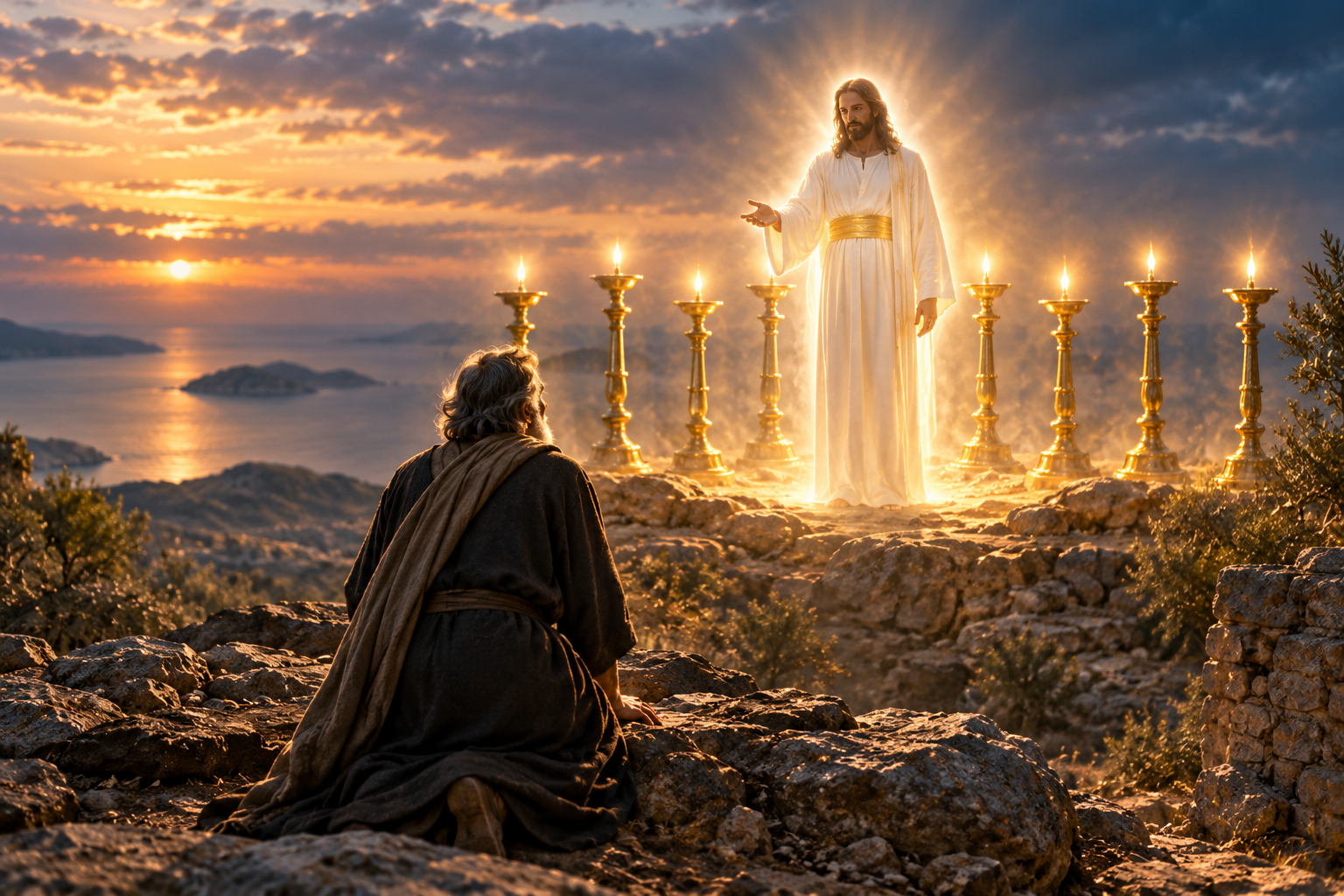
Seven golden lampstands.
And:
“in the midst of the seven lampstands One like the Son of Man…” Revelation 1:13
The description that follows draws heavily on biblical imagery.
He wears a long garment with a golden band around His chest.
His head and hair are white.
His eyes are like a flame of fire.
His feet resemble refined bronze.
His voice sounds like many waters.
A sharp two-edged sword proceeds from His mouth.
His face shines like the sun.
This is not the picture of a powerless Christ.
John encounters the glorified Son of Man.
9. John Falls at His Feet
John’s response is immediate:
“And when I saw Him, I fell at His feet as dead.” Revelation 1:17
But then something beautiful happens. Jesus places His right hand upon him. The same right hand that holds the seven stars reaches down to John.
And Jesus says:
“Do not be afraid.”
That deserves to be noticed.
The glory of Christ overwhelms John.
But the response of Jesus is not to terrorise him.
He touches him.
Then He identifies Himself:
“I am the First and the Last. I am He who lives, and was dead, and behold, I am alive forevermore.” Revelation 1:17–18
The One standing before John is the One who conquered death.
10. The Seven Stars and Seven Lampstands
And here Scripture does something extremely helpful. It interprets its own symbols. Jesus tells John:
“The seven stars are the angels of the seven churches, and the seven lampstands which you saw are the seven churches.” Revelation 1:20
We do not have to invent meanings for these symbols.
The text tells us.
The lampstands represent the churches.
The precise sense of the Greek angeloi (“angels” or “messengers”) in relation to the seven churches has been interpreted differently, but the central picture is unmistakable:
Christ holds the stars, and Christ walks among the lampstands.
And that became, for me, one of the most beautiful images in the entire chapter.
11. He Walks Among the Lampstands
Think about where Jesus is standing. Not far away. Not watching His churches from some distant place.
He is among them.
That becomes even more significant when we continue into Revelation 2 and 3.
Those churches are not perfect.
Some are faithful.
Some are struggling.
Some have compromised.
Some have lost their first love.
Some require serious correction.
Yet before Jesus says any of those things, Revelation 1 establishes something fundamental:
He is present among His people.
He knows them.
He sees them.
He corrects them.
He encourages them.
And He has not abandoned them.
Before Revelation shows us the great conflict of history, it shows us where Christ is standing.
Before the Seals, Trumpets and Beasts
This became the thought I kept returning to.
Before the seals were opened…
Before the trumpets sounded…
Before John saw beasts and kingdoms…
Before persecution, judgment and the great conflict unfolded before him…
John saw Jesus.
Perhaps we should remember that when studying prophecy.
The purpose is not to make us afraid of everything that might happen.
It is to teach us to know the One who will still be standing when everything else has passed away.
What Does Revelation 1 Reveal About God?
It reveals a Christ who loves and redeems.
A Christ who speaks.
A Christ who knows His people.
A Christ who is present among His churches.
A Christ who holds history without becoming distant from individual human beings.
A Christ whose glory caused John to fall down — and whose hand then reached down to touch him.
And a Christ who says:
“Do not be afraid.”
What Does This Mean for Us?
Perhaps the first lesson of Revelation is much simpler than we sometimes make it.
Look at Jesus before you look at the symbols.
When the world feels unstable, look at Jesus.
When the church disappoints you, remember who still walks among the lampstands.
When you feel isolated, remember Patmos.
When you are frightened by what lies ahead, remember the hand placed upon John and the words:
“Do not be afraid.”
And when Scripture becomes difficult, keep searching.
Read.
Listen.
Compare Scripture with Scripture.
Ask questions.
Test interpretations.
And keep looking for Christ.
Because ultimately Revelation is not merely about knowing what happens at the end.
It is about knowing Who will be there.
From Study to Song
This study did not end when I closed my Bible.
One image stayed with me:
Christ walking among the lampstands.
Before John was shown the seals, trumpets, beasts and conflict that would unfold throughout Revelation, he was first shown Jesus among His people. That thought followed me long after the study ended.
Eventually, it became a song:
Walk Among the Lampstands
The bridge expresses the thought that had settled most deeply in my heart:
Before the seals were ever opened,
Before the trumpets filled the sky,
Before the beasts and kings of history,
Before the saints would question, “Why?”The Lord revealed His heart of mercy:
“My child, you’re never left alone.”
When the Music section of Grace Encounters is completed, I’ll share the song there as part of this journey through Revelation.
For now, perhaps this is enough to remember:
The Christ who walked among the lampstands still walks among His people today.
Come Into the Conversation
Don’t simply accept what you’ve read here.
Open Revelation 1 for yourself.
What do you notice about Jesus that you may not have noticed before?
Which image in this chapter speaks most strongly to you?
Is there something you understand differently?
Is there another passage of Scripture that helps illuminate something we’ve studied here?
Bring your Bible. Bring your questions. Test everything against Scripture.
We are not studying Revelation merely to collect answers.
We are seeking to encounter the One it reveals.
Come. Seek. Listen. Encounter.