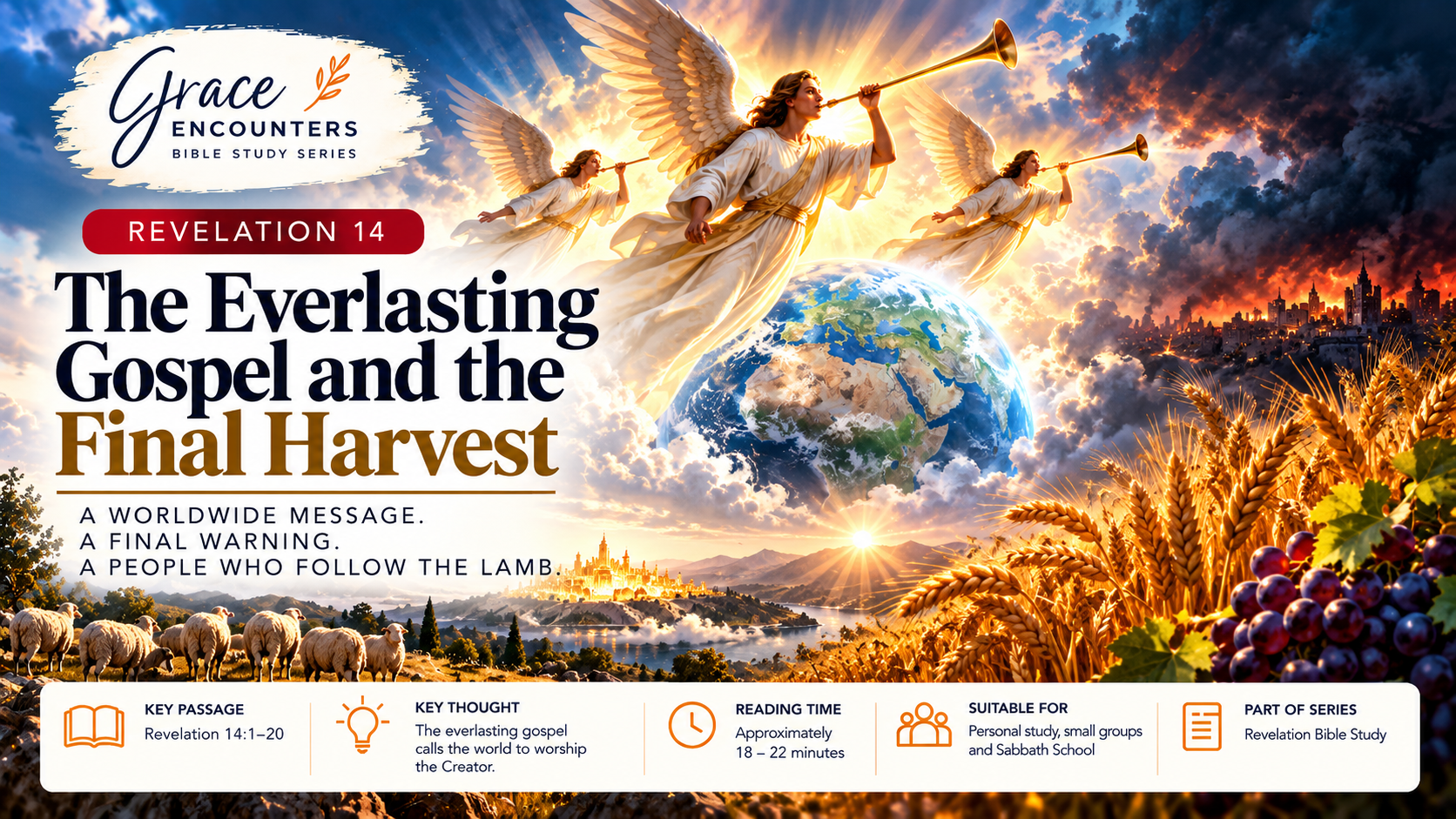
Grace Encounters | Bible Study Series: The Revelation of Jesus Christ
Scripture Reading: Revelation 14:1–20
Key Scripture: Revelation 14:12
Reading Time: Approximately 18–22 minutes
“Here is the patience of the saints: here are they that keep the commandments of God, and the faith of Jesus.” — Revelation 14:12, KJV
Introduction — When the Whole World Must Choose
Revelation 13 ends with a disturbing picture of a world in which worship, political authority, and economic participation become intertwined. The beast and its image demand allegiance, and those who refuse to conform face increasingly severe consequences.
But Revelation 14 opens with an entirely different picture.
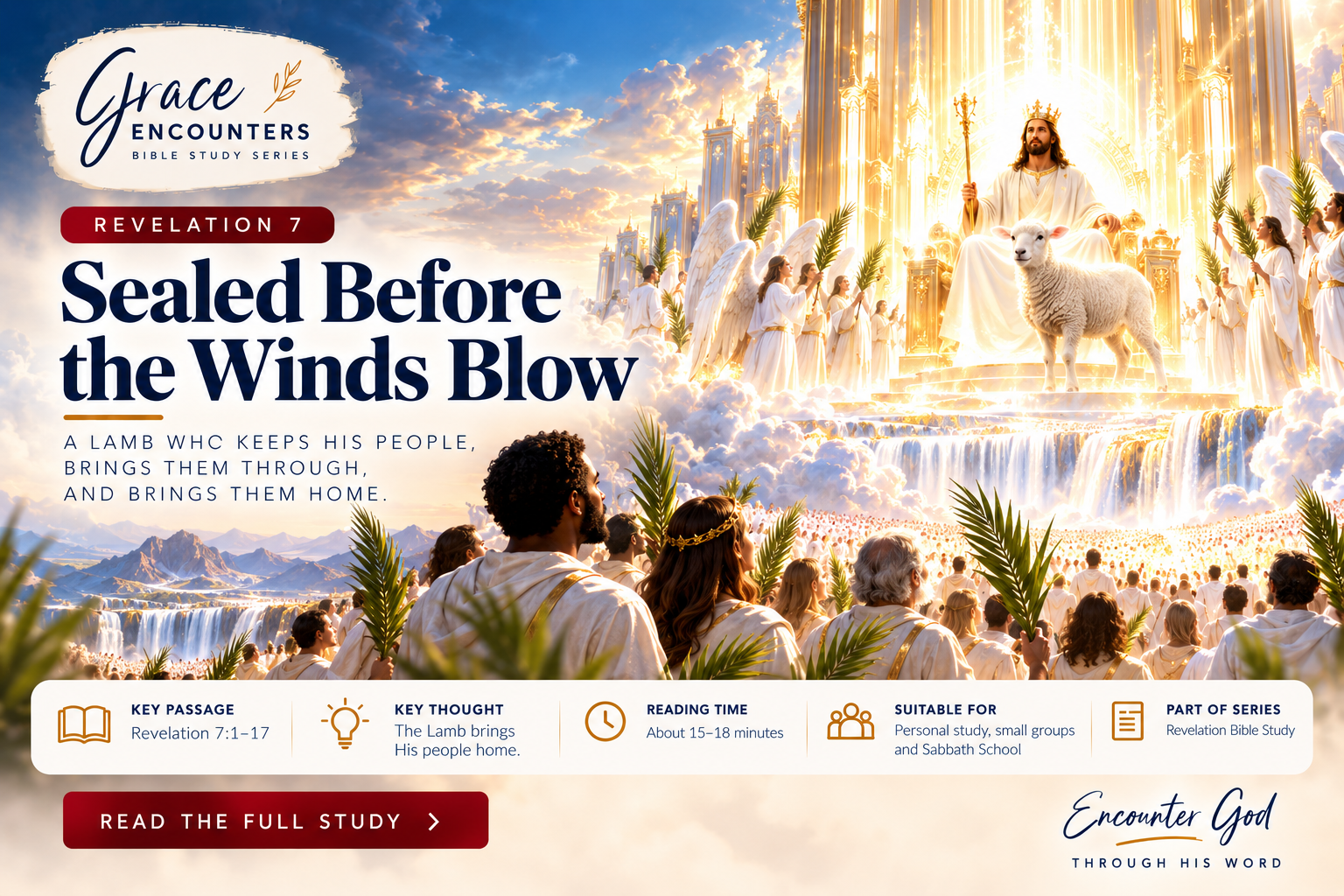
John sees the Lamb standing on Mount Zion, surrounded by those who belong to Him.
Before God shows us the final warnings, the final conflict, or the final harvest, He shows us the Lamb and His redeemed people.
This is significant.
Revelation is not primarily the story of the beast. It is the revelation of Jesus Christ. The beast may appear powerful, but the Lamb is victorious.
And those who remain with Him will ultimately stand with Him.
1. The Lamb on Mount Zion — Revelation 14:1–5
John writes:
“And I looked, and, lo, a Lamb stood on the mount Sion, and with him an hundred forty and four thousand, having his Father’s name written in their foreheads.” — Revelation 14:1
In Revelation 13, the followers of the beast receive a mark associated with its authority.
In Revelation 14, God’s people bear the Father’s name.
The contrast concerns identity, loyalty, and allegiance.
The forehead represents the mind, where convictions and decisions are formed. God’s people are identified as belonging to Him.
The 144,000 are described as following the Lamb wherever He goes. Their defining characteristic is not that they have achieved spiritual independence or perfection through their own strength.
They follow the Lamb.
They have been redeemed.
They have learned to trust Him.
Revelation 14:4 calls them the firstfruits unto God and the Lamb, while verse 5 describes their integrity before God.
The passage invites us to consider what it means to be wholly surrendered to Christ.
The final generation of believers will not survive because they possess extraordinary human strength. Their security is found in the One they follow.
Grace Encounter: The question is not whether I am strong enough to stand in the last days. The question is whether I am learning to depend upon Jesus today.
2. The First Angel — The Everlasting Gospel (Revelation 14:6–7)
“And I saw another angel fly in the midst of heaven, having the everlasting gospel to preach unto them that dwell on the earth…” — Revelation 14:6
Before the final judgment comes the everlasting gospel.
This is one of the most important truths in Revelation 14.
God does not begin His final appeal with threats. He begins with good news.
The gospel is the announcement that salvation is found in Jesus Christ, who lived, died, rose again, and now ministers on behalf of humanity.
It is the same gospel that has always been offered: sinners are saved by grace through faith.
The angel calls every nation, kindred, tongue, and people to fear God, give Him glory, and worship the Creator.
What does it mean to fear God?
To fear God is not to live in terror of Him.
It is to recognise His holiness, reverence His character, trust His Word, and respond to Him with love and obedience.
God is worthy of our worship because He is our Creator and Redeemer.
The language of Revelation 14:7 recalls the fourth commandment:
“For in six days the LORD made heaven and earth, the sea, and all that in them is…” — Exodus 20:11
The Sabbath points us back to creation and reminds us that life itself is a gift from God.
It also teaches dependence.
For one day each week, we cease our ordinary labour and acknowledge that our existence, our provision, and our salvation do not ultimately depend upon our own efforts.
The hour of His judgment
The first angel also announces that the hour of God’s judgment has come.
Within the Seventh-day Adventist historicist understanding, this is connected with the heavenly judgment described in Daniel 7 and the sanctuary prophecy of Daniel 8:14.
Judgment is not merely about exposing human failure.
It is also about vindicating God’s character, revealing the justice of His decisions, and bringing the great controversy between good and evil to its conclusion.
The One who judges is also the One who gave Himself for us.
Grace Encounter: We need not fear approaching the judgment with Jesus as our Saviour and Advocate. Our confidence rests not in our righteousness but in His.
3. The Second Angel — Babylon Is Fallen (Revelation 14:8)
“Babylon is fallen, is fallen, that great city, because she made all nations drink of the wine of the wrath of her fornication.” — Revelation 14:8
Babylon represents religious confusion, spiritual unfaithfulness, and systems of worship that substitute human authority and tradition for God’s Word.
Throughout Scripture, spiritual adultery is used to describe unfaithfulness to God.
The Greek word porneia, translated here as fornication, carries the imagery of illicit spiritual relationships and compromised allegiance.
In the prophetic setting of Revelation, Babylon’s influence reaches beyond one nation.
She makes the nations drink of her wine.
Wine becomes an important recurring image in Revelation 14.
First, Babylon offers her wine.
Then the third angel warns of the wine of God’s wrath.
Finally, the chapter describes the grapes of the earth being gathered into the great winepress.
The imagery connects spiritual deception, moral responsibility, and the final consequences of humanity’s choices.
Yet God does not abandon those who have been deceived.
In Revelation 18:4, He calls:
“Come out of her, my people…”
Even within Babylon, God has people whom He loves and calls His own.
This reminds us to distinguish between individuals, whom God knows and loves, and religious systems whose teachings or exercise of power may be contrary to His Word.
Our calling is not to despise people who believe differently.
It is to proclaim truth faithfully and reveal the character of Christ.
4. The Third Angel — The Final Question of Worship (Revelation 14:9–11)
The third angel gives one of the most solemn warnings in Scripture.
It concerns worship of the beast and its image, and receiving its mark.
To understand this warning, we must return to Revelation 13.
There, the second beast exercises authority, promotes an image to the first beast, and causes people to receive a mark associated with allegiance to that power.
Revelation 13:17 describes the economic consequence:
“And that no man might buy or sell, save he that had the mark…”
The issue is not merely private religious opinion.
The prophecy describes a situation in which religious conformity becomes connected to civil authority and participation in the economy.
Can economic restrictions become religious coercion?
Consider a person who is told that nobody will force them to worship contrary to conscience, but that their ability to work, trade, or support their family will be restricted unless they conform to a religiously grounded law.
Such a person may technically retain freedom of belief while experiencing significant pressure upon their freedom of practice.
Economic coercion is still a form of coercion.
However, not every restriction on commerce constitutes the mark of the beast. Revelation connects the restriction specifically with worship, allegiance, the beast’s authority, and its mark.
Within historic Seventh-day Adventist interpretation, the final Sabbath–Sunday conflict concerns the point at which religious observance is enforced by civil authority in opposition to God’s commandments.
The essential issue is not simply which day appears on a calendar.
It is whose authority we recognise when human requirements conflict with God’s Word.
The historical warning
Religious persecution has not always begun with imprisonment or execution.
History contains examples of restrictions on religious practice developing into increasingly severe penalties.
But we must be careful not to assume that every contemporary religious law will inevitably follow that course.
The biblical warning gives us reason to defend liberty of conscience before coercion becomes more severe.
Revelation 13:15 describes the ultimate threat of death against those who refuse the demanded worship.
That makes the question of conscience profoundly serious.
Would we remain faithful if obedience to God cost us our livelihood?
Would we still trust Him if faithfulness meant losing the security we had worked to establish?
These questions are not invitations to panic.
They are invitations to deepen our relationship with Christ.
5. God’s Wrath and God’s Character
Revelation 14:10 speaks of the wine of the wrath of God.
This is difficult language, particularly if we understand divine wrath through the behaviour of angry or abusive human beings.
But Scripture invites us to understand God’s judgment through the character revealed in Jesus Christ.
God does not delight in suffering or destruction.
“For I have no pleasure in the death of him that dieth, saith the Lord GOD: wherefore turn yourselves, and live ye.” — Ezekiel 18:32
The cross reveals the depth of God’s love and the seriousness of sin.
At Calvary, Jesus bore the consequences of sin to make salvation possible.
The same God who gave His Son to save the world will not allow evil to continue destroying His creation forever.
God’s wrath is not the opposite of His love.
His final judgment means that His patience with evil will not become permanent permission for evil to destroy His people and His creation.
Within the Adventist understanding of conditional immortality, the final punishment of the wicked culminates in the destruction of sin and death, rather than endless conscious torment.
Romans 6:23 contrasts death with eternal life, while Revelation 20:14 identifies the lake of fire as the second death.
The final purpose is a universe in which sin will never rise again.
6. The Patience of the Saints — Revelation 14:12
After the solemn warning, John describes God’s faithful people:
“Here is the patience of the saints: here are they that keep the commandments of God, and the faith of Jesus.”
This verse brings the focus back to the relationship between faith and obedience.
God’s people are not described merely as those who understand prophecy.
They keep His commandments and possess the faith of Jesus.
Their obedience is not an attempt to purchase salvation.
It is the fruit of their relationship with Him.
Jesus said:
“If ye love me, keep my commandments.” — John 14:15
And Hebrews 12:2 calls us to look unto Jesus, the Author and Finisher of our faith.
This is vital.
We cannot prepare for the final crisis simply by studying political developments, tracking legislation, or identifying prophetic symbols.
We prepare by knowing Jesus.
A person may understand the prophetic interpretation of the beast and still fail to trust the Lamb.
The final question is not merely whether we recognise deception.
It is whether we know the voice of our Shepherd well enough to follow Him.
7. Blessed Are the Dead Who Die in the Lord — Revelation 14:13
In the middle of a chapter filled with warnings and judgment, heaven speaks a word of comfort:
“Blessed are the dead which die in the Lord from henceforth…”
Those who die trusting Christ are not forgotten.
Their labour, their faithfulness, and their suffering are known to God.
Their works follow them, not as the purchase price of salvation, but as the evidence of lives transformed by grace.
Death does not cancel God’s promises.
The resurrection remains certain because Jesus Himself conquered the grave.
For believers who face persecution, this promise is particularly precious.
Their enemies may take their earthly lives, but they cannot take away the resurrection promised by Christ.
8. The First Harvest — The Son of Man Returns (Revelation 14:14–16)
John sees One like the Son of Man sitting upon a white cloud, wearing a golden crown and holding a sharp sickle.
The imagery recalls Daniel 7:13–14, where One like the Son of Man receives dominion and a kingdom.
It also recalls Jesus’ description of His return in Matthew 24:30.
The harvest represents the conclusion of the world’s history.
Jesus explained in Matthew 13:39:
“The harvest is the end of the world…”
Notice the order in Revelation 14.
The everlasting gospel is proclaimed.
Babylon’s fall is announced.
The warning against false worship is given.
God’s faithful people are identified.
Then comes the harvest.
God does not bring the final harvest without first sending His appeal.
He warns because He loves.
He gives humanity opportunity to respond.
And when the harvest comes, the Lamb is not absent.
The One who gave His life for humanity is the One who returns to gather His redeemed people.
9. The Second Harvest — The Grapes of the Earth (Revelation 14:17–20)
A second angel appears, also holding a sharp sickle.
Another angel comes from the altar and commands that the clusters of the vine of the earth be gathered because the grapes are fully ripe.
The grapes are cast into the great winepress of God’s wrath.
This imagery recalls Joel 3:13 and Isaiah 63:1–6.
The two harvests present contrasting outcomes at the conclusion of the great controversy.
The first directs our attention to the gathering associated with the Son of Man.
The second portrays judgment upon ripened wickedness.
Why does the angel come from the altar?
This detail connects with an earlier scene in Revelation.
In Revelation 6:9–10, John sees the souls of the martyrs symbolically represented beneath the altar.
They cry:
“How long, O Lord, holy and true, dost thou not judge and avenge our blood…?”
Their cry is not forgotten.
In Revelation 14, the command to gather the grapes comes from an angel associated with the altar.
This suggests a meaningful connection between the suffering of God’s people and the final judgment of evil.
The Bible does not present God as indifferent to persecution.
His apparent delay is not abandonment.
He knows every injustice.
He has heard every cry.
And the time will come when evil is finally held accountable.
When wickedness becomes fully ripe
The angel says the grapes are fully ripe.
The language suggests that evil has reached its appointed culmination.
Genesis 15:16 gives a related principle when God says that the iniquity of the Amorites is not yet full.
God’s judgment is not arbitrary or impulsive.
He is patient.
But His patience does not mean that evil can continue indefinitely.
The ripening grapes portray the terrible maturity of rebellion against God.
The blood and the winepress
Revelation 14:20 describes blood flowing from the winepress.
This is severe judgment imagery.
It also belongs to a larger pattern throughout Revelation.
In chapter 6, the martyrs cry for justice.
In chapter 17, Babylon is described as drunk with the blood of the saints.
In chapter 18, the blood of prophets and saints is found in her.
And in chapter 16, God’s judgments are connected explicitly with the shedding of innocent blood.
The winepress therefore belongs to the biblical theme of divine justice against persistent evil.
We should not confuse the blood flowing from the winepress with the martyrs’ blood itself. The immediate image concerns judgment.
Yet the literary connections show that God has not forgotten those who suffered.
The persecuting powers do not have the final word.
God does.
10. The Great Contrast — The Beast Compels, but the Lamb Calls
When we place Revelation 13 and 14 side by side, a profound contrast emerges.
Revelation 13 describes enforced allegiance.
Revelation 14 begins with the everlasting gospel.
The beast uses authority to demand conformity.
God sends a worldwide message calling humanity to worship its Creator.
The beast restricts economic participation.
God promises blessing to those who remain faithful, even in death.
The beast threatens those who refuse its authority.
The Lamb gives His own life to save those who could never save themselves.
This does not mean that God’s warnings carry no consequences. Revelation 14 makes the seriousness of rejecting Him unmistakable.
But His appeal is grounded in truth, love, and the gift of salvation through Christ.
The great controversy ultimately reveals the difference between the character of Christ and the character of the powers that oppose Him.
One seeks worship through coercion.
The Other has already demonstrated His love at Calvary.
11. What Does Revelation 14 Ask of Us Today?
It is possible to become so absorbed in prophetic developments that we lose sight of the Person whom prophecy reveals.
We may watch the world changing.
We may recognise increasing debates about religious authority, legislation, and liberty of conscience.
We may see patterns that resemble the conditions described in Revelation 13.
These matters deserve thoughtful study.
But we must distinguish between the prophetic description, historical parallels, and claims that a particular event definitively fulfils prophecy.
Our confidence must remain anchored in Scripture rather than speculation.
Above all, Revelation 14 calls us to examine our own hearts.
Am I following the Lamb?
Am I learning to trust God when circumstances are difficult?
Do I obey Him because I love Him, or because I am afraid of punishment?
Have I surrendered my will to Christ?
And am I becoming so familiar with His voice that I will recognise it even when other voices grow louder?
We cannot manufacture the faith that will carry us through the final conflict.
But we can come to Jesus today.
We can spend time in His Word.
We can learn to depend upon Him in ordinary circumstances.
And we can allow His grace to transform our hearts.
The same Jesus who begins our faith has promised to finish His work in us.
Grace Encounters — The Lamb Before the Harvest
There is something deeply reassuring about the way Revelation 14 begins.
Before John sees the angels announcing judgment, before the final warning, before the harvest, he sees the Lamb.
And He is not standing alone.
His people are with Him.
Perhaps that is the picture we most need to carry into our study of the last days.
The final conflict will be serious. Scripture does not hide that reality.
But Revelation does not leave us staring at the beast.
It lifts our eyes to Jesus.
The Lamb who was slain is the Lamb who stands victorious.
The One who died for us will return for us.
And those who belong to Him will stand with Him.
We do not prepare for the final harvest by becoming consumed with fear of the beast. We prepare by learning to follow the Lamb.
Closing Prayer
Heavenly Father,
Thank You that before You reveal the final warnings and judgments, You show us Jesus, the Lamb standing victorious.
Lord, we recognise how easily our hearts can become troubled when we see the world changing around us. We hear of conflict, coercion, uncertainty, and the possibility of persecution.
But You have not called us to live in fear.
You have called us to follow Your Son.
Teach us to know His voice. Teach us to trust His character. Give us hearts that respond to Your love with willing obedience.
May we never mistake knowledge of prophecy for a living relationship with Jesus.
Where we are fearful, give us faith.
Where we are self-reliant, teach us dependence.
Where we have compromised, draw us gently back to You.
And when the harvest of the earth finally comes, may we be found among those who follow the Lamb wherever He goes.
Not because we were strong enough, but because Your grace was sufficient.
In the precious name of Jesus,
Amen.
Scripture for Further Thought
Take time to explore these passages alongside this study. Compare Scripture with Scripture, follow the connections, and allow the Bible to illuminate its own message.
- Daniel 7:9–14 — The heavenly judgment and the Son of Man
- Exodus 20:8–11 — The Sabbath and the Creator
- Matthew 13:24–43 — The wheat, the tares, and the harvest
- Revelation 6:9–11 — The cry of the martyrs
- Revelation 13:11–17 — The image, the mark, and enforced worship
- Revelation 15–16 — The final judgments
- Revelation 18:1–4 — God’s final call to come out of Babylon
- Hebrews 12:1–3 — Looking unto Jesus
Continue to the next study: Revelation 15 — The Song of Moses and the Lamb
Grace Encounters
https://graceencounters.org.za/
An invitation to know His heart, trust His grace, and follow the Lamb.