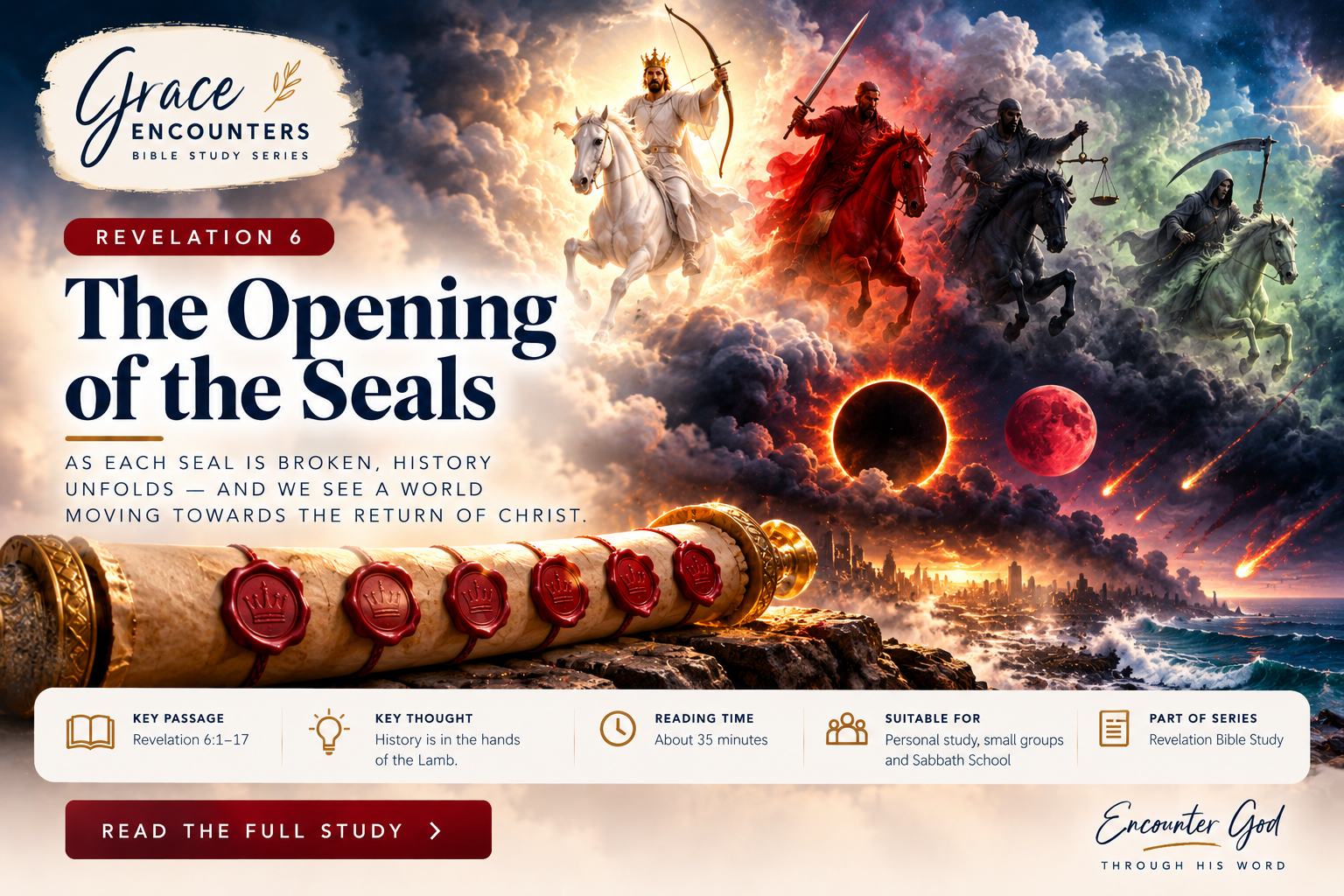
When the world seems out of control, the Lamb still holds history
Key passage: Revelation 6:1–17
Revelation 5 ends with all heaven worshipping the Lamb. John has wept because no one could open the scroll, until he is told that the Lion of the tribe of Judah has overcome. But when John looks, he sees a Lamb who has been slain.
That matters enormously as we enter Revelation 6.
Before God shows John war, famine, persecution, death and cosmic upheaval, He first shows him Who is opening the seals.
“And I saw when the Lamb opened one of the seals…”
Revelation 6:1
The seals are not opened by Satan. They are not opened by an earthly ruler. They are opened by the Lamb.
Whatever happens next, the throne is still occupied, the Lamb is still worthy, and history has not slipped from God’s hands.
The Seals and the Seven Churches
There is a strong parallel between the seven churches of Revelation 2–3 and the seals of Revelation 6.
In the historicist understanding of Revelation, these visions do not necessarily describe completely separate periods one after another. Rather, Revelation repeatedly takes us across the Christian era from different perspectives.
The seven churches particularly show us the spiritual condition of the church.
The seals show us something of what happens as the gospel moves through history.
This helps explain the progression we are about to see:
White → red → black → pale.
The gospel goes out in purity and power. Persecution follows. Compromise and spiritual famine develop. Eventually spiritual death follows.
Yet through all of it, Christ remains present.
The First Seal: The White Horse
Revelation 6:1–2
John sees:
“a white horse: and he that sat on him had a bow; and a crown was given unto him: and he went forth conquering, and to conquer.”
Throughout Revelation, white is associated with purity, righteousness and victory.
The rider receives a stephanos, the victor’s crown, and goes out “conquering, and to conquer”.
This fits beautifully with the explosive growth of the gospel after Pentecost.
A small group of frightened disciples becomes a Spirit-filled church.
Three thousand respond at Pentecost.
The Word spreads.
The number of disciples multiplies.
Eventually the accusation is made:
“These that have turned the world upside down are come hither also.”
Acts 17:6
The first horse therefore points us towards the victorious advance of Christ’s gospel, particularly during the apostolic period.
But Christ conquers very differently from earthly empires.
Rome conquered enemies by defeating them.
Christ conquers enemies by transforming them.
Saul of Tarsus is a wonderful example. Jesus did not destroy His enemy. He encountered him.
Saul became Paul.
The persecutor became the preacher.
The enemy became the child of God.
That is what the conquest of the Lamb looks like.
And although the first seal has a particular historical application to the apostolic church, the white horse has not stopped riding. Wherever the genuine gospel reaches a human heart and Christ transforms a life, His kingdom continues to advance.
The Second Seal: The Red Horse
Revelation 6:3–4
The second horse is dramatically different:
“there went out another horse that was red: and power was given to him that sat thereon to take peace from the earth…”
Red naturally evokes bloodshed.
Historically, this corresponds well with the period of severe persecution experienced by the early Christian church, paralleling the church of Smyrna.
The gospel did not advance without opposition.
Jesus had warned His disciples:
“If they have persecuted me, they will also persecute you.”
John 15:20
But there is something important in the wording of Revelation 6.
Peace is taken away.
This introduces a theme that becomes increasingly important throughout Revelation: restraint.
God’s government restrains evil.
When restraint is withdrawn, the consequences of human rebellion become increasingly visible.
That does not mean every instance of suffering is God’s direct punishment. Scripture gives us no permission to look at someone suffering and conclude that God must be punishing that person for sin.
Job should permanently cure us of that idea.
Instead, Revelation begins showing us what happens in a world increasingly resisting the government of God.
The Third Seal: The Black Horse
Revelation 6:5–6
John next sees:
“a black horse; and he that sat on him had a pair of balances in his hand.”
Food becomes desperately expensive:
“A measure of wheat for a penny, and three measures of barley for a penny…”
The imagery is of scarcity and famine.
But within the historicist progression, there is also a profound spiritual dimension.
The white purity of the gospel gives way first to persecution and then increasingly to compromise.
This corresponds broadly with the Pergamum period.
Christianity’s greatest danger was not necessarily persecution.
Sometimes persecution purified the church.
A much more subtle danger arose when Christianity gained political acceptance and began accommodating itself to worldly power.
The black horse therefore presents the terrible possibility of spiritual famine.
Amos describes such a famine:
“not a famine of bread, nor a thirst for water, but of hearing the words of the LORD.”
Amos 8:11
A church can possess buildings, wealth, influence and political power while starving for the Word of God.
And that should make us pause.
The greatest evidence of God’s blessing is not necessarily comfort or prosperity.
The question is whether we still know Him.
The Fourth Seal: The Pale Horse
Revelation 6:7–8
The progression now reaches its darkest point:
“behold a pale horse: and his name that sat on him was Death, and Hell followed with him.”
The Greek word translated “pale” describes a sickly, greenish colour, the colour associated with death.
The progression is sobering:
Gospel → persecution → compromise and famine → death.
Within the historicist tradition, which has deep roots in Protestant Reformation interpretation and was later developed more systematically by Seventh-day Adventist interpreters, the pale horse has often been associated with the spiritual decline of medieval Christianity and the period of papal ascendancy. Early Protestant Reformers such as John Hooper connected the fourth seal with the corruption and spiritual death they believed had entered the medieval church. Adventist historicists later developed this interpretation into a more defined prophetic chronology, generally associating the fourth seal with the period from the rise of papal supremacy to the Reformation.
The text mentions sword, hunger, death and wild beasts, imagery strongly reminiscent of Old Testament covenant judgements.
And this led us into an important discussion about God’s discipline.
Is God Punishing His Children?
The Old Testament frequently describes terrible consequences following Israel’s unfaithfulness.
It would be easy to read those passages and imagine God saying:
“You disobeyed Me, therefore I am going to hurt you.”
But that gives us a distorted picture of divine discipline.
Sometimes God’s judgement consists of allowing people to experience the consequences of leaving His protection.
Israel’s experience with the fiery serpents in the wilderness helps us understand this.
Deuteronomy tells us that the wilderness already contained:
“fiery serpents, and scorpions…”
Deuteronomy 8:15
God had been protecting Israel in an environment already filled with danger.
When that protection was withdrawn, they discovered something they had previously taken for granted:
God’s protection itself was grace.
This is also illustrated vividly in Job.
Satan complains:
“Hast not thou made an hedge about him…?”
Job 1:10
Satan recognises God’s protective boundary around Job.
When God permits that protection to be reduced, Satan immediately attacks. Yet God still establishes the boundary:
“Behold, he is in thine hand; but save his life.”
Job 2:6
This gives us an important distinction:
God restrains evil.
Sometimes He permits that restraint to be reduced.
But that does not make God the author of the evil that follows.
The Discipline of a Loving Father
Hebrews gives another dimension:
“For whom the Lord loveth he chasteneth…”
Hebrews 12:6
Why?
“for our profit, that we might be partakers of his holiness.”
Hebrews 12:10
Divine discipline therefore has a redemptive purpose.
Imagine a small child who has repeatedly been told not to run through the gate into a busy road.
The boundary is not there because the parent wants to restrict the child’s happiness.
The boundary exists because the parent understands a danger the child does not yet comprehend.
Sometimes love must intervene firmly.
Not because love is angry that its authority has been challenged, but because love desperately wants the child to live.
So it is with God.
Sometimes He gives.
Sometimes He withholds.
Sometimes, in mercy, He restrains the full consequences of our choices.
Sometimes He allows those consequences to unfold more fully.
Forgiveness does not necessarily remove consequence. God may forgive completely while the effects of what we have done remain. David’s life demonstrates this painfully. His sin was forgiven, yet the damage caused by his choices continued to reverberate through his family. This was not God punishing David’s children for their father’s guilt. Sin itself has consequences that reach beyond the person who commits it.
God’s mercy is therefore sometimes seen not in removing every consequence, but in placing limits around how far destruction is permitted to go.
Sometimes He removes the trial.
Sometimes, as with Paul’s thorn, He says:
“My grace is sufficient for thee.”
2 Corinthians 12:9
God’s primary purpose is not to give us the most comfortable earthly existence possible.
He wants to bring us home.
And the character of the One disciplining us has already been revealed in Revelation 5.
He is the Lamb who was slain.
Calvary tells us what motivates Him.
The Fifth Seal: The Souls Beneath the Altar
Revelation 6:9–11
The scene changes dramatically.
John sees:
“under the altar the souls of them that were slain for the word of God, and for the testimony which they held.”
This passage is sometimes interpreted as teaching that conscious souls live in heaven after death.
But Revelation is communicating through symbolic imagery.
There are not literally dead Christians crowded beneath an altar in heaven.
The Old Testament background helps us.
When Cain murdered Abel, God said:
“the voice of thy brother’s blood crieth unto me from the ground.”
Genesis 4:10
Abel’s blood was not literally speaking.
His unjust death demanded justice.
The martyrs beneath the altar function similarly.
Their lives have been poured out because they remained faithful to God’s Word and their testimony.
Their blood cries:
“How long, O Lord…?”
This is not a cry for personal revenge.
It is the ancient cry of suffering believers:
How long will evil be permitted to continue?
Why Does God Wait?
This became one of the most important questions in our study.
If God can end evil, why doesn’t He simply end it immediately?
Because the Great Controversy involves more than God’s power.
Nobody needs proof that the Creator is stronger than Satan.
The controversy concerns God’s character and government.
Sin must finally be revealed for what it truly is.
God allows rebellion to mature, not because He delights in suffering, but because the universe must ultimately understand what separation from God produces.
James describes the trajectory:
“sin, when it is finished, bringeth forth death.”
James 1:15
That is profound.
Death is where sin goes.
The martyrs are therefore told to rest “yet for a little season”.
God has not forgotten them.
Justice has not been abandoned.
But the story is not yet complete.
Their white robes signify vindication. Their apparent defeat is not the final verdict.
The persecutors may have killed them.
The Lamb says they overcame.
The Sixth Seal: Creation Begins to Shake
Revelation 6:12–14
John sees an extraordinary sequence: a great earthquake, the sun becoming black, the moon appearing like blood, the stars falling, and finally the heavens receding like a scroll.
These images did not originate with Revelation. They draw deeply from the language of the Old Testament prophets. Joel speaks of the sun being darkened and the moon turning to blood before the Day of the Lord (Joel 2:30–31). Isaiah describes the stars being darkened and the earth being shaken in the context of divine judgement (Isaiah 13:10–13). Jesus Himself uses similar language when describing events associated with His return (Matthew 24:29–30).
The central biblical message is therefore larger than identifying individual astronomical or historical events. Creation itself seems to announce that human history is moving towards an encounter with its Creator.
Christians following the historicist approach to prophecy have often looked for these signs within history. Some significant events attracted particular attention. The devastating Lisbon earthquake of 1755, for example, was interpreted by some contemporary Christians in relation to divine judgement and the end of the age. The extraordinary Dark Day of 19 May 1780 in New England likewise prompted religious reflection among those who experienced it. Later, the spectacular Leonid meteor storm of 1833 became particularly significant to nineteenth-century Advent believers.
Seventh-day Adventist interpreters subsequently brought these three events together into a more specific historicist sequence, associating them with Revelation 6:12–13. Other Christian interpreters understand the passage differently, and even historicist interpreters have not always agreed on precisely how these signs should be identified.
We therefore do not need to make our faith depend upon proving that one particular earthquake, darkened sky or meteor shower was the exclusive fulfilment of John’s vision.
The vision itself carries us further.
John eventually sees the sky recede “as a scroll when it is rolled up” and every mountain and island moved from its place. Whatever preliminary signs may have appeared throughout history, the sixth seal ultimately points beyond them towards the unmistakable intervention of God and the return of Christ.
That is where John’s emphasis lies.
The question is not merely, Have we correctly identified the signs?
It is:
Are we ready to meet the One to whom the signs are pointing?
Two Responses to the Same Jesus
Revelation 6:15–17
Kings, wealthy people, military leaders, powerful people, slaves and free people hide themselves.
They cry:
“Fall on us, and hide us from the face of him that sitteth on the throne…”
And then comes one of Revelation’s strangest expressions:
“the wrath of the Lamb.”
A lamb is almost the opposite of what we associate with wrath.
Yet this is the same Lamb who was slain.
The tragedy is not that Jesus suddenly becomes somebody different.
The tragedy is that people have spent their lives refusing the One who loved them enough to die for them.
And now they would rather have mountains fall upon them than see His face.
But there is another group.
They have been waiting for precisely the same Person.
For them His appearing is not terror.
It is homecoming.
The difference is not Jesus.
The difference is relationship.
One group says, “Hide us from His face.”
The other has spent a lifetime learning to seek His face.
“Who Shall Be Able to Stand?”
Revelation 6 ends with a question:
“For the great day of his wrath is come; and who shall be able to stand?”
Revelation 6:17
And then Revelation does something beautiful.
It pauses.
Before the seventh seal opens, Revelation 7 answers the question.
John sees four angels:
“holding the four winds of the earth…”
They are commanded:
“Hurt not the earth… till we have sealed the servants of our God in their foreheads.”
Revelation 7:3
Again we encounter restraint.
The winds already exist.
They are being held.
God has been restraining forces of destruction.
A time comes when that restraint will no longer operate in the same way, and humanity will see with terrifying clarity what rebellion against God ultimately produces.
But before that happens:
God seals His people.
When God Lets the Winds Go
This gives us a very different picture of the final crisis.
The final events are not God finally losing His patience and unleashing cruelty upon people who refused to obey Him.
They reveal something much more serious.
For thousands of years God has restrained evil.
He has protected.
He has intervened.
He has limited Satan.
He has placed boundaries around what evil is permitted to do.
Job gives us the picture of the hedge.
Revelation gives us the picture of angels holding the winds.
But eventually humanity’s rejection of God’s government reaches maturity.
And God permits sin to demonstrate its own character.
The universe finally sees where both roads lead.
Satan’s kingdom produces what Satan’s principles have always contained.
God’s kingdom produces what God’s character has always contained.
This is why the final destruction of sin is not an arbitrary act of a threatened ruler.
The universe has seen what sin becomes when allowed to mature.
God can finally say:
This is what I am bringing to an end.
Not freedom.
Not individuality.
Not people who dared to question Him.
Sin.
The thing that destroys His children.
The Lamb Still Holds History
Revelation 6 can look frightening when we first read it.
War.
Famine.
Persecution.
Death.
Martyrdom.
Earthquake.
Cosmic upheaval.
People crying for mountains to bury them.
But perhaps we have been looking at the wrong thing.
Revelation 6 does not begin:
“And I saw Satan release four horsemen.”
It begins:
“And I saw when the Lamb opened one of the seals…”
That changes everything.
The Lamb of Revelation 5 has not disappeared.
The One who was slain is still there.
The One who conquered through self-sacrificing love still holds the scroll.
And therefore the message of Revelation 6 is not:
Be afraid because terrible things are coming.
It is:
Know the Lamb before they come.
How Then Should We Wait?
Waiting for Jesus cannot simply mean watching world events and trying to determine how close we are to the end.
We wait by knowing Him.
We wait by trusting Him.
We wait by loving His children.
We wait by serving people who are hurting.
We wait by forgiving.
We wait by allowing His character to become visible through ours.
We wait in such a way that someone who encounters us might become curious about the God we love.
That is especially important when life becomes difficult.
There is a difference between honestly bringing our pain to God and living as though God has abandoned us.
Biblical faith does not deny suffering.
It says:
Even here, I know Who holds me.
And perhaps that is why the final question is not:
Who understands every prophetic detail?
It is:
“Who shall be able to stand?”
Revelation 7 will answer that question.
They are people who belong to God.
People who have learned to trust the Lamb.
People who would rather remain with Him through the storm than find safety anywhere else.
Grace Encounter
There is something deeply personal hidden inside all this prophecy.
Perhaps God has protected us from things we never even knew were approaching us.
Perhaps some of the things we called unanswered prayers were actually His protection.
Perhaps some things He allowed us to experience were the very things that taught us that life away from Him was not where we wanted to be.
And perhaps some fires He did not extinguish became places where we discovered that He would walk through the fire with us.
Revelation 6 invites us to stop measuring God’s love by the comfort of our circumstances.
Look instead at the Lamb.
Look at Calvary.
There we discover what His heart towards us really is.
The same Jesus who gave Himself for us holds history.
The same Jesus holds His church.
And the same Jesus holds you.
So when the winds blow, our security is not found in understanding every detail of what is happening around us.
Our security is found in knowing the One who says:
“I am with you alway, even unto the end of the world.”
Matthew 28:20
The question Revelation leaves with us is therefore profoundly simple:
If everything else were shaken, would knowing Jesus be enough?
That is the preparation Revelation calls us to.
Not fear.
Relationship.
Prayer
Father,
Thank You that before You showed John the seals, You showed him the Lamb.
When we look at our world and see suffering, violence, confusion and death, help us remember that You have not abandoned Your creation.
Teach us to trust Your heart when we cannot understand Your hand.
When You protect us, make us grateful.
When You discipline us, help us recognise the love of a Father who wants to bring His children home.
When You allow us to walk through trials, keep us close enough to You that the fire draws us nearer rather than driving us away.
Lord Jesus, we want to know You now.
We do not want to wait until the heavens roll back to discover Who You are.
Teach us to seek Your face today so that when we finally see Your face, our response will not be fear but joy:
This is the One we have been waiting for.
And while we wait, make our lives witnesses to Your character. Help us love Your children, serve those who are hurting, forgive freely, speak truth with grace, and live in such a way that others want to know the God we know.
Hold us when the winds blow.
Keep us faithful when everything else is shaken.
And bring us safely home.
In Jesus’ name,
Amen.
Scriptures for Further Study
Take time to explore these passages alongside this study. Compare Scripture with Scripture, follow the connections, and allow the Bible to illuminate its own message.
Revelation 4:1–11
Revelation 5:1–14
Revelation 6:1–17
Revelation 7:1–17
Revelation 8:1
Genesis 4:8–10
Job 1:6–12
Job 2:1–7
Job 38:8–11
Leviticus 26:14–45
Deuteronomy 8:11–18
Deuteronomy 28:15–68
Psalm 45:1–7
Amos 8:11–12
Matthew 24:1–31
John 15:18–21
Acts 2:37–47
Acts 6:7
Acts 9:1–22
Acts 17:6
Romans 1:18–32
Romans 6:23
2 Corinthians 12:7–10
Hebrews 12:5–11
James 1:12–18
For the relationship between the seals and Christ’s end-time discourse:
Matthew 24:4–31
Mark 13:5–27
Luke 21:8–28
For the biblical imagery behind the four horsemen:
Leviticus 26:21–26
Deuteronomy 32:23–25
Jeremiah 14:12
Ezekiel 5:12–17
Ezekiel 14:21
For the martyrs and the cry for justice:
Genesis 4:10
Psalm 79:5–10
Habakkuk 1:2–4
Revelation 12:11
Revelation 14:18–20
Revelation 19:1–2
For God’s restraint and the final crisis:
Job 1:10–12
2 Thessalonians 2:6–8
Revelation 7:1–3
Revelation 9:13–15
Revelation 20:1–3
Grace Encounters | Bible Study Series
Revelation 6: The Lamb Opens the Seals
Continue to Revelation 7: Sealed Before the Winds Blow