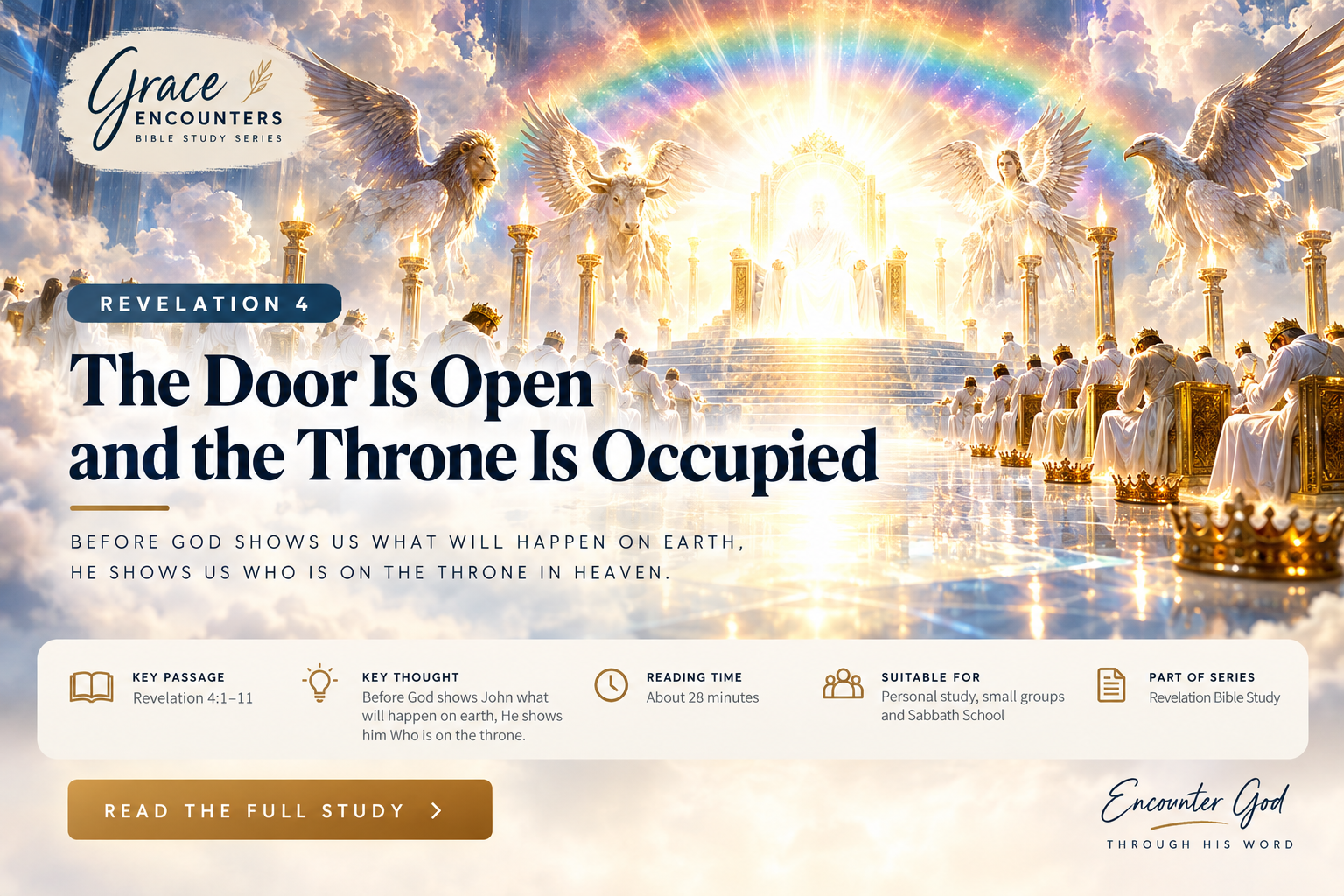
Key Passage: Revelation 4:1–11
Key Thought: Before God shows John what will happen on earth, He shows him Who is on the throne in heaven.
“After these things I looked, and behold, a door standing open in heaven.”
Revelation 4:1
Revelation 4 contains no beasts making war, no plagues, no mark of the beast and no final crisis. It can therefore be tempting to treat it simply as the introduction to the dramatic events that follow.
But Revelation 4 is foundational to everything that comes afterwards.
Before John sees the seals opened…
Before he sees persecution…
Before he sees earthly powers apparently triumphing…
Before Babylon rises and falls…
Before the final conflict over worship…
God shows John the throne.
It is almost as though God is saying:
Before I show you what will happen, I want you to see Who is still in control.
Earth may descend into chaos.
Heaven has not.
The throne is occupied.
And everything John will see afterwards must be understood from that perspective.
Revelation 4 and 5: One Throne-Room Vision
Although our Bibles divide Revelation 4 and 5 into separate chapters, they form one continuous heavenly throne-room scene.
Chapter 4 focuses particularly on God as Creator.
Chapter 5 will introduce Christ as the Lamb and Redeemer.
That distinction becomes important.
In Revelation 4 the heavenly beings declare:
“You are worthy, O Lord,
To receive glory and honour and power;
For You created all things,
And by Your will they exist and were created.”
Revelation 4:11
Then in Revelation 5 the song changes:
“You are worthy to take the scroll,
And to open its seals;
For You were slain,
And have redeemed us to God by Your blood…”
Revelation 5:9
Creation and redemption.
Creator and Lamb.
The throne and the cross.
They belong together.
1. “A Door Standing Open in Heaven”
“After these things I looked, and behold, a door standing open in heaven. And the first voice which I heard was like a trumpet speaking with me, saying, ‘Come up here, and I will show you things which must take place after this.’”
Revelation 4:1
The immediate meaning is straightforward: John is being invited into a heavenly vision.
But during our study, the image of that open door became deeply meaningful.
Because the whole story of Scripture contains another story about access to God’s presence.
Eden’s door was closed
After Adam and Eve sinned:
“He placed cherubim at the east of the garden of Eden, and a flaming sword…to guard the way to the tree of life.”
Genesis 3:24
Sin brought separation.
The sanctuary later illustrated the same reality. God wanted to dwell among His people, but His holiness and humanity’s sinful condition could not simply be ignored.
There were courts.
Veils.
Priests.
Sacrifices.
And then Jesus came.
At His death:
“The veil of the temple was torn in two from top to bottom.”
Matthew 27:51
Hebrews explains the significance:
“Having boldness to enter the Holiest by the blood of Jesus, by a new and living way…”
Hebrews 10:19–20
Jesus Himself said:
“I am the door. If anyone enters by Me, he will be saved.”
John 10:9
And:
“I am the way, the truth, and the life. No one comes to the Father except through Me.”
John 14:6
We should not make Revelation 4:1 say more than John explicitly says. Its primary purpose is to introduce John’s heavenly vision.
But within the larger story of Scripture, the imagery is beautiful.
The gospel is the story of God reopening the way home.
The door is open because of Jesus.
2. The First Thing John Sees: The Throne
“Immediately I was in the Spirit; and behold, a throne set in heaven, and One sat on the throne.”
Revelation 4:2
John does not first describe heaven’s architecture.
He doesn’t describe angels.
He doesn’t tell us about streets of gold.
He sees a throne.
And Someone is sitting on it.
This is one of the most important truths in Revelation.
John lived in a world dominated by Rome. Emperors claimed enormous authority. Christians could be persecuted and earthly governments could appear overwhelmingly powerful.
Yet behind every earthly throne John is shown another throne.
The throne.
Later Revelation will show us powers that seem almost unstoppable.
But none of them occupies this throne.
God does.
This gives us one of the great interpretive principles for Revelation:
Never interpret the chaos on earth without first remembering the throne in heaven.
God has not lost control of history.
3. John Struggles to Describe God
“And He who sat there was like a jasper and a sardius stone in appearance…”
Revelation 4:3
Something remarkable happens here.
John does not attempt to describe God’s face.
He describes brilliance.
Colour.
Radiance.
Precious stones.
There are possible connections between these stones and Old Testament sanctuary imagery, including the high priest’s breastplate. But we should be careful not to assign meanings that Scripture itself does not give.
Perhaps the most important point is much simpler.
John cannot reduce God to a human description.
Moses was once told:
“You cannot see My face; for no man shall see Me, and live.”
Exodus 33:20
John reaches for the language of precious stones because ordinary language is inadequate.
The God of heaven exceeds human categories.
4. The Rainbow Around the Throne
Then John sees something breathtaking:
“And there was a rainbow around the throne, in appearance like an emerald.”
Revelation 4:3
The rainbow immediately takes us back to Genesis.
After the flood God said:
“I set My rainbow in the cloud, and it shall be for the sign of the covenant between Me and the earth.”
Genesis 9:13
The rainbow is a sign of covenant faithfulness.
And where does John see it?
Around God’s throne.
This becomes enormously important when reading the rest of Revelation.
Judgment will eventually proceed from this throne.
But the throne of judgment is surrounded by the sign of God’s covenant.
Justice is surrounded by mercy.
God’s justice and God’s love are not opposing characteristics.
The Judge is the same God who keeps covenant.
Before Revelation shows us the judgments of God, it shows us the character of the One who judges.
That matters.
Because prophecy must always be interpreted through the character of God.
5. Reverence, Not Terror
“And from the throne proceeded lightnings, thunderings, and voices.”
Revelation 4:5
This imagery immediately recalls Mount Sinai:
“There were thunderings and lightnings, and a thick cloud on the mountain…”
Exodus 19:16
God’s presence is not casual.
He is holy.
Sometimes Christians struggle with biblical language about “fearing God” because we associate fear exclusively with terror.
But Scripture also speaks about reverence and awe.
Hebrews says:
“Let us have grace, by which we may serve God acceptably with reverence and godly fear. For our God is a consuming fire.”
Hebrews 12:28–29
Grace does not make God less holy.
Grace makes it possible for sinful human beings to approach the Holy One.
And perhaps that is why the open door at the beginning of the chapter is so extraordinary.
The One sitting on that throne is infinitely holy.
And yet He wants us near Him.
6. The Seven Lamps of Fire
“Seven lamps of fire were burning before the throne, which are the seven Spirits of God.”
Revelation 4:5
We encountered the “seven Spirits” earlier in Revelation.
This is not teaching that there are seven Holy Spirits. Seven repeatedly carries the idea of completeness or fullness in Revelation.
The imagery therefore points towards the fullness of the Holy Spirit.
The lamps also recall the sanctuary lampstand.
Already the throne room contains imagery reminiscent of Israel’s sanctuary worship.
This should not surprise us.
The earthly sanctuary was designed to teach heavenly realities.
7. The Twenty-Four Elders
“Around the throne were twenty-four thrones, and on the thrones I saw twenty-four elders sitting, clothed in white robes; and they had crowns of gold on their heads.”
Revelation 4:4
Who are they?
This is one of those places where we must distinguish between what Scripture tells us and what we infer.
They are:
- twenty-four in number,
- called elders,
- seated on thrones,
- clothed in white,
- wearing golden crowns,
- and participating in heavenly worship.
White garments, thrones and victory crowns are all imagery Revelation elsewhere associates with God’s victorious people.
There may also be an Old Testament priestly connection. David organised the priests into twenty-four divisions for sanctuary service (1 Chronicles 24).
Another possibility is that twenty-four represents the fullness of God’s covenant people: twelve tribes of Israel and twelve apostles. Revelation 21 later places the names of the twelve tribes and twelve apostles within the imagery of the New Jerusalem.
Could they be people resurrected with Christ?
Matthew records something extraordinary at Christ’s death:
“The graves were opened; and many bodies of the saints who had fallen asleep were raised…”
Matthew 27:52
Some Adventist interpreters have connected these resurrected saints with the twenty-four elders.
It is an intriguing possibility.
But Scripture never explicitly says:
“The twenty-four elders are the saints raised in Matthew 27.”
We should therefore hold that interpretation with humility.
The safest conclusion is that the elders function as heavenly representatives associated with God’s redeemed people, while acknowledging that their precise identity is not explicitly revealed.
8. The Sea of Glass
“Before the throne there was a sea of glass, like crystal.”
Revelation 4:6
Water sometimes represents peoples and nations in prophecy. Revelation itself explicitly tells us this in Revelation 17:15.
But that does not mean every reference to water carries the same meaning.
Context must interpret the symbol.
Revelation 4 describes something resembling glass or crystal.
There are important Old Testament parallels.
When Moses and the elders encountered God:
“There was under His feet as it were a paved work of sapphire stone, and it was like the very heavens in its clarity.”
Exodus 24:10
Ezekiel also describes a crystal-like expanse associated with God’s throne (Ezekiel 1:22–26).
The sanctuary background may also be relevant. Solomon’s temple contained the great bronze basin called the Sea (1 Kings 7:23).
Whatever all the details ultimately signify, the overwhelming impression is one of clarity, stability and majesty.
And later something wonderful happens.
Revelation 15 shows God’s victorious people standing beside or upon:
“A sea of glass mingled with fire.”
Revelation 15:2
There they sing the song of Moses and the Lamb.
The sea of glass therefore becomes part of Revelation’s imagery of heavenly victory and worship.
9. Four Living Creatures
“And in the midst of the throne, and around the throne, were four living creatures full of eyes in front and in back.”
Revelation 4:6
These strange beings make far more sense when we allow the Old Testament to interpret Revelation.
John is drawing from two major throne-room visions.
Ezekiel 1
Ezekiel sees four living creatures associated with God’s throne.
Each possesses faces connected with:
the lion,
the ox,
the man,
and the eagle.
Ezekiel later identifies these throne-associated living beings as cherubim (Ezekiel 10).
Isaiah 6
Isaiah sees heavenly beings around God’s throne crying:
“Holy, holy, holy is the LORD of hosts.”
Isaiah 6:3
Isaiah’s seraphim have six wings.
Now notice what John does.
His creatures resemble Ezekiel’s living creatures, but they possess six wings and sing Isaiah’s “Holy, holy, holy.”
Revelation is weaving earlier biblical throne-room visions together.
10. The Lion, Ox, Man and Eagle
“The first living creature was like a lion, the second living creature like a calf, the third living creature had a face like a man, and the fourth living creature was like a flying eagle.”
Revelation 4:7
Later Christian tradition sometimes associated these four creatures with the four Gospel writers.
That interpretation has produced beautiful Christian art, but Revelation itself does not make that identification.
A more natural interpretation from the Old Testament background is that these creatures symbolically encompass the created order.
The lion represents the majesty and strength of wild creatures.
The ox or calf represents domesticated animals, strength and service.
The man represents humanity, uniquely created in God’s image.
The eagle represents the creatures of the heavens, with its strength, height and vision.
We should again avoid becoming dogmatic about every individual characteristic.
But taken together, the imagery strongly suggests creation gathered around its Creator.
That fits perfectly with the climax of the chapter:
“For You created all things.”
Revelation 4:11
11. Full of Eyes
The creatures are described as:
“Full of eyes around and within.”
Revelation 4:8
The imagery communicates extraordinary awareness and watchfulness.
We should resist the temptation to turn every eye into a separate prophetic symbol.
John is describing beings associated with the immediate presence and government of God.
Nothing about this scene suggests spiritual blindness.
Everything is awake.
Everything is attentive.
Everything is looking towards the throne.
12. “Holy, Holy, Holy”
“And they do not rest day or night, saying:
‘Holy, holy, holy,
Lord God Almighty,
Who was and is and is to come!’”
Revelation 4:8
During our study this became one of the most beautiful parts of the chapter.
We sometimes imagine heavenly beings worshipping God because worship is somehow their assigned job.
But Scripture gives a different impression.
They worship because they are in His presence.
Look at what happens throughout Scripture when human beings encounter God’s glory.
Isaiah cries:
“Woe is me!”
Ezekiel falls on his face.
Daniel loses his strength.
John himself falls before Christ “as dead” in Revelation 1.
Nobody has to announce:
“It is now time for worship.”
Worship is the natural response to seeing God as He truly is.
Perhaps that is why heavenly worship never becomes monotonous.
An infinite God can never be exhausted.
There will never come a point in eternity where we can say:
“Now I know everything there is to know about Him.”
13. They Cast Their Crowns Before Him
“The twenty-four elders fall down before Him who sits on the throne and worship Him who lives forever and ever, and cast their crowns before the throne.”
Revelation 4:10
This became the deeply personal centre of our Revelation 4 study.
From a human perspective these elders appear to have arrived.
They sit on thrones.
They wear white robes.
They possess golden crowns.
Everything about them communicates victory and honour.
And then they take those crowns off.
Why?
Because when they look at God, they understand where every victory came from.
Their crowns do not ultimately testify:
“Look what I accomplished.”
They testify:
“Look what He accomplished.”
Perhaps their worship could be expressed this way:
Lord, everyone looking at us might think these crowns are our greatest achievement. But if You had not sought us, loved us, redeemed us, forgiven us and sustained us, these crowns would not exist. They belong at Your feet.
That changes the way we think about our own “crowns”.
Career.
Education.
Money.
Reputation.
Possessions.
Talents.
Family.
Even ministry.
None of these things is necessarily evil.
The elders’ crowns weren’t evil either.
The issue is not whether we possess them.
The question is who receives the glory for them.
John the Baptist expressed the principle perfectly:
“He must increase, but I must decrease.”
John 3:30
14. Why Is God Worthy?
The chapter reaches its theological climax:
“You are worthy, O Lord,
To receive glory and honour and power;
For You created all things,
And by Your will they exist and were created.”
Revelation 4:11
Why does heaven worship God?
Because He is Creator.
That theme will return with enormous significance.
In Revelation 14 the first angel proclaims:
“Fear God and give glory to Him…and worship Him who made heaven and earth, the sea and springs of water.”
Revelation 14:7
Revelation’s final conflict ultimately concerns worship.
Who deserves worship?
Revelation 4 has already given the answer.
The Creator.
For Seventh-day Adventists, it is difficult not to hear the language of the fourth commandment here:
“For in six days the LORD made the heavens and the earth, the sea, and all that is in them…”
Exodus 20:11
The Sabbath is therefore more than a day on a calendar.
It is a weekly acknowledgement:
I am not my own creator. I belong to the One who made me.
That becomes profoundly significant in a book whose final crisis concerns worship and allegiance.
The Heavenly Sanctuary in Revelation 4
When the whole chapter is viewed together, sanctuary imagery appears repeatedly:
the open heavenly door,
the throne and divine presence,
the seven lamps,
the crystal sea with possible laver/“Sea” associations,
priestly imagery surrounding the elders,
and continual heavenly worship.
Revelation is not presenting heaven as an abstract spiritual dimension.
John is being shown the reality towards which Israel’s sanctuary pointed.
Hebrews expresses the same principle when it describes the earthly sanctuary as a “copy and shadow of the heavenly things” (Hebrews 8:5).
The sanctuary story was always about something much bigger.
God wants to dwell with His children.
That begins in Eden.
It runs through the tabernacle.
It continues through the temple.
It reaches its fulfilment through Christ.
And Revelation eventually ends:
“Behold, the tabernacle of God is with men, and He will dwell with them.”
Revelation 21:3
The Bible begins with humanity losing the presence of God.
Revelation ends with humanity living in His presence again.
What Revelation 4 Reveals About God’s Character
This is perhaps the most important question we can ask of any passage of Scripture:
What does this reveal about God?
Revelation 4 shows us a God who is sovereign. His throne remains occupied regardless of what happens on earth.
He is holy. His presence inspires reverence and awe.
He is Creator. Everything owes its existence to Him.
He is covenant-keeping. The rainbow surrounds His throne.
He is worthy of worship, not because He demands empty flattery, but because creation recognises the goodness and greatness of its Creator.
And remarkably, He is accessible through Christ.
The holy God wants His children home.
The Destination Is Not Heaven
This became perhaps the deepest realisation of our study.
We often speak of heaven as the reward of salvation.
No death.
No sickness.
No tears.
No suffering.
Streets of gold.
The tree of life.
Reunion with people we have loved.
All of those promises are precious.
But none of them is the ultimate reward.
Jesus prayed:
“Father, I desire that they also whom You gave Me may be with Me where I am.”
John 17:24
And Revelation eventually gives us perhaps the most beautiful description of eternity:
“They shall see His face.”
Revelation 22:4
The destination isn’t merely heaven.
The destination is Him.
Heaven without Jesus would simply be another place.
What makes heaven home is the presence of the One who loved us enough to bring us there.
“We Shall Be Like Him”
John later writes:
“Beloved, now we are children of God; and it has not yet been revealed what we shall be, but we know that when He is revealed, we shall be like Him, for we shall see Him as He is.”
1 John 3:2
That takes us back to the beginning:
“Let Us make man in Our image, according to Our likeness.”
Genesis 1:26
Humanity was created to reflect God’s character.
Sin damaged that image.
Salvation is not merely God’s plan to relocate forgiven sinners from earth to heaven.
It is God’s work of restoration.
Paul describes that restoration beginning now:
“But we all, with unveiled face, beholding as in a mirror the glory of the Lord, are being transformed into the same image from glory to glory…”
2 Corinthians 3:18
We become like Him by beholding Him.
Perhaps that is another reason Revelation begins by revealing Jesus.
God is not merely preparing a place for His children.
He is preparing His children for His presence.
“How Did I Get Here?”
Perhaps one day, standing among the redeemed, some of us will look around and our first thought will simply be:
How did I get here?
Because we will remember.
We will remember how many times we failed Him.
How many times we misunderstood Him.
How many times we misrepresented Him.
How many times we wandered.
How many times we walked away.
And then perhaps the parable of the lost sheep will finally make complete sense.
Jesus said:
“What man of you, having a hundred sheep, if he loses one of them, does not leave the ninety-nine…and go after the one which is lost until he finds it?”
Luke 15:4
Notice who does the searching.
The sheep doesn’t find the Shepherd.
The Shepherd finds the sheep.
And when He finds it:
“He lays it on his shoulders, rejoicing.”
Luke 15:5
Even the journey home is carried by the Shepherd.
That is grace.
The Prodigal Comes Home
Jesus tells another story.
A son walks away from his father.
He wastes what he has been given.
Eventually he comes home rehearsing a confession:
“Father, I have sinned against heaven and in your sight, and am no longer worthy to be called your son.”
Luke 15:21
But the father doesn’t make him earn his place back.
Instead:
“Bring out the best robe…put a ring on his hand and sandals on his feet.”
Luke 15:22
Grace restores what rebellion surrendered.
That story belongs beside Revelation 4.
Because the people surrounding God’s throne will not be there because they never wandered.
They will be there because grace brought prodigals home.
Perhaps that is why the crowns end up on the floor.
When We Finally Understand
There are things in this life we would never choose.
Pain.
Loss.
Failure.
Betrayal.
Brokenness.
Scripture never asks us to call evil good.
Joseph said to his brothers:
“You meant evil against me; but God meant it for good.”
Genesis 50:20
Notice the distinction.
Joseph does not say:
“What you did was good.”
It wasn’t.
He says that God was able to take what others intended for evil and bring something redemptive from it.
That is the extraordinary power of grace.
Perhaps one day, when we can finally see our lives from God’s perspective, we will understand things that presently make no sense.
We may discover that in moments when we thought God had abandoned us, He was carrying us.
That when we thought He was silent, He was still present.
That when we wandered away, He had not moved.
And perhaps some of us will realise something even more profound:
If I had never discovered how helpless I was, perhaps I would never have discovered how much He loved me.
Not because the suffering was good.
But because He was good in the suffering.
The Rainbow Was There All Along
And suddenly the rainbow around the throne means even more.
There were days when all we could see were storm clouds.
God could already see the rainbow.
There were moments when we could not understand the story.
He already knew the ending.
There were times when we thought we had wandered beyond His reach.
The Shepherd was already looking for us.
Final Reflection: Before You Look at the Storm, Look at the Throne
Revelation is about to become intense.
There will be seals.
Horsemen.
Martyrs.
Trumpets.
Beasts.
Babylon.
Plagues.
Deception.
Persecution.
And a final conflict over worship.
God knows that.
So before He shows John any of it, He says:
Come up here.
And the first thing John sees is a throne.
The throne is occupied.
The rainbow surrounds it.
The Spirit burns before it.
Creation worships around it.
The redeemed cast their crowns before it.
And in the next chapter John will discover a Lamb standing at its centre.
A Lamb who had been slain.
This is why prophecy was never intended merely to frighten us.
God reveals the future so that His children can be prepared.
But even more importantly, He reveals Himself so that His children will know whom they can trust when that future arrives.
Revelation 4 therefore leaves us with something far greater than information about heaven.
It leaves us with an invitation.
Look at the throne.
Look at the rainbow.
Look at the open door.
Look at the crowns lying on the ground.
And ask yourself:
What does this reveal to me about the character of God?
Perhaps eventually the answer becomes very simple.
He is holy.
He is Creator.
He is faithful.
He is worthy.
And somehow, despite everything we have done, everything we have suffered and every time we have wandered…
He still wants us home.
One day, by His grace, we may stand there ourselves and wonder:
“How did I ever get here?”
And perhaps then we will understand.
It was never the strength of the sheep.
It was the faithfulness of the Shepherd.
It was never the worthiness of the prodigal.
It was the love of the Father.
It was never the crown.
It was always the Lamb.
Closing Prayer
Father,
Open our eyes to see You as John saw You: holy, sovereign, faithful and surrounded by mercy.
When the events of this world frighten or confuse us, remind us that Your throne is still occupied.
When we are tempted to place confidence in our achievements, teach us to lay our crowns at Your feet.
When we wander, remind us that our Shepherd still seeks His sheep.
When we cannot understand the road You have allowed us to travel, help us to trust the heart of the One who walks it with us.
Most of all, Lord, reveal Jesus to us.
As we behold Him, transform us into His likeness from glory to glory, until the day when faith becomes sight and we finally see Him face to face.
And when that day comes, may every crown, every achievement and every earthly treasure lose its importance in the joy of simply being with You.
Keep us faithful until then.
In Jesus’ name,
Amen.
Grace Encounter
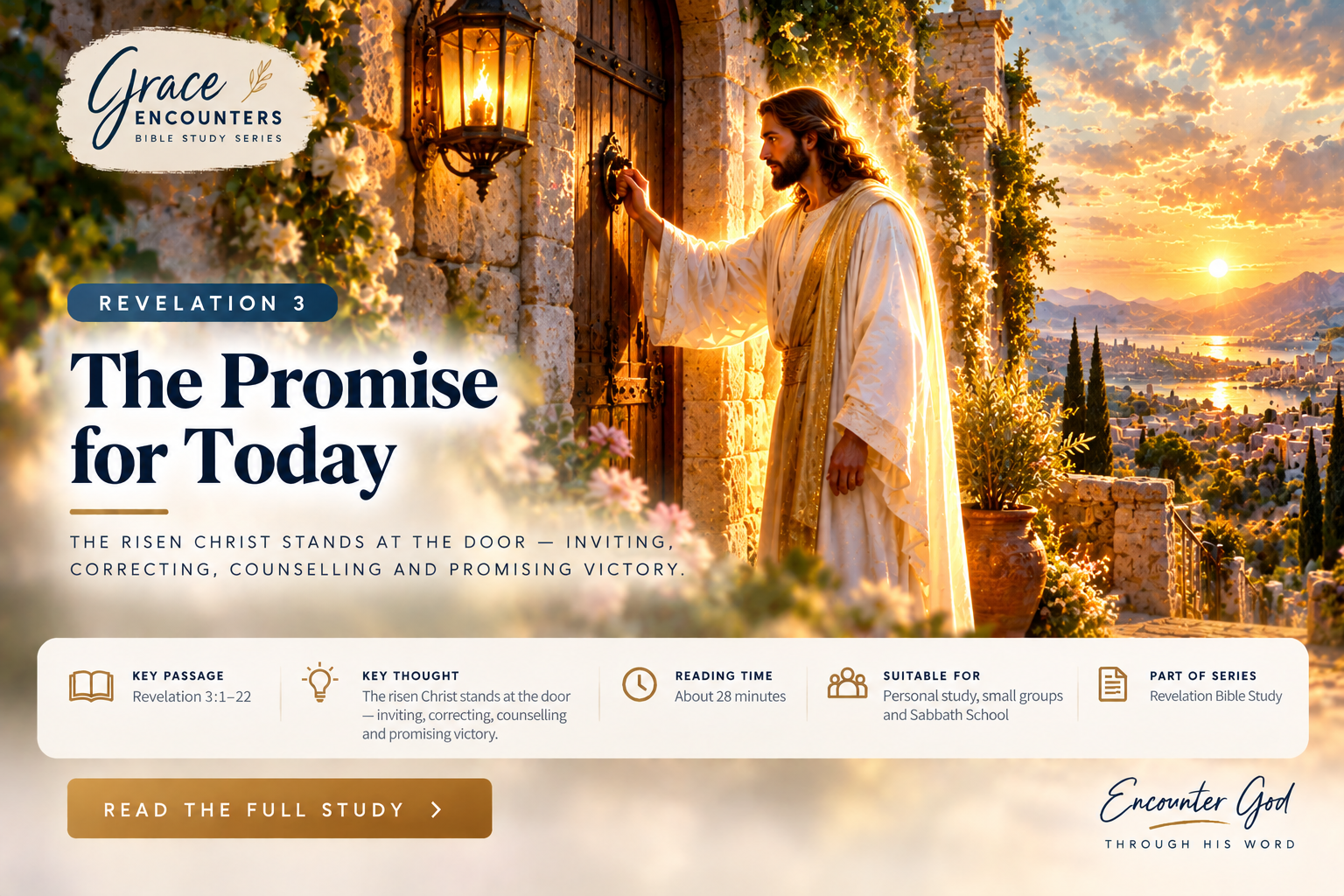
John sees a door standing open in heaven.
And beyond that door:
a throne.
That may be exactly the picture we need when our own world feels uncertain.
The throne is not vacant.
God has not stepped away.
Heaven is not scrambling to respond to events on earth.
The throne is occupied.
Around it John sees the rainbow, reminding us that the One who rules is also the covenant-keeping God of mercy.
He sees worship.
He sees creatures declaring God’s holiness.
He sees elders laying their crowns before Him.
Everything eventually points back to the One sitting upon the throne.
And perhaps our grace encounter is this:
We spend enormous amounts of energy trying to control things we were never capable of controlling.
Our families.
Our futures.
Our circumstances.
Sometimes even other people.
Revelation 4 invites us to look through the open door and remember:
There is already Someone on the throne.
We don’t need to be.
Grace allows us to put down the crown, surrender the illusion of control, and trust the One who created us.
The throne is occupied.
And the One sitting there can be trusted.
Scriptures for Further Study
Take time to explore these passages alongside this study. Compare Scripture with Scripture, follow the connections, and allow the Bible to illuminate its own message
Genesis 1:26–27
Genesis 3:22–24
Genesis 9:8–17
Genesis 50:20
Exodus 19:16–20
Exodus 20:8–11
Exodus 24:9–11
Exodus 33:18–23
1 Kings 7:23–26
1 Chronicles 24
Isaiah 6:1–8
Isaiah 57:20–21
Ezekiel 1
Ezekiel 10
Matthew 27:50–53 Luke 15:1–32
John 3:30
John 10:7–10
John 14:1–6
John 17:3, 24
2 Corinthians 3:18
Hebrews 4:14–16
Hebrews 8:1–5
Hebrews 10:19–22
Hebrews 12:28–29
1 John 3:1–3
Revelation 1:4–8
Revelation 3:20–22
Revelation 5
Revelation 7:9–17
Revelation 14:6–7
Revelation 15:1–4
Revelation 17:15
Revelation 21:1–4
Revelation 22:1–5
Grace Encounters | Bible Study Series
Revelation 4: The Door Is Open and the Throne Is Occupied
Continue to Revelation 5: The Lamb and the Scroll